
There is factory information out there on all platforms on the 9T50 transmission that is very confusing. In this edition of Fun With Transmissions, we are going to provide you, the reader, with a simpler way of identifying solenoids. We’ll also clarify one or two diagnostic schemes that actually make sense.
LINE PRESSURE TESTING
Let’s start with pressure testing. As we know, pressure testing can give us a tremendous amount of data that we can use to make decisions during the diagnostic process. Those who have used the ATRA tech help line will know that, more often than not, one of the first questions that are asked is ”What is line pressure doing?”
Line pressure testing for the 9T series units is just about the same as testing most common transmissions. We have an idle reading and a wide-open throttle (WOT) reading. These tests show how the line pressure rise systems are working. The problem comes up when we read the factory pressure testing. It is not very specific at all!

 The following is the factory procedure:
WARNING: Keep the brakes applied at all times to prevent unexpected vehicle motion. Personal injury may result if the vehicle moves unexpectedly.
- Start the engine.
- Inspect the transmission for the proper fluid level; refer to Transmission Fluid Level and Condition Check.
- Turn the engine OFF.
NOTE: You may need to remove or disconnect components in order to gain access to the transmission line pressure test hole plug. - Remove – Line Pressure Test Hole Plug Automatic Transmission Fluid Pressure
- Install – GE-21867 Pressure Gauge (1)
- Start the engine.
- Verify the Transmission Fluid Pressure = Greater than 345 kPa (50 PSI)
- If 345 kPa (50 PSI) or less. Refer to Fluid Pressure High or Low checks.
- Go to next step: If greater than 345 kPa (50 PSI)
- Turn the engine OFF.
- Remove – GE-21867 Pressure Gauge
- Install and tighten – Line Pressure Test Hole Plug
What the factory steps tell us is that if the pressure is 50 psi or less, you have a problem. If you have 50 psi or more, things are fine, and you are done with the pressure test.

 Not a very promising pressure check?
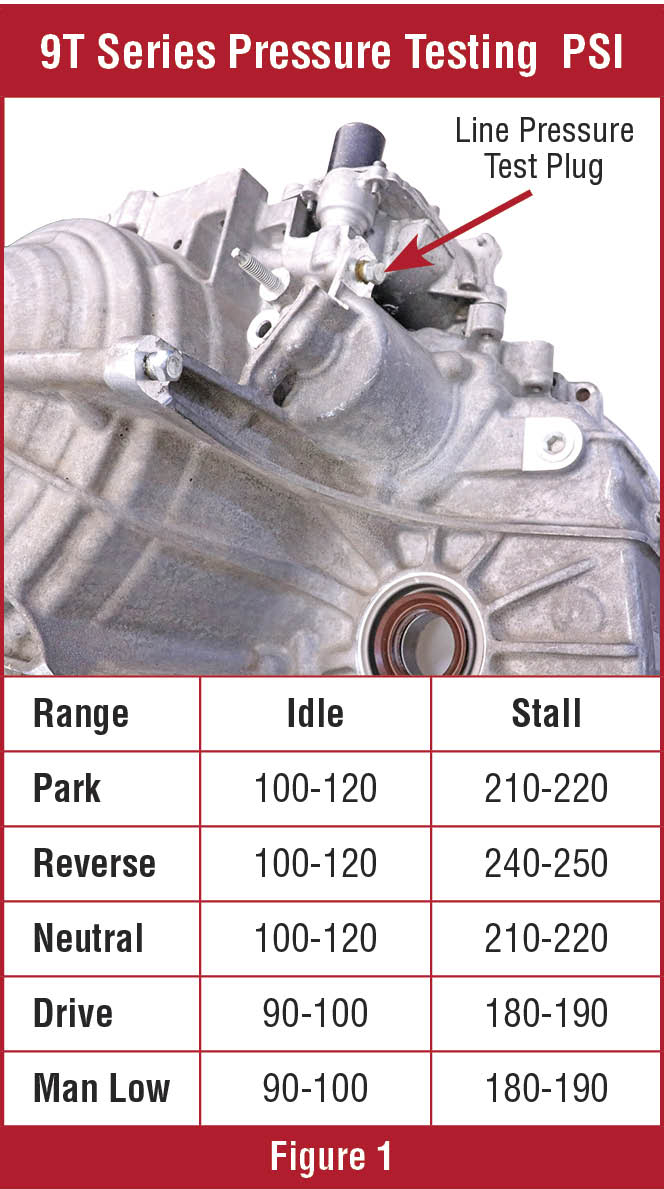
We pressure-tested several good-working vehicles to develop pressure-test numbers we can include in a pressure-test chart (Figure 1).
SOLENOID NAMES AND LOCATIONS
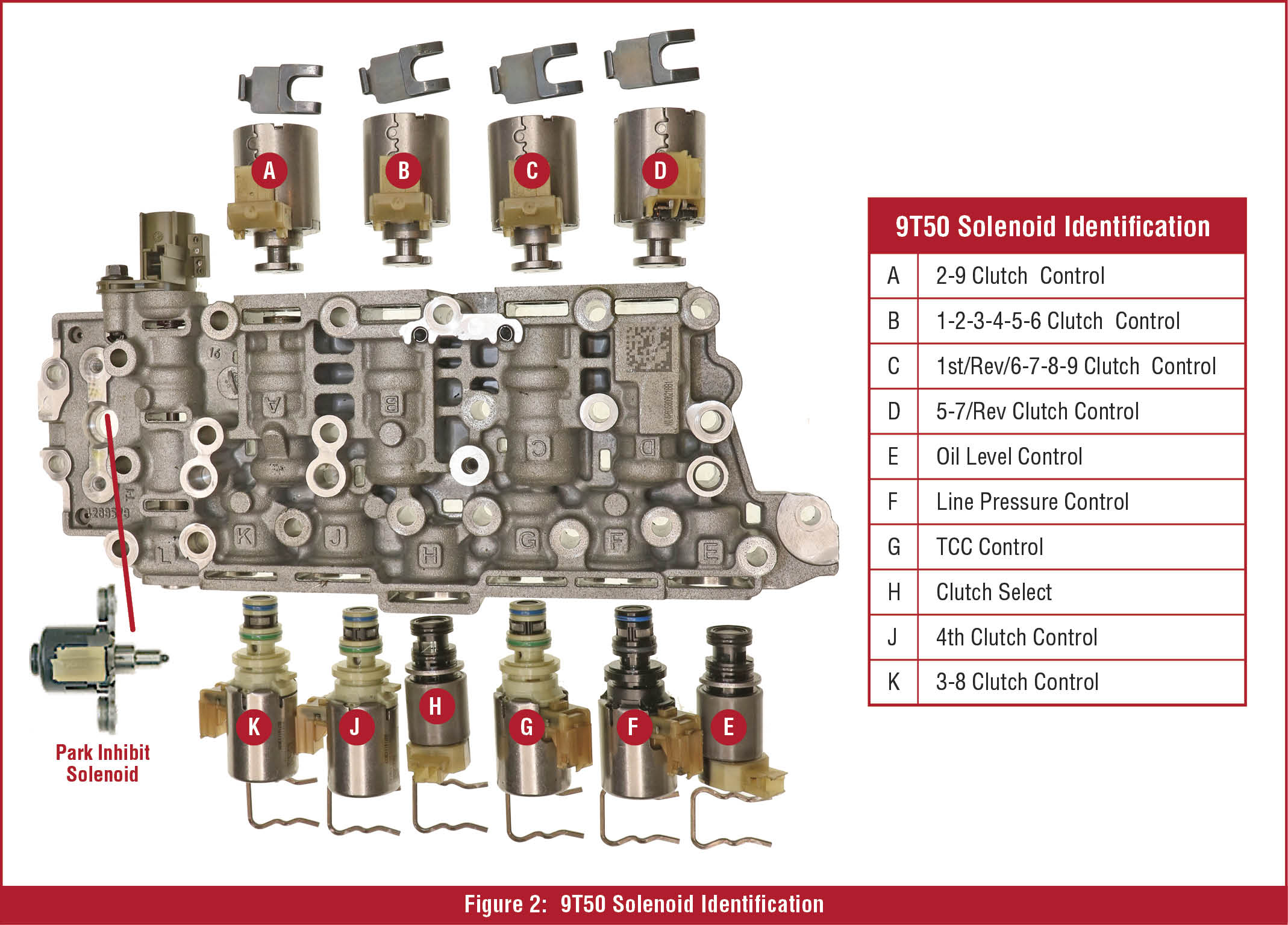
Figure 2 lists the solenoid names and their locations relative to the letters in the casting. Other published charts can be extremely confusing. Let’s use a chart that is simple to read and is based on the location of the solenoid in the solenoid body and the letter that is cast into the aluminum. The example in the illustration is for the Electronic Transmission Range Sensor (ETRS) solenoid body, which is a park-by-wire unit. This solenoid body has the Park Inhibit Solenoid Assembly PISA). The Non-ETRS solenoid does not have a PISA and is a park-by-cable unit.
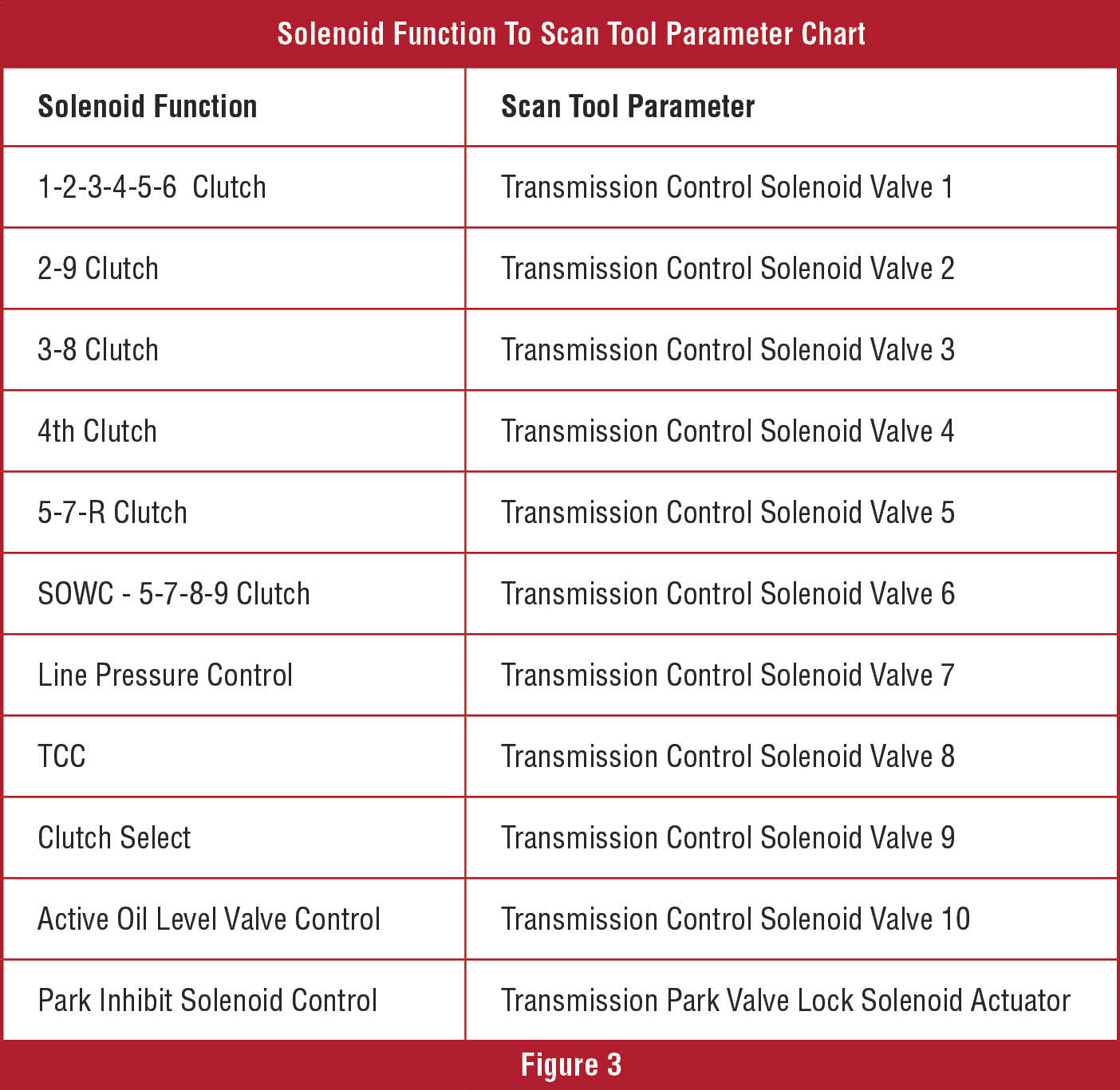
The next diagnostic aid is the Solenoid Function To Scan Tool Parameter Chart (Figure 3). When viewed on the scan tool, the solenoids are listed in numerical order as solenoids 1 through 10. The solenoidto- scan tool chart makes identification easy.
HYDRAULIC SCHEMATICS
When talking about hydraulic schematics for the 9T series, the first thing that needs to happen is a huge thank you to GM for publishing these diagrams. So many manufacturers no longer release hydraulic schematics because they do not service the valve bodies. If the valve body is determined to be bad after diagnosis, replace it.
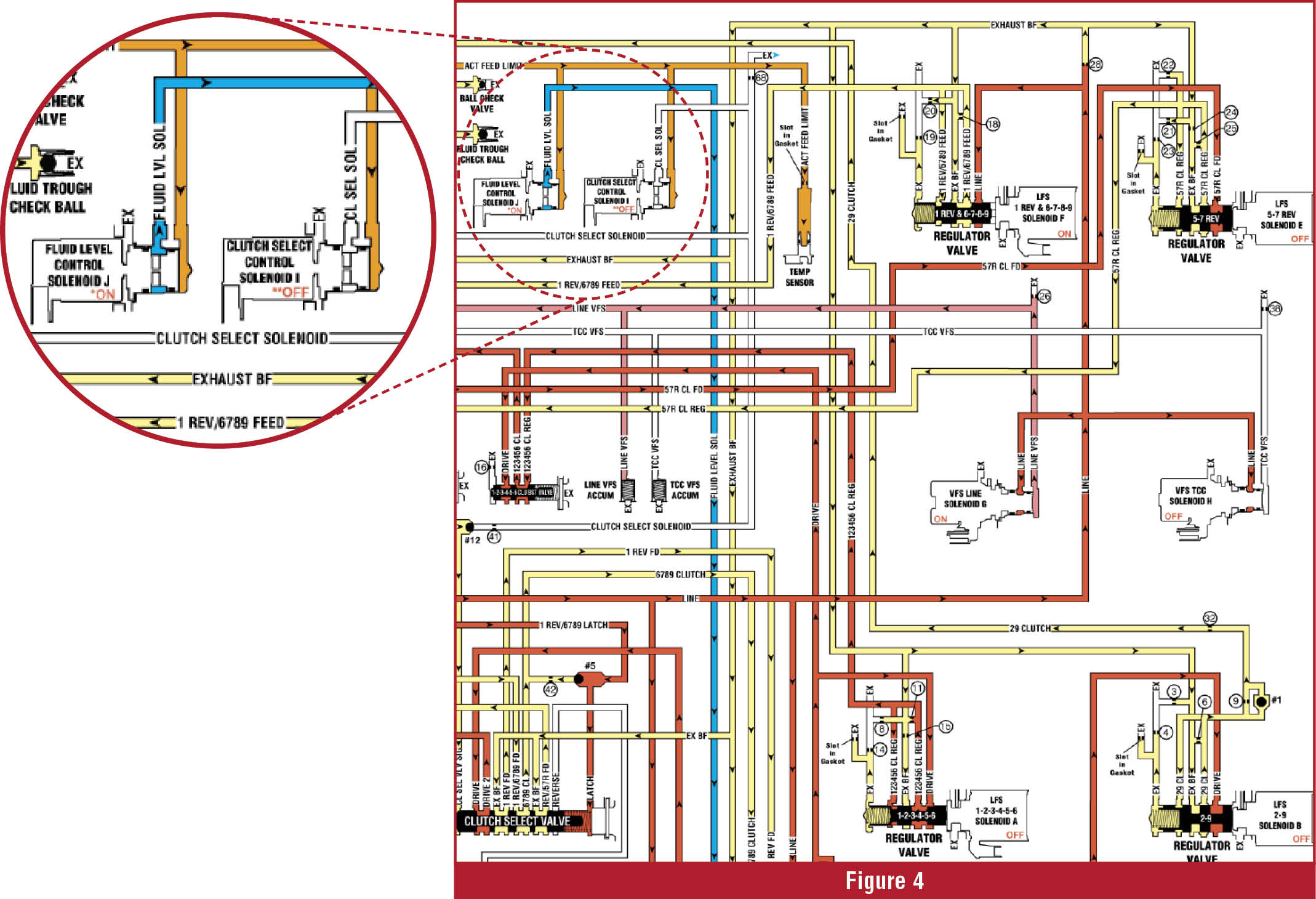
Back to the hydraulics. The good news is that the solenoids in the hydraulic diagrams have the function right on the solenoid (Figure 4). Please do not look at the letters on the solenoids. That will only confuse everyone involved. One solenoid has the letter “I” on it. There is no other reference to a solenoid with the letter “I” anywhere.
CASE CONNECTOR PIN CHART
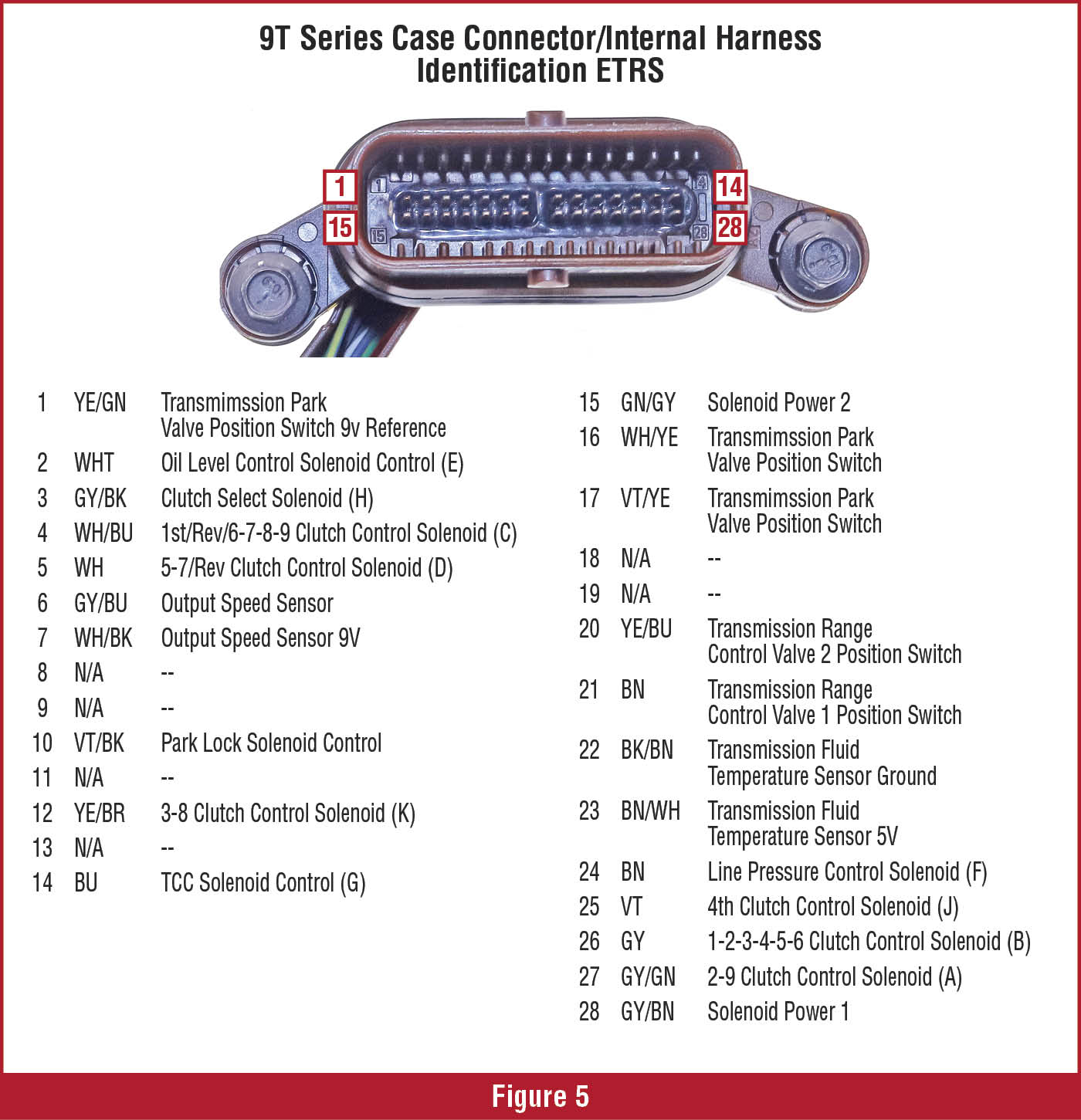
The case connector pin chart was another area that needed some work to make it more readable. The wires were run to their specific locations on the solenoid body and renamed for the solenoid’s function (Figure 5). The example given is for a 2019 Chevy Equinox with an ETRS transmission. Always refer to your specific application, as there may be minor differences between applications.
Using the information provided will make diagnosing this transmission much smoother. We all know that when things are simple and easy to use, we tend to use those things more often. We also know that when things are simple, it’s easier to have Fun With Transmissions!