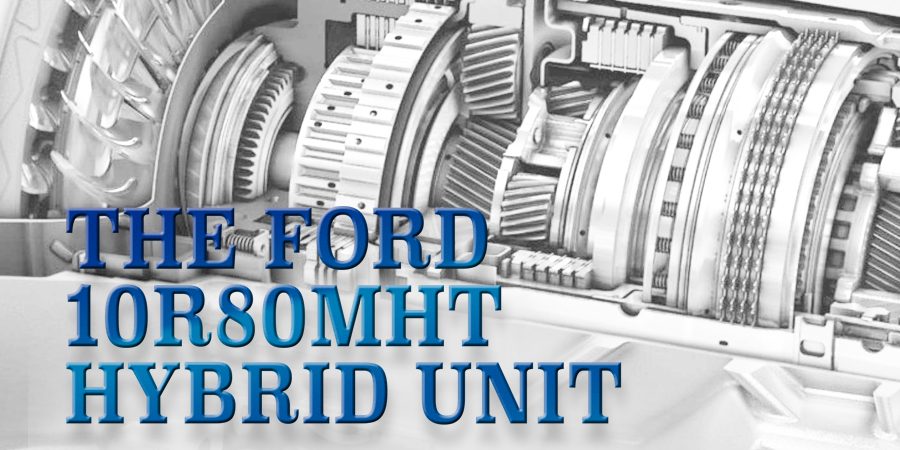
Ford is doing its part in the EV and Hybrid markets these days. Full-EV plug-in models include the Mustang Mach E and the F-150 Lightning. Ford offers several models in the Hybrid category (which has an engine and electric drive components) market, including the Explorer, Lincoln Aviator, and the F-150.
In this edition of Fun With Transmissions we are going to check out the 10R80 Modular Hybrid Transmission (MHT). The hybrid drive module is manufactured by the Schaeffler corporation.
 The first thing that caught my eye when I received this unit from Ford is how it reminded me of an old-time unit that was big and bulky (Figure 1). The older Slim Jim, say 61-64 pontiac transmission had the input shaft splined to the flywheel and had an internal fluid coupler (Figure 2). The 10R80MHT also is splined to the dual mass flywheel and has an internal torque converter. More on how the torque converter is driven coming up shortly.

HOW IT WORKS
The hybrid drive unit has an input shaft directly splined to the engine dual mass flywheel. When the engine is running the input shaft rotates an engine disconnect clutch (EDC) that is hydraulically locked by fluid pressure from the transmission fluid auxiliary pump. The transmission fluid pressure supplied by the transmission fluid auxiliary pump is monitored by a pressure sensor when the engine disconnect clutch is locked. When the engine disconnect clutch is in a locked state the torque converter is driven by being directly locked to the engine flywheel. When the engine is not running the fluid auxiliary pump is turned off to switch the engine disconnect clutch to an unlocked state and the torque converter is driven by the electric drive motor. The electric motor produces an extra 35kW or 47Hp.
 The hybrid drive unit has three different driving modes:
- Electric only drive (the electric motor drives the torque converter)
- Gas engine only drive (The EDC drives the torque converter)
- Combined electric and gas engine drive (boost mode)


WHAT’S IN THERE
The major components in the hybrid drive are the Engine Disconnect Clutch, Stator, Armature and the torque converter (Figure 3). The armature is riveted to the converter shell at the factory.
In the bell housing is a component called resolver. A resolver is a type of rotary electrical transformer used for measuring degrees of rotation (Figure 4). It is considered an analog device, and has digital counterparts such as the digital resolver, rotary (or pulse) encoder.
In simple terms, the computer sends an exciter signal to the resolver and the two two-phase windings. The two two-phase windings, fixed at right 90° angles to each other on the stator, produce a sine and cosine feedback current (Figure 5). Using this information the computer can tell where the stator is in relation to the commutator (windings).

ENGINE DISCONNECT CLUTCH
 The engine disconnect clutch (EDC) is the most normal component in a not-so-normal assembly, The EDC consists of usual apply piston, balance piston and return springs. So simple we are showing just the (4) clutches and (4) steel plates (Figure 6). We think that in the future there will be serviceable parts for this drum. Remember this clutch pack splines to the inside of the armature for the electric motor and is being applied & released with great frequency.
COOLING
Electric motors generate quite a bit of heat when under load. To take care of cooling the internals, there is a pipe in the pan, which runs from the auxiliary electric pump in the rear of the case to the hybrid drive housing. The passage in the hybrid case goes to the top of the hybrid drive housing and a plastic nozzle that sprays oil onto the whole assembly (Figure 7).
SERVICING
 When servicing this unit, it is important to pay attention to the seals in the valve body and the pan. Failure to install these seals (should they fall out) will cause the Engine Disconnect Clutch (EDC) to burn up and possible complete hybrid drive unit failure due to a lack of cooling (figure 8). Besides the regular pump intake seal, there is also a seal for the auxiliary pump in back for the extra hole in the filter.
Also when servicing the 10R80MHT the engine needs to be put into “engine running diagnostic mode”. What the heck is that you may ask. Because this is a hybrid drive, the engine can and will shut itself off. That’s the whole idea behind the hybrid drive; to save fuel. The following are steps to put the drivetrain into the engine running diagnostic mode: 1. Connect the diagnostic scan tool and position the vehicle on a hoist. 2. With the engine running, place the transmission selector lever in each gear position, holding approximately five seconds in each position. Place the transmission selector lever in PARK. Follow the steps  below to enter the engine running diagnostic mode:
- Place the vehicle in PARK.
- Push the start button to enter the accessory mode.
- Press the brake pedal and accelerator pedal together for five seconds.
- Steps 5 and 6 should be performed within 15 seconds after completing Step 3.
- Release both the accelerator and brake pedals.
- Press the brake pedal and push the start button so that the vehicle is in drivable state.
- Press the brake pedal and accelerator pedal together for 5 seconds.
NOTE: The READY TO DRIVE or DRIVE symbol should be flashing on the instrument cluster at a regular interval when the Engine Running diagnostic mode is active.
When this sequence is complete, the vehicle enters the diagnostic mode and the engine should remain running continuously.
Now we can check the fluid using the dipstick on the driver’s side of the vehicle (Figure 9). After the level has been checked we can exit the engine running mode. The PCM exits the engine running mode when the gear selector is shifted to any gear other than PARK, when the ignition is turned to the OFF or ACC position, or the powertrain or hybrid electric system exceeds calibrated limits.
 The 10R80MHT hybrid drive unit may be showing up in your shop any day now. Especially if you are working with your local police department vehicles. As of this writing the hybrid drive unit is available from your local Ford dealership. We, as transmission mechanics have always been fascinated with “what’s in there” when it comes to new transmissions. It’s a discovery thing I suppose, like olden day explorers. When we open things up and find out what’s in there it’s that Ah-ha! Moment that keeps us having Fun With Transmissions!