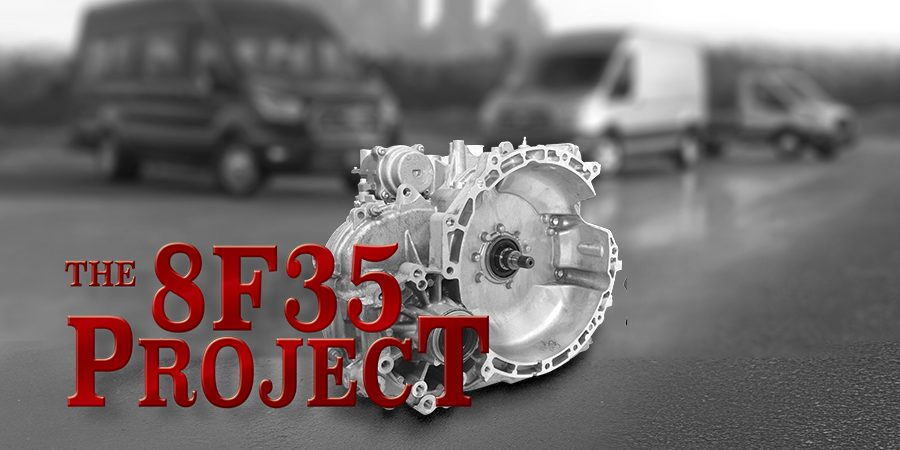
Not long ago, I wrote a book on the 8F35. Shortly after the book came out, a good friend of mine called me and said his Ford Transit van had a transmission problem. He had it diagnosed at the dealer but couldn’t afford to have the transmission replaced. He had considered getting a used transmission when he called me. I’m always ready for a project, so I arranged to have the transmission sent to my research lab.
The 8F35 that comes in the Ford Transit Connect is also standard in many other models, including the Ford Edge, Ford Maverick, and the Lincoln Nautilus. There are tons of these units out there, so we will be seeing these things coming into our shop. In this edition of Fun With Transmissions, we’ll check out some of the issues that we need to pay attention to during the rebuild.

The book time on this thing says 18 hours for R&R and overhaul for the unit, so right off the bat, we know it’s not going to be an easy in and out of the vehicle. This means when we go through the unit, it’s got to be right the first time!
 The main complaint on this unit was a severe surge. Unfortunately, I wasn’t able to drive the vehicle before the rebuild.
When the unit got to the bench upon tear down, I really didn’t find too much wrong. Don’t you just hate that when the unit didn’t drive all that well, and you expect to find something really wrong, and when we tear it down, you’re like, “What the heck??”
THE PLANET
Now it’s time to really dig in and start looking really close to the hard parts. The 8F35 has a history of having a bad output planet, and this one was worn out (Figure 1). Ford knows about this problem and published TSB# 22-2281. It talks about planets built before December 2021needing to be replaced. We have heard of these planets really coming apart!

 THE STATOR SUPPORT

The 8F35 does not have sealing rings on the input shaft to seal the converter charge and TCC release/ apply circuits like so many other transmissions. This fact makes it super critical that the input shaft bushings and the input shaft seal in the stator support are in very good shape.
THE BUSHINGS
To inspect the bushings, the input shaft seal must be removed (more on this coming up). If the bushings have a considerable amount of movement, they need to be replaced. If there is slight movement detected, we can do a test with a piece of cellophane tape. Did you know cellophane tape is 0.0015″ thick? This makes it a great measuring tool for bushings. Install the input shaft into the stator support and place a piece of tape on the shaft (Figure 2). Now, pull the shaft and tape through the bushing. If the tape goes through, the bushings must be replaced. When the bushings were inspected in this manner, I had that AH-HA! Moment. Here was the cause of the surge. The bushings in the stator support were extremely worn out, and the tape on the shaft fell through the bushing! This severe wear caused a major TCC apply oil leak. When the bushings are good, the tape will either jam up the shaft or the tape will be shaved off the shaft.
THE INPUT: SHAFT SEAL
There are a couple of steps that need to happen to ensure the seal is installed correctly. The seal is staked in place from the factory. First, the factory manual tells us to use special tool to deburr the stator support prior to removing the seal (Figure 3). Once the seal is removed, a half-moon file can be used to clean up the seal bore (Figure 4).
 Now, the new seal is driven in just to the bottom of the chamfer or to a depth of .069-.080″.
Next, we are going to use special tool # 307-762 to stake the seal into place. As one can see, the tool is needed to place the stake in the perfect location relative to the seal location (Figure 5).
Caution! If the seal is not staked correctly, the seal can blow out of the bore and cause severe internal damage due to loss of pressure.
THE TORQUE CONVERTER
 The 8F35 uses a converter clutch that applies towards the transmission. This is often referred to as the “LuK Design, or LuK TorCon, developed by Schaeffler.
- The LuK design can offer several potential advantages:
- Improved NVH (Noise, Vibration, and Harshness): By applying the clutch against the impeller, the design can sometimes provide better dampening of engine vibrations transmitted to the transmission.
- More Active Clutch Control: The LuK design often allows for more active and precise control of the TCC, including partial application (slippage) in more gears and under a wider range of conditions. This can contribute to fuel efficiency and smoother operation.
- Potentially Lower Operating Temperatures: Some sources suggest that this design can lead to lower clutch surface temperatures.
 After examining the converter, we saw that the converter lining and the apply surface on the impeller actually look pretty good. The reason for this is the customer felt the drivability issues and brought the car in before too much damage occurred.
CONCLUSION
Because these units are very difficult to R&R, it is super important that we get it right the first time. This is not the unit to “save a friend some money.” Think of that time when you cut a few corners to save the dough, and it ended up biting you in the behind. Or the time you used the wrong torque converter, and the unit had to come back out again? This is definitely NOT that unit.
When we pay attention to the details and build a solid unit, we can be sure that the customer will be happy, the techs will be happy, and we all have Fun With Transmissions!