
I received a call from a lifelong member in the Jacksonville, FL area. The conversation revolved around the business, or lack thereof. He was making the same amount of money, but the volume was way down. Almost 50% from 5 years ago. Over the last five years, I’ve been analyzing the transmission and automotive repair industries. Charting reports on a quarterly basis, in my opinion, there’s no better time to be in the transmission industry than right now!
The transmission repair industry is no longer solely about turning wrenches; we operate in a sophisticated arena defined by mechatronics, advanced software algorithms, and shifting macroeconomic realities. For those tracking the trajectory of automotive care, here is my analysis of the overarching trends that have redefined our industry since 2021.
1. The Macroeconomic Driver: Asset Longevity
We are currently servicing the oldest fleet in modern history, with the average vehicle age exceeding 12.8 years. This is not a temporary anomaly; it is a shift driven by high interest rates and escalating new-vehicle MSRPs.
Consumers and fleet operators are conducting a cost-benefit analysis: investing in a complex, multi-thousand-dollar transmission overhaul is now more economical than taking out a new auto loan. Consequently, the industry is experiencing high demand for repairs on vehicles well outside their factory warranties.
2. The Economic Pivot: Component-Level Rebuilding
The manufacturing costs of OEM (Original Equipment Manufacturer) and the Reman transmissions have reached a threshold where complete replacement is often not viable.
As a strategic response, the industry has shifted toward precision rebuilding and component-level repair. This requires a higher degree of technical expertise but delivers the cost-effective reliability that today’s market demands.
3. Drivetrain Evolution: Managing Hyper-Complexity
The era of the conventional, hydraulically controlled 4-speed automatic is officially behind us. Today’s service bays are dominated by highly specialized powertrains that demand distinct engineering knowledge:
- Continuously Variable Transmissions (CVTs): These systems are highly sensitive to fluid shear and degradation. They require strict adherence to maintenance protocols to prevent catastrophic internal failure.
- Dual-Clutch Transmissions (DCTs): Engineered for rapid shifts and efficiency, these systems blur the line between manual and automatic, requiring precise mechanical tolerances and frequent software recalibrations.
- Electrification and Hybrids: Modern hybrid systems merge traditional gearsets with high-voltage architectures. Repairing these demands not only for technical proficiency but for rigorous training in high-voltage safety and electro-diagnostic expertise.
4. Digital Transformation: AI and Mechatronics
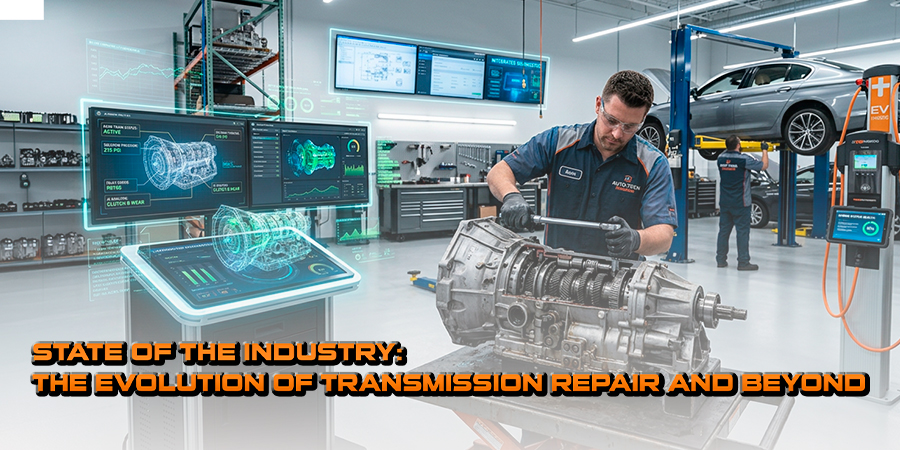
There is no doubt that we have moved from the mechanical age into the digital age. Advanced electrohydraulic control systems now manage transmissions.
To adapt, industry leaders are shifting their capital expenditures from traditional hard tooling toward proprietary diagnostic software and AI-assisted data analysis. They are leveraging AI learning to analyze CAN bus data, enabling us to pinpoint micro variations in fluid pressure or shift timing before they lead to hard-part failures. Accurate, software-driven diagnostics are now the primary differentiator between an average shop and an industry leader.
5. Proactive Management: Servicing and Yearly Checkups
Modern gearboxes run at higher thermal capacities. This heat accelerates the breakdown of fluid additives. By proactively servicing synthetic fluids, replacing filters, and executing system flushes, we are extending the lifespan of these units. Preventive care is no longer an upsell; it is a critical engineering requirement.
6. The Human Capital Challenge: The Evolving Technician
The most pressing bottleneck in our industry is a shortage of qualified technical talent.
We are seeing a generational exit of master technicians just as the job’s technical demands are peaking. The “grease monkey” archetype is dead; today’s transmission technicians are effectively computer scientists who don’t mind getting their hands dirty. Bridging this skills gap requires a radical rethinking of how we recruit, compensate, and train the next generation of drivetrain technicians.
Looking Ahead
The transmission repair industry is currently a high-barrier-to-entry market that rewards technical excellence and adaptability. By treating these systems as the sophisticated computer-driven networks they are, and by elevating the technical capabilities of our workforce, we are uniquely positioned to navigate the next decade of automotive evolution.