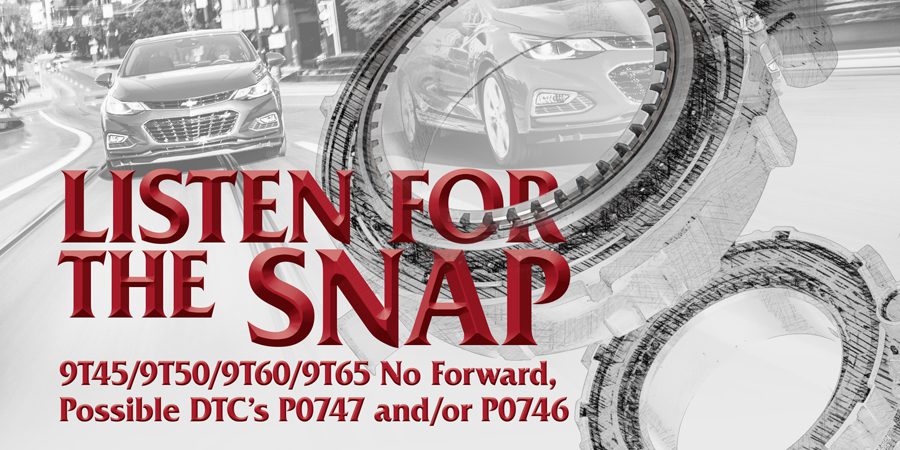
This week I ran into a 9T application that experienced a slipping condition when in a forward range. The vehicle would not move unless you applied a lot of throttle, and even then, it would barely creep forward on a flat surface. The unit was full of fluid, the pressures were good, and the fluid appeared in good condition.
After doing a little research on the issue, I discovered that GM had some issues leading to this exact concern. The 9T units utilize a solenoid to control each individual clutch. The clutch in question was the 1-2-3-4- 5-6 which is housed in the Selective One-Way Clutch (SOWC), which is housed deep inside the transmission.
Since the 1-2-3-4-5-6 clutch utilizes a solenoid to control the 1-2-3-4-5-6 clutch regulator valve, which feeds the fluid to the clutch, it could also be an issue with the solenoid, clutch regulator valve, or its circuit. In the last few years of seminars, we have spent a lot of time talking about issues related to the solenoid clips that hold the solenoids in the valve body on GM and Ford 8, 9, and 10-speed applications. The clips fatigue, allowing the solenoid to be pushed partially out of the bore, leading to clutch regulator valve operation issues and, ultimately, clutch apply pressure.

In addition to the slippage symptom, my vehicle also had a P0746 DTC set. P0746 and P0747 indicate an issue with the operation of the solenoid IE:
- P0746 Transmission Control Solenoid Valve 1 Stuck Off
- P0747 Transmission Control Solenoid Valve 1 Stuck On
The thing with the P0746 and P0747 DTCs is that more than just the solenoid can cause DTCs such as the clutch regulator valve, seal/circuit leakage, clutch mechanical operation or, in the instance of a P0746, an electrical issue. Now, one can easily understand how a P0746 could be related to hydraulic or mechanical issues, but some may be confused regarding an electrical issue causing a solenoid performance DTC. P0746 will set if:
- Other DTCs are not set.
- High-side drivers 1 and 2 are on.
- The gear ratio indicates that the 1-2- 3-4-5-6 clutch is not applied when the clutch is commanded on.
P0747 will set if:
- Other DTCs are not set.
- High-side drivers 1 and 2 are on.
- The gear ratio indicates that the 1-2- 3-4-5-6 clutch is applied when it is supposed to be released.
So, what about an electrical issue causing the P0746? Most transmission solenoid performance DTCs are set based on the commanded gear ratio varying from the actual gear ratio the TCM monitors for the gear being commanded. In other words, the TCM expects to see a specific gear ratio for the gear being commanded, but that ratio is not present.
In our case, if the solenoid current flow is low, the clutch regulator valve won’t be moved far enough into the bore to achieve the correct clutch apply pressure leading to the DTC but since the current flow is not 0 the TCM will not set a DTC for a solenoid electrical fault. This means resistance in the solenoid circuit, the solenoid itself or the TCM can also cause this DTC to set. In addition, since the TCM uses gear ratio as its calculation criteria, a problem with a speed sensor could also result in a P0746 being set.
This will give you a bunch of areas to inspect such as:
- The solenoid clips for being collapsed.
- The clutch regulator valve and/or clutch boost valve for being stuck or leakage in the clutch circuit.
- The solenoid for being faulty mechanically or electrically.
- The solenoid harness for excessive resistance or connection issues.
- A faulty speed sensor.
- A mechanical issue with the clutch.
Since the clutch is housed deep in the case it makes sense to inspect the other areas as you disassemble the case components to look for a clutch mechanical issue. GM is having some issues with the snap ring that retains the clutch plates in the housing.
Variations in the snap ring dimensions lead the snap ring to pop out even if it is installed correctly (Figure 1). This issue has been identified on all 9T 2023/2024 applications with Julian Dates between 2023, 274 and 2024, 113. Does that mean that you could not see it outside of these break points? Like other issues, the problem may occur outside those break points but it is not as likely. In addition, if this unit has been apart previous to you working on it could be that the snap ring was not installed correctly.
 The snap ring on these applications makes a loud popping noise when installed correctly. GM uses tools DT47797 and DT47797-2 or equivalents, to hold and force the snap ring into position while using a press. After the clutches are installed, the snap ring is placed in the housing making sure it is evenly spaced around the housing. The installer tools are then placed over the snap ring and you press the snap ring in place while compressing the return spring (Figure 2). When the snap ring moves into position, a loud snap will be heard indicating the ring is fully seated. Once the clutch is reassembled and the friction and steel plates are installed, the clutch should be air check using 10-15 psi of air pressure (Maximum of 20 psi on this clutch).
In our instance when the unit was disassembled, the snap ring was no longer in its groove so that meant that we would need to replace the snap ring before putting the unit back together.
That’s about all the time we have for now. So, until next time, remember: “Wasting time is the most extravagant and costly of all expenses.”