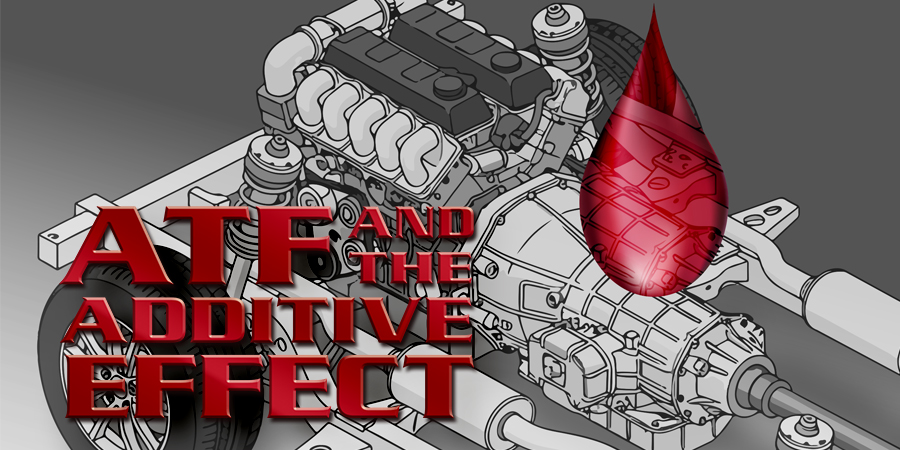
The use of “additives” in ATF has been an ongoing discussion since I started working in the automotive lubrication business in the 1980s. Before 1985, there were very few products other than seal swell products and some aggressively marketed fluid flush products (designed for “professional use only”) that, in general, had a terrible reputation and were looked down on by many transmission shops and technicians. As automatic transmissions slowly but surely became the transmission choice of the driving public, the proliferation of transmission shops and aftermarket products to keep transmissions running started to grow exponentially. Before long, there was a transmission shop at every major intersection, and the local auto parts store had its own section for ATF and automatic transmission products.
The biggest problems with the automatic transmissions of that time were durability and reliability issues caused by using ATF designed for a new-car warranty that rarely exceeded 36,000 miles. Fluid choice was limited, fluid quality was sometimes questionable, and extended warranties were a thing of the future, so the public was open to buying after-market additives that kept your transmission shifting properly long after the warranty was a thing of the past.
Great in theory, but often the additives were long on promises and short on good outcomes. In the mid-1980s, this started to change with the need for improved fluids (which the OEMs responded to) and the introduction of electrical controls and lockup torque converters, which introduced a new set of frictional and durability problems that the fluid technologies of the day were not yet formulated to prevent. The necessity for products to combat these types of problems created a consumer, service technician, or transmission shop manager looking for solutions that satisfied customer expectations at a price they were willing to pay.

Necessity being the mother of invention, this led to the proliferation of new aftermarket automatic transmission products, some with cutting-edge technologies that paved the way for a new category of transmission fluid additives, which now had their own shelf and were considered a desirable category of aftermarket products. There were also old or low-tech products that did little or nothing other than add some seal swell for “tired” seals or tackifiers to thicken sheared-down, and used low-quality ATF to increase viscosity and reduce internal hydraulic leakage.
With the growth of proprietary OEM ATFs available from a limited, and often costly, supply chain, a whole new category of transmission fluid additives evolved around “converting” readily available DEXRON/MERCON ATF to meet the performance requirements of these new automatic transmission fluids. From the late 1980s to today, the market for these “conversion” products remains strong after 40 years of providing safe and functional options for those who can’t or will not use the specified OEM ATF.
When you discuss the notion of fluid conversion with professionals, there are always those who scoff at the notion and take the hardline approach, and will only use the OE-recommended service fluids. This position can be based on a situation in which much of their service work is performed on newer vehicles with active OEM warranties, or, more often these days, on vehicles with aftermarket warranties that require the use of OE fluids, or warranty coverage will be denied. For many shops that service the huge fleet of older “long out of warranty” vehicles, the customer has no formal warranty, and the cost of service quickly becomes important, and the use of non-OEM alternatives becomes attractive.
The shop owners often realize that any warranty claim due to problems or failure will fall on them, so they, in essence, are assuming some liability for their service fluid choices. Their service fluid choices revolve around well-known brands or “certified” ATF, such as DEXRON or MERCON, with an aftermarket additive formulated for the “conversion” application for which they are providing fluid service.
In many ways, the term conversion is a poor choice to describe the process where a good, whole fluid is top-treated with additional additive content to give the base fluid the performance properties required by the specific OE transmission technology you are servicing (you aren’t really converting anything, just augmenting the additive content to meet specific performance requirements). For those who doubt the process and technologies, all I can do is point out 40 years in the aftermarket and literally millions of “conversion” services successfully performed by the service aftermarket with no problems and the resulting millions of miles of trouble-free driving.
With the improvements in fluid supply chains and the growth of the extended warranty not as many shops these days use “conversion” products for service but have discovered the value of adding a supplement to extend the life of the “fill for life” fluids that start to suffer problems (like T/C shudder) from additive depletion long before the OE service recommendation is reached. The fluids may have changed, but the problems haven’t.
When trying to convince buyers that there is a need and a place for automatic transmission additive products, it becomes necessary to prove to the end user that there is real value in using these products and a financial incentive for their additional cost over base service fluids. Understanding the concept and science behind the technologies used in transmission additives helps put things into perspective. Because the evolutionary notion of adding products to transmission fluid to enhance the performance of the base lubricant is a new concept, a unique lexicon has emerged, with new terms to describe what is happening.
Meriam Webster dictionary describes additives as: A substance added to another in relatively small amounts to effect a desired change in properties. The business dictionary concludes: An agent or factor (additives), when combined with other agents, adds to their cumulative effect usually by a known degree. This leads to the “additive effect”: An effect in which two substances or actions used in combination produce a “total effect” that is the same as the sum of the individual effects.
The evolution of CAD engineering, along with QC-driven precision manufacturing processes and the growing demands of ICE and EV power systems, is driving demand for synthetic lubricants and additives to address new and old problems. Some technologies have been designed for use where high temperatures and severe duty conditions generate heavy stress. This category of additive technology provides easier starts, improved cold-weather performance, longer drain intervals, reduced wear, and improved fuel economy. Other additive technologies extend running time, reduce maintenance costs, and are compatible with all seal materials and electrical and electronic components, while enhancing the lubricant’s thermal stability for protection during extreme service events and extended oil change intervals.
The goal of the additive supplier is to demonstrate improvements to the transmission oils from their proprietary additive formulation that demonstrates the phenomenon of “additive effect,” where, across the board, performance improvements, when evaluated in combination, produce a “total effect” the same as the sum of the individual effects from the combined components. Meaning improved anti-wear, improved oxidative stability, and improved efficiency, demonstrated in transmission applications, resulting in total improvement that translates into less downtime, reduced maintenance, long-term frictional stability, and improved fuel efficiency, resulting in reduced operational costs.
What started out as simple “tools” for conditioning leaking seals on higher-mileage transmissions and identifying additive-depleted used ATF causing low-speed frictional problems like T/C shudder has evolved into innovative aftermarket transmission fluid additives that give the transmission technician effective, affordable “tools” they can rely on to solve problems. This allows the technician, mechanic, or end user to quickly and cost-effectively restore used automatic transmission fluid lubricity to a level of performance and protection that enables the vehicle owner to defer expensive service, or to provide an affordable but acceptable OEM transmission fluid formulation that is safe, readily available, and affordable.
Thanks to the FTC (Federal Trade Commission) and its tendency to challenge products that make false or unsubstantiated claims, or that do not add value or perform as advertised, the market for these products has become tough to survive in or compete in. Many of the aftermarket ATF additives of the past would come out with lots of marketing hype and fancy packaging, but were short on performance and did not deliver the benefits they advertised. They were cited by the FTC and quickly and quietly disappeared from the ATF product shelves at automotive stores. The survivors we now find are a much stronger category with a whole new set of priorities in the current marketplace.
Another huge factor these days is the internet as a resource for researching and reviewing specific products and their actual performance, based on tutorials and YouTube videos. In the past, we made limited decisions based on unreliable advertising or fancy packaging that didn’t work out as promised. The growth of the internet as a source of information, driven by performance claims and positive outcomes for technicians and consumers, quickly eliminates products that do not deliver as promised, and the whole product category has slimmed down significantly, with the survivors growing and prospering while many underperformers or obsolete technologies quietly disappear.
 With consumers keeping vehicles longer than at any other time in the last 50 years, the need for products that keep the fleet running has enabled the market for transmission fluid additives designed to correct deficiencies in new and used ATF to prosper and grow. The notion that you can add a bottle of transmission fluid additive and repair anything that is truly broken or worn out is an incorrect assumption. No matter what anyone tells you, there is no such thing as” mechanic in a bottle”, but if the problem is related to any number of conditions that are influenced or caused by high mileage, used additive depleted transmission fluid or service fluids that are cheap and low quality to start with can be treated with targeted additive products that will fix the problem. This will often allow a concerned customer to continue using the vehicle until the proper service interval or repairs can be performed at a cost that may be more affordable than the alternative.
I can vouch for the fact that the end user is delighted when this simple approach works, and the expectation of more miles from higher-mileage vehicles becomes a reality. When the transmission starts to experience problems a few miles down the road, they usually remember the positive outcome and return to the shop that helped them last time.
Depending on how you see it, adding transmission fluid additives can be the first step in diagnosing fluid-related problems, the last resort before you must drop the transmission, or just a more cost-effective service option. Regardless of how you have perceived ATF additives in the past, they are an often-overlooked service option or tool that has survived in the aftermarket, even as so many other products have been timed out.