The 8L90 is quickly becoming one of the most popular units making their way into shops today. Whether we are talking about a dealership or an independent shop, these units take up much floor space.
Most of the issues with this unit are related to shift quality complaints or TCC shudder-related problems. GM has put a lot of effort into addressing the issues with changes to the fluid, calibrations, and hard/soft parts. While I could fill this whole magazine with details regarding all of the changes that have occurred, in this issue, we will discuss the clutch-related updates that you should be aware of for the 2018/2019 model years. Many changes are not designed to back service previous model year units as calibration changes were associated with the hard part changes.

 2018 was a year that saw many clutch updates, including the 2-3-4-6-8 (C4) clutch seals, pistons, housing, and wave plate. The clutch piston and dam update was made to mitigate cracking issues, while the updated wave plate addressed shift-related concerns. The updated piston seal bore dimensions also changed, resulting in different seal dimensions. As a result, seals from the early design and later designs are different, so it is imperative that you have the correct gasket and seal kit for your application. Dimensions that changed are as follows:
2-3-4-6-8 Clutch D Rings
- D rings 2015-17: GM# 24259281 (Precision International # 33281): 5.515” ID x 0.080” AW x 0.141” RW
- D Rings 2018-up: GM# 24283348 (Precision International # 33348): 5.505” ID x 0.088” AW x 0.132” RW
2-3-4-6-8 Retainer Piston – Large Diameter:
- 2015-17: GM# 24259278 (Precision International # 33278): 5.855” ID x 0.080” AW x 0.141” RW
- 2018-up: GM# 24283350 (Precision International # 33350): 5.830” ID x 0.088” AW x 0.132” RW
2-3-4-6-8 Retainer Piston – Small Diameter:
- 2015-17: GM# 24259269 (Precision International # 33269): 4.165” ID x 0.082” AW x 0.142” RW
- 2018-up: GM# 24283351 (Precision International # 33833): 4.160” ID x 0.088” AW x 0.132” RW
2-3-4-6-8 Wave plate was updated when the piston changes occurred. The wave plate is not designed to work with the previous design piston housing (figure 1).
 2018 1-2-7-8-R RETURN SPRING UPDATE (C4)
The return spring for the clutch was updated starting with the 2018 model year. The spring is now stronger, which will affect the clutch stroke rate. This change is designed to improve the shift feel. In addition, the thickness of the return spring changed with the new return spring being thicker. The updated return spring has cutouts in two spring lugs so that you can ID the updated design. The updated spring was not designed to back service due to calibration changes.
2019 CLUTCH DISK UPDATE – 4-5-6-7-8-R (C5)
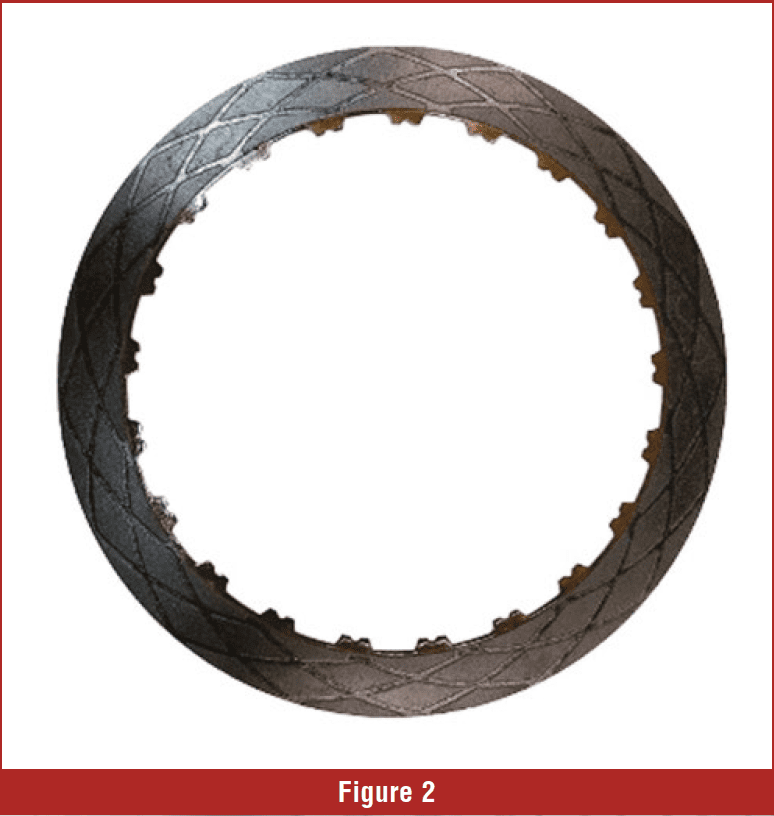
A change was made in the clutch material design to improve the 3-4 shift, accompanied by a calibration change. You can ID the updated clutch discs by the spiral friction design versus the radial friction material design used with the previous discs.
This change occurred for both the 8L90 and the 8L45. The different groove designs can identify updated discs (figure 2). In addition, the updated plates were NOT designed to back service due to calibration changes.
2019 RETURN SPRING UPDATE – 1-3-5-6-7 (C1)

The clutch return spring tension changed due to 2-3 shift concerns. The return spring tension was increased to alter the release/apply rate of the clutch. The dimples in the clutch spring retainer identify the updated return spring (figure 3). The updated spring is not designed to back service.
CLUTCH DRUM 1-3-5-6-7 (C1) DESIGNS
This clutch drum is available in two different designs, five clutch or four clutch capacities.
The design your unit uses is based on the application and year. The drum design is identified by locating the QR code on the top of the drum.
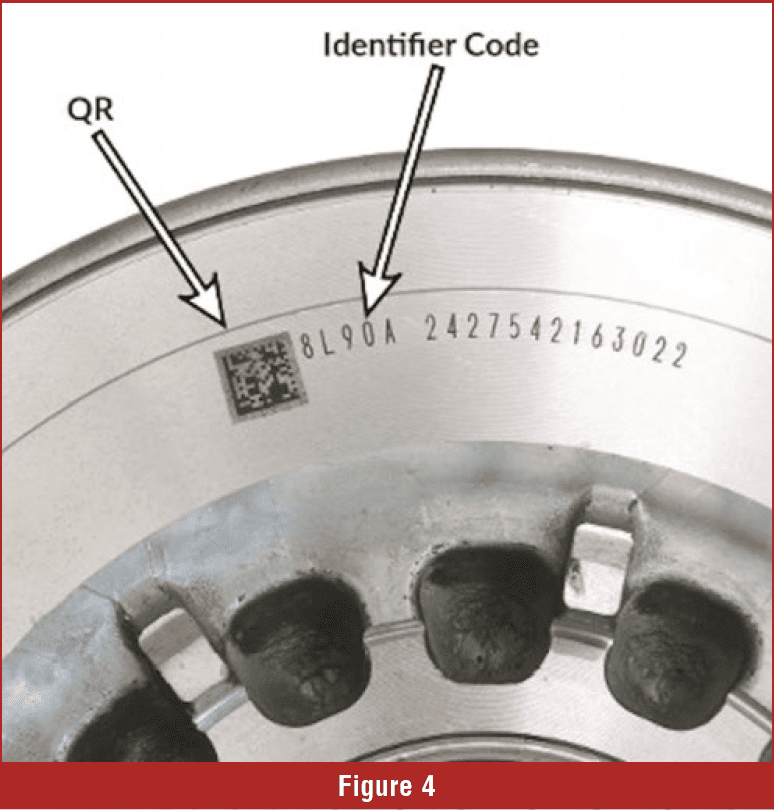 Next to the QR code, you will find the drum identifier code 8L90A or 8L90B (figure 4). The A-coded drums use four clutches, while the B-coded drums use five.
Change in this industry is constant, and it does not look like anything will let up in the future. Every manufacturer is doing the same thing, so there is no escaping the need for technicians to attend training whenever the chance arises, as having the correct information can save time and money.
Until next time remember, “You miss 100% of the shots you don’t take”.