Controller programming has become a standard practice in all shops throughout the world. Whether for a new module installation or simply to update the controller’s software/firmware to address a specific customer issue, access to the information, tools, and knowledge is essential for all shops.
You have heard me talk about “Global A and Global B” vehicle communication architecture used in GM vehicles for years. As we have discussed, many manufacturers are expanding the communication systems used on their vehicles to this type of technology. Everything from the CAN Bus to the actual OBD II system is currently in a major state of change, and you will start to see these changes affecting the tools and techniques you use to service today’s vehicles.
For many years, GM used a programming protocol known as ‘Sequential Programming.” What this meant was the process accessed various modules when you chose to update the programming of a single module. For example, if you chose to update the program for your TCM, the process would not only rework the TCM software but may update portions of the ECM, ABS, BCM, and other module software as those modules share information and functionality with the TCM. When the software loads, the program will choose a sequence to follow as it loads portions of the update into each module. This slows the programming process down as compared to the “old days” when software was loaded only into the module you selected. Keep in mind that the only module fully updated will likely be the module you selected, so if you want to fully update any of the other modules, you should choose that module and perform an update.
 With the advent of the “Global B” architecture (Also known as VIP or Vehicle Intelligence Platform), a new process was implemented for the reprogramming process. This process is NOT used if you install a NEW module; it is used if you are reprogramming modules. The process is currently being rolled out on only Global B/VIP platforms such as the following:
- 2024/Later Cadillac Lyriq and XT4
- 2024/Later Chevrolet Blazer EV and Silverado EV
- 2024/Later GMC Sierra EV
- 2023/Later Chevrolet Colorado/ GMC Canyon
- 2022/Later Hummer EV
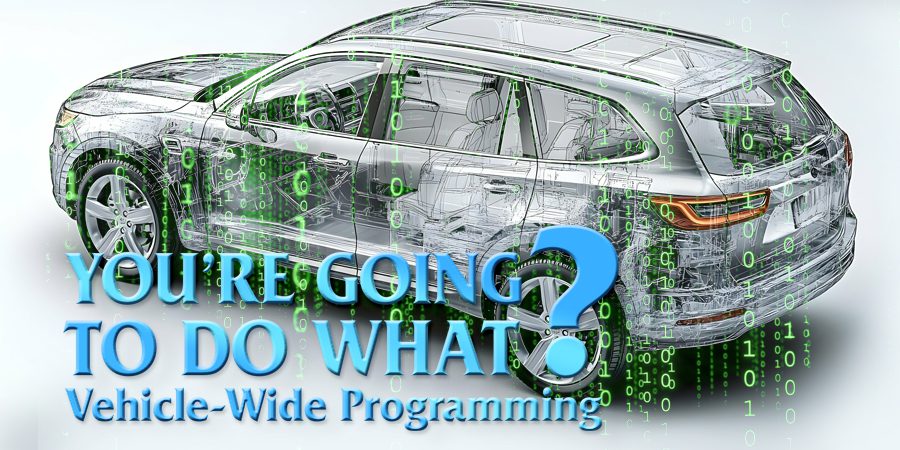
The updated process is scheduled to be rolled into other applications and prior model years in the future. The new process goes by a couple of names, “Vehicle Wide Programming and Parallel Programming,” depending on who you are talking to.
The process checks all the modules for their updated status and then displays that information to the technician (Figure 1). Unlike the previous system, the technician will update all the modules at the same time except for the radio and On star with a single press of a button (Figure 2). When the programming occurs, the system programs all the controllers required and updates them in “parallel” at one time. The process is simple and straightforward and will make updating the vehicle software much faster and simpler for the technician.
 A few things to keep in mind with vehicle-wide programming include:
- Your computer MUST be hardwired to the internet as a tremendous amount of data is being transmitted during the process. If you lose connection to the internet or the vehicle, multiple module failures may occur, which could be very expensive for your shop.
- An updated interface connection is required for your scan tool. GM requires the MDI 2 interface for the GM dealers.
- Make sure nothing else, such as dongles or other devices, is connected to the DLC.
- If the process fails to update all the modules, repeat the process. If that is unsuccessful, select the module from the display and program only that module.
- Like other programming, make sure you clear DTCs and relearn any adaptive values lost during the programming process when you are done.AD
- Keep in mind that this process is used only for reprogramming and NOT for the initial programming of a new module.
Well, that’s about all the time we have, until next time, remember what you tell your spouse: “Please, Just one more car.”