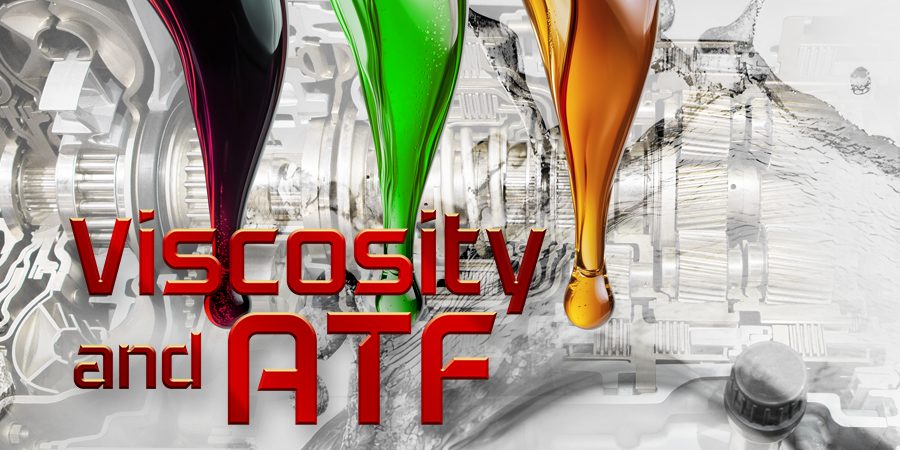
Before 2005, there were basically a few automatic transmission fluids that shops used to service everything. These were Dexron/ Mercon ATF and Ford Type F. A few OEMs had their own fluids (Chrysler, Toyota, and VW), but in general, service choices were simple, and new vehicle warranties were much shorter. The viscosity of the few ATFs was similar, and only motor oils and gear fluids had different viscosity requirements, which were mainly driven by seasonal requirements. Understanding ATF was simple. It was the red fluid that went into the automatic transmissions, and knowing the fluid’s viscosity was not important. Then it all changed.
Within a few years, we were in a situation where reading the fluid specification sheets oil distributors sent with the new fluids was essential to understand the physical properties of a quickly growing list of “proprietary” transmission fluids. This was essential knowledge for evaluating and classifying automotive lubricants like motor oil, gear lubes, and now automatic transmission fluid. In the last twenty years, viscosity is the one physical property that has totally changed how we specify automatic transmission fluid in the automotive aftermarket.

There are two methods for measuring viscosity; Kinematic and Dynamic. The two are easily confused but are very different. Kinematic viscosity measures the transmission fluid’s internal resistance to flow because of gravity. It is calculated by measuring the time in seconds required for a fixed amount of fluid to flow a known distance by gravity through a calibrated capillary tube at a fixed temperature. This is converted to a standard unit for measurement and reporting purposes. In this case, centistokes (cSt). Centistokes is measured in mm 2/s (millimeters squared per second). When reporting results, the temperature at which the test was conducted is also noted, for example, 6.0 cSt @ 100°. Dynamic viscosity is the measure of resistance to flow when an external source and controlled force, like a pump or compressed air, forces oil through a capillary tube or a component. For example, the Brookfield -40° C. test rig measures how well fluid flows at -40° C.
Regardless of method and temperature, the resistance to flow as a function of the input force can be determined by measuring the internal resistance of the fluid to the applied force, whether it be from gravity, a pump, or a spindle. Product specification sheets issued by lubricant manufacturers usually include kinematic viscosity values for two temperatures per the SAE grading system: 40° C. and 100° C., along with dynamic (absolute) viscosity for the Brookfield -40° C. temperatures.
The most common engineering units used to indicate viscosity are the centistoke (cSt) for kinematic viscosity and centipoise cP (centimeter-gram-second) used for dynamic viscosity. OEMs list the -40 Brookfield values in centipoise (cP) on the specification sheets when reporting the Brookfield results. ATF with a low centipoise value flows easily and quickly when very cold. ATF with a higher centipoise value flows more slowly. Anything over 20,000 cP is generally unacceptable for modern ATF, with most newer fluid technologies falling to 15,000 cP or lower. It’s common to see values below 10,000 cP when synthetic base oil ATFs are used. That’s why the -40° C Brookfield viscosity test is important. An example would be 12,000 cP@ -40° C.

Different from the higher temperature viscosity testing, this test measures the ability of the fluid to spin a spindle in very cold ATF, simulating starting conditions in an arctic environment. Unlike the higher temperatures, these values are reported as absolute viscosity, not kinematic viscosity. If you live where it gets arctic cold, Brookfield viscosity is an important measurement of ATF fluidity performance when choosing service fluids.
Once you are familiar with how the viscosity values are generated, understanding the Viscosity Index (VI) concept comes next. The Viscosity Index is listed on most specification sheets that are generated when you have the 40° C. (100° F.) and the 100° C. (210° F.) kinematic viscosity measurements. These temperature-specific measurements are inserted in an engineering formula based on crude oil viscosity performance, with the viscosity index value being a calculated index. The VI number ranges from as low as 100 to well over 200, depending on the base oils used. This makes the VI an arbitrary measurement of a lubricating fluid’s change in viscosity relative to temperature change. It is used mainly to indicate the viscosity-temperature behavior of automotive lubrication oils. The lower the VI, the more the viscosity is affected by changes in temperature. The higher the VI, the more stable the fluid viscosity stays over the range of temperatures encountered in automatic transmissions. Automatic transmission fluids need a minimum VI of 150 to meet the requirements for older automatic transmission fluids, with many synthetic base ATFs having a much higher VI, well over 200.
The changes in ATF viscosity started with the advent of electronically controlled transmissions in the early 2000s. The engineers quickly found out one of the most important factors for maintaining shift quality was having an ATF that did not change viscosity during the life of the fluid. The fluids of the day quickly sheared down until the oxidative stability went away, and the fluids rapidly became thicker as the additive content depleted. This had a negative effect on long-term frictional stability and extended warranties. Fixing this was possible but would require higher-quality base oil and improved additive packages such as VI improvers.
The fluid specifications were then changed to require performance that could only be obtained using these new improved additives and “Group II/III/IV” base oils. These programs were very successful, and they got what they were looking for: a shear-stable ATF with outstanding oxidative stability that would meet the new extended warranty offered by OEMs. The only problem was that these new fluids did not shear down to a viscosity that met the manufacturing and fuel efficiency requirements for the latest 6- and 8-speed transmissions that were starting to appear.
The search for improved fuel mileage resulted in automatic transmissions that had reduced sump volumes, higher fluid turnover rates (with aerodynamic shrouding inhibiting airflow over hot transmissions), and increased temperatures from heat-generating electronics in the transmission. When you factor in reducing viscous drag in the transmission drive train to improve efficiency, it became obvious to many OEM engineers that reduced viscosity ATFs would be a winner. New transmissions were designed for them, and each transmission manufacturer had its own requirements for viscosity and frictional properties, with an OEM-branded fluid available only through the dealer network.
OEM service departments were programmed to deny warranty if “improper” fluid (anything not sold by them) was used for non-dealership service. Today, the list of OEM-specified and required fluids contains over 100 different types of ATF, with many having very limited availability. When you include all types of automatic transmission fluids, such as aftermarket ATF, CVT fluid, and DCT fluid, the list gets even bigger and more complicated because of the unique properties that CVT and DCT fluids must have.
With that said, back to the question, “When did the viscosity of the ATF you use become so important?” Because the automotive aftermarket is a dynamic free market entity, there will always be an oil company willing to take the same technology they sell to OEMs and package it for consumers available at their favorite auto parts store. Recognizing the need for shear-stable “synthetic” ATF, many manufacturers have products designed to meet or exceed the OEM requirements for the new automatic transmission fluids. Because the different OEMs have different engineering requirements, most new transmission fluids are formulated for the type of transmission they are designed for.
It is somewhat determined by the number of speeds in the step automatics, with fluid viscosity dropping as the transmission technology advanced and we went from four to ten speeds. Before 2005, ATF viscosity was designed to fall between 6.8 and 8.0 cSt at 100° degrees C. It was the “conventional” viscosity of that pre-2005 era.
In 2005, GM dropped the Dexron III specification and adopted a new fluid specification called Dexron VI (5.8-6.4 cSt at 100° C.) This fluid was thinner at operational temperatures than the pre-2005 Dexron II/III and conventional viscosity ATFs. These new reduced viscosity fluids were designed for the 6- and 8-speed technology coming into the new vehicles of the time. Shortly after GM moved to reduced-viscosity ATF, Ford did the same thing as GM and discontinued the old Mercon specification (replacing it with Mercon V) and issued a new specification now called Mercon LV (low viscosity) ATF. These new fluids quickly became the service fluids for the 6- and 8-speed step automatics.
Several OEMs view their reduced viscosity ATF as reverse compatible with older transmissions. GM has indicated that transmissions that originally used Dexron II/III ATF can now be serviced using GM (Dexron VI), and Honda (Honda Genuine Z-1) stated their new reduced viscosity ATF (Honda Genuine DW-1) was reverse compatible and can be used safely in older vehicles with their automatic transmissions. Other OEMs like Ford, Chrysler, and Toyota do not make that claim and have multiple specified OEM fluids to meet specific transmission viscosity requirements.
When GM and Ford collaborated on the 10-speed step automatic transmissions, the quest for improved efficiency and costs resulted in sharing hard parts with each OEM using their own proprietary corporate control software and shifting strategies. This also required a new ultra-low viscosity (ULV) ATF (4.5 cSt @ 100° C.), unique to the application and exclusive to the technology. Ford developed the fluid specification and shared the development with GM, resulting in GM and Ford versions of ULV ATF. This new third category of ATF is not reverse-compatible to other applications.
The use of ULV fluids for 8- and 9-speed transmissions by Chrysler/ Dodge (MOPAR 8- and 9-speed ATF) is OE specific because the ULV fluid used by Chrysler/Dodge is colored green, not the red color used by Ford and GM for their ULV fluid. I could go on like this forever. But the point is that the complexity of specifying automatic transmission fluid has become very tricky, like a minefield. It’s not so much a problem if you know where the mines are. That’s where knowing how to read a specification sheet on the fluids you use for service comes to the rescue.
Technology and high-quality products are not exclusive to OEM dealerships, but you must know what is required and make sure what you use meets those needs. Reading and interpreting ATF Technical data sheets goes a long way to understanding the physical properties of the transmission fluid you are looking for. Several aftermarket companies make developing OEM alternatives their daily business. It would serve the informed consumer well to remember this and seek the advice and products of these experts.