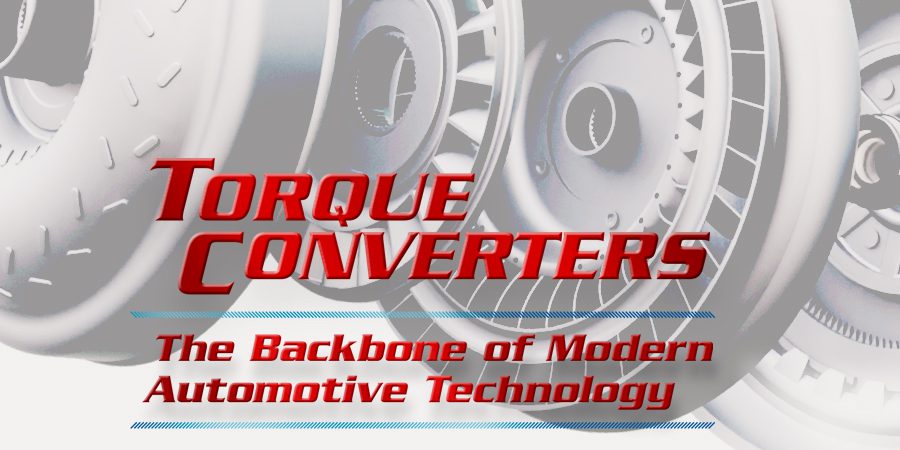
In modern automotive technology, the torque converter is a pivotal component of automatic transmissions. For transmission technicians, mastering the design and functionality of torque converters is crucial for achieving effective diagnostics and repairs. The torque converter is one of the most critical components in an automatic transmission. This overview will cover the basic torque converters, the essential components, and their integration into automatic transmission systems.
THE EVOLUTION OF TORQUE CONVERTERS
The history of torque converters is a compelling narrative of innovation in automotive engineering. The concept gained significant traction after World War II, particularly with the use of the Hydra-Matic transmission in select military vehicles. In 1948, however, torque converters began to replace fluid couplings, exemplified by Buick’s revolutionary Dynaflow transmission. This unique design relied heavily on the torque converter for precise speed control while primarily operating in top gear during standard driving.
 The advancement continued with the introduction of the Packard Ultramatic in 1949 and Chevrolet’s Powerglide in 1950. These early models utilized two-speed transmissions, with the torque converter handling torque multiplication. By the 1950s, innovations such as BorgWarner’s three-speed automatics and Chrysler’s TorqueFlite, which featured a Simpson compound planetary gearset, firmly established torque converters as indispensable components in automatic transmissions.
DEFINING THE TORQUE CONVERTER
The torque converter is a fluid coupling connecting the engine to the automatic transmission. Unlike manual transmissions that employ clutch mechanisms, the torque converter uses hydraulic fluid to transmit and amplify torque. At its core, a torque converter comprises four critical components, each playing a vital role in its operation (Figure 1):
- Turbine: Directly transfers power to the transmission’s input shaft.
- Impeller and Converter Housing: Pumps fluid to the stator and turbine.
- Stator: Redirects fluid flow to the impeller, enhancing torque multiplication.
- Lock-Up Clutch: Establishes a direct mechanical connection that maximizes efficiency at cruising speeds.

HOW DOES A TORQUE CONVERTER WORK?
From Fluid Motion to Mechanical Operation
 The torque converter cycle begins with the impeller, which is directly linked to the engine. The impeller generates a centrifugal force that pushes hydraulic fluid into the turbine’s vanes (Figure 2). The turbine then transfers this force to the transmission’s input shaft, propelling the vehicle.
The fluid then recirculates to the impeller, which is redirected by the stator for torque multiplication. This design ensures smooth acceleration, even at low speeds, by allowing slippage between the impeller and the turbine.
Maximizing Torque Multiplication and Efficiency
A torque converter’s ability to multiply torque relies on slippage, defined as the speed difference between the turbine and impeller. The increased slippage results in enhanced torque multiplication, which is most effective during acceleration. At cruising speeds, slippage diminishes, and the converter enters the coupling stage, where the turbine’s rotation closely aligns with the impeller.
Modern advancements, such as the introduction of the lock-up clutch in 1981, have significantly minimized energy loss during the coupling stage by establishing a mechanical link between the turbine and the engine, achieving a precise 1:1 ratio.
Key Components and Their Critical Roles
The Turbine: The turbine is essential for transmitting power to the transmission. Fluid flow through the turbine’s vanes causes it to spin, driving the transmission’s input shaft. Supported by bearings and connected to the input shaft, the turbine guarantees smooth operation throughout the transmission system.
The Impeller and Housing: Bolted to the engine’s flywheel, the impeller serves as the system’s pump. Its vanes propel hydraulic fluid toward the turbine, enabling continuous fluid flow through redirection by the stator. Without the torque multiplication provided by the stator, this setup functions merely as a fluid coupling.
 The Stator: The stator is critical for torque multiplication. Positioned strategically between the turbine and the impeller, it redirects returning fluid into the impeller at an optimal angle, thereby contributing additional force to the system. A one-way clutch within the stator facilitates free rotation during the coupling stage, preventing any hindrance to rotary flow.
Fluid Dynamics in Torque Converters
A deep understanding of fluid dynamics—specifically vortex and rotary flow—is vital for transmission technicians.
Vortex Flow: Represents the spiral-like movement of fluid through the impeller, stator, and turbine. Torque multiplication peaks during acceleration when vortex flow dominates (Figure 3).
 Rotary Flow: Occurs at cruising speeds when fluid flows parallel to the converter’s circumference. This flow reduces vortex activity, signaling the coupling stage (Figure 4). The transition from vortex to rotary flow exemplifies the torque converter’s efficiency in adapting to various driving conditions (Figure 5).
Coupling Stage in Torque Converters
Understanding the coupling stage is crucial for transmission performance. At maximum torque multiplication or acceleration, vortex flow is at its peak, but as cruising speed is reached, this flow diminishes significantly, marking the transition to the coupling stage.
 During this stage, fluid flow becomes almost entirely rotary, as there is minimal to no vortex flow. Importantly, there is no mechanical connection between the impeller and turbine. Instead, we observe a marginal speed difference or slippage, which is a normal characteristic of this stage.
At cruising speed, this slippage is minor, typically resulting in a ratio of about 1.11:1. Simply put, the turbine completes nine rotations for every ten impeller rotations. This minimal slippage does, however, create a slight power loss to the rear wheels.
How was this resolved? With the introduction of lock-up converters, this power loss was eliminated. Once engaged, the lock-up mechanism connects the engine to the turbine at a 1:1 ratio, ensuring no slippage and direct power transfer.
One-Way Clutch in the Coupling Stage
The coupling stage plays a critical role in maintaining efficient transmission performance. During this stage, fluid flow transitions to being primarily rotary, with minimal vortex flow present. However, this poses a potential challenge for the system. Without intervention, the stator vanes could slow rotary fluid flow, compromising efficiency.
A one-way roller clutch is integrated into the stator hub to address this issue. This clutch prevents rotary flow disruptions by allowing the stator to turn along with the unit when necessary. Here’s how the system works:
One-Way Clutch Inner Race: Splined to fit the stator support at the front of the transmission. For rear-wheel-drive transmissions, the stator support is part of the front pump. On front-wheel-drive units, it bolts directly to the case and remains stationary.
Outer Race: Splined to the stator and separated from the inner race by roller elements, which allow smooth and controlled movement.
Roller Elements: Provide the mechanism for holding or freewheeling the stator. These ensure that the stator operates efficiently in the coupling stage.
Energizer Springs: Hold the rollers locked in place, eliminating any slack or free play between the inner and outer races. This allows for precise engagement and smooth function during operation.
Functionality
The one-way clutch ensures the stator performs optimally by providing two essential modes:
Holding Mode: When fluid flow conditions demand, the stator remains stationary to redirect flow and maximize torque multiplication.
Freewheeling Mode: At higher speeds or cruising conditions, the stator can rotate freely with the unit, reducing resistance and improving efficiency.
When the clutch is engaged, the slippage between the impeller and turbine is minimal, resulting in a minor power loss to the rear wheels— typically at a ratio of about 1.11:1. However, in lock-up style converters, this power loss is eliminated, allowing a direct 1:1 connection between the engine and the turbine.
Why It Matters
For transmission technicians, understanding the one-way clutch in the coupling stage is vital for proper diagnostics and maintenance. Efficient stator operation directly impacts the torque converter’s fluid dynamics and overall performance. The one-way clutch prevents common flow disruptions, ensuring seamless operation and prolonged transmission life.
Torque Converter Multiplication and Ratios
Maximum torque multiplication is achieved at full stall speed when the impeller rotates faster than the turbine. This fundamental principle underpins the efficient operation of torque converters. For example:
A transmission with a ratio of 2.46:1 and a converter stall ratio of 2.2:1 results in an overall ratio of 5.41:1 during full stall.
The ratio drops to 2.73:1 at the coupling stage, reflecting increased efficiency.
These figures highlight the torque converter’s ability to provide multiple ratios without mechanical shifts—a vital function in automatic transmissions.
Torque Converter Highlights Worth Noting
For automatic transmission technicians, here are key points to remember about torque converters:
- They act as a clutch, connecting and disconnecting the engine from the transmission.
- Torque multiplication peaks during acceleration due to vortex flow.
- Rotary flow dominates during cruising, improving efficiency.
- Lock-up clutches eliminate power loss during coupling, achieving a 1:1 engine-to-transmission ratio.
- The stator’s one-way clutch prevents slowing the rotary flow during the coupling stage.
The torque converter is an engineering marvel that merges fluid dynamics with automotive mechanics. Its role in torque multiplication, power transfer, and efficiency makes it indispensable in automatic transmission systems.
At ATRA, we empower automatic transmission technicians with the knowledge and tools needed to excel in their craft. For further insights or resources, reach out to our expert team today and enhance your technical expertise.