So many times we run into this type of problem. We diagnose the transmission, determine it needs a solenoid, replace it and we still have the concern. So then we move on and look for other issues that can cause the concern all the while thinking, it’s not the solenoid because I replaced it.
The Valve Body Pro (VBP) HotLine regularly receives calls about 48RE transmissions behind diesel engines that won’t upshift at wide open throttle. Most were basic transmission overhauls with nothing out of the ordinary.
The technician overhauled the valve body and even replaced the governor solenoid and transducer; but all were corrected by simply telling them to install an OE governor solenoid.
We wanted to know why this was happening, so we had a technician who was dealing with this problem send the complete valve body to our office. We installed it in a 2003 Dodge 4×4 with a 5.9 diesel engine and cable operated TV. We installed pressure transducers on the accumulator (line) pressure tap (channel 1; yellow) and the governor tap (channel 2; green) so we could capture the pressure signals with a scope.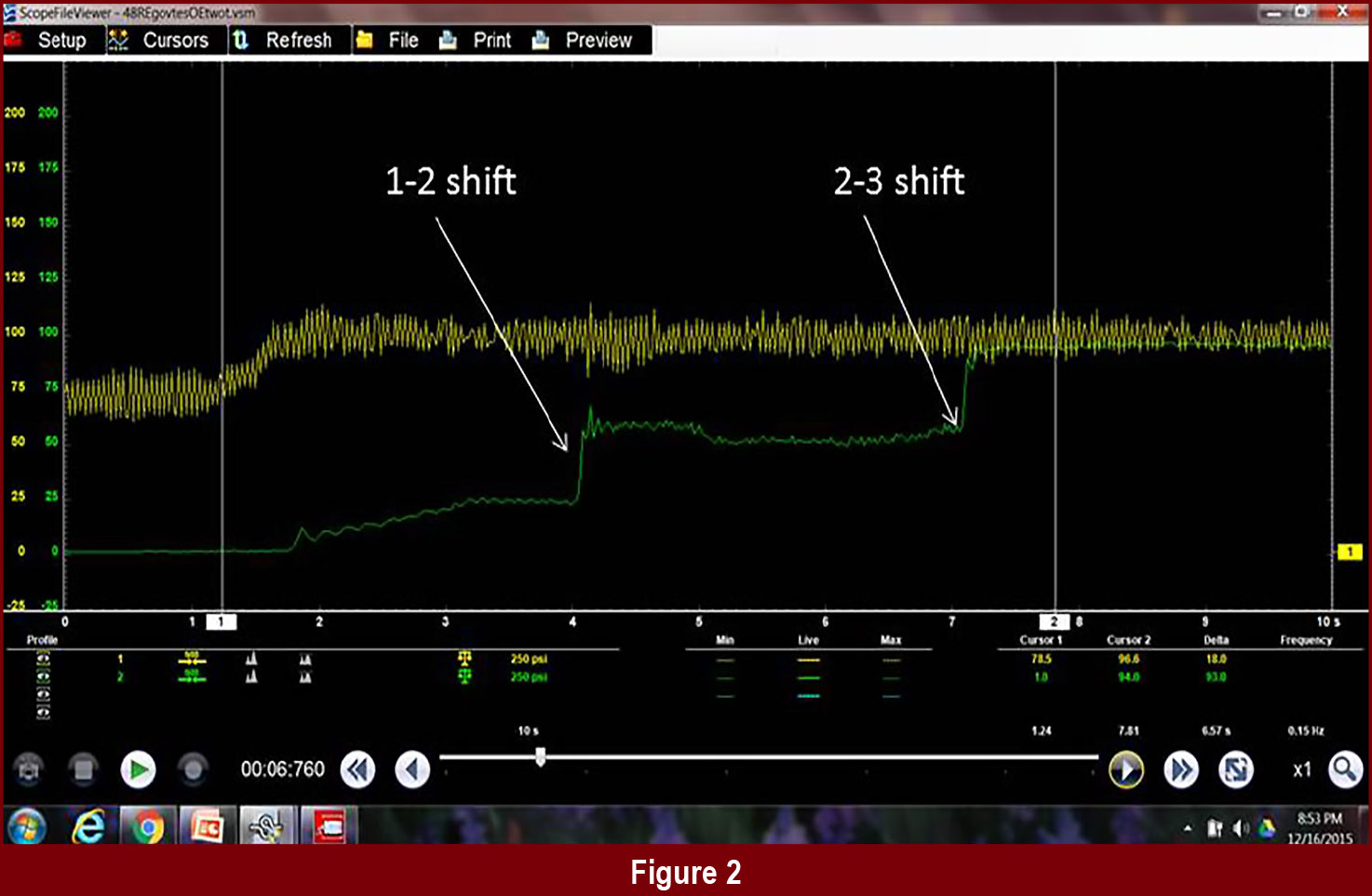
Under wide open throttle we could feel the 1-2 shift, but the transmission wouldn’t do the 2-3 shift unless we backed off the throttle. We noticed the governor pressure (channel 2; green); was unstable and never equal to line pressure when the PCM lowered the governor solenoid duty cycle signal to 1% (figure 1). This was a brand-new, governor solenoid; replacing it with an OE solenoid corrected the problem (figure 2). With the new, OE solenoid in place you can see the governor pressure (channel 2; green) is more stable and the pressure rises to equal line pressure (channel 1; yellow) when the PCM commands 1% duty cycle. The Parameter Identification (PID) can be used to see when the PCM commands governor pressure to equal line pressure by looking at the desired and actual governor pressures.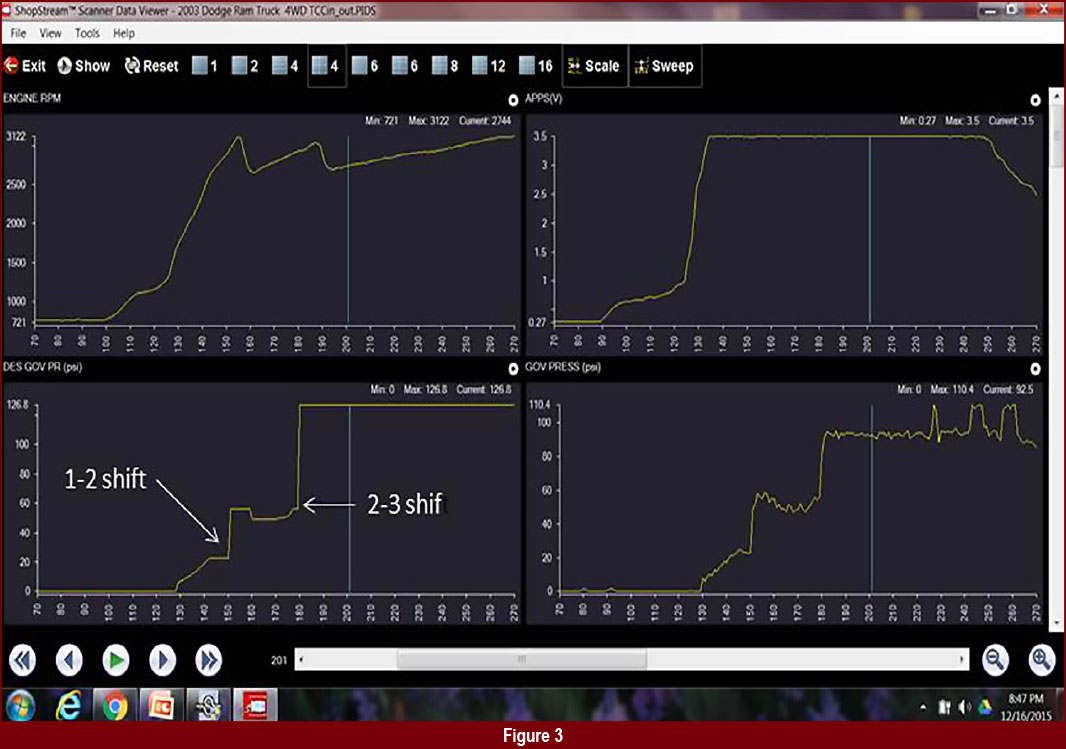
On the 48RE transmission, line pressure (and therefore governor) pressure increase when the PCM commands 4th gear or TCC apply, because the boost valve is stroked. Figure 5 shows the Curser 1 when transmission is in 3rd gear; curser 2 is when it’s in 4th. Even here we can see the governor pressure which is now equal to line pressure rise.
So what causes the shifting problem? Look at the 2-3 shift valve setup (figure 4). We’ve assigned letters to the valve lands for reference purposes. Throttle (TV) pressure enters between lands F and G, where it combines with the spring and applies to the right side of land H.
Governor pressure — on the left side of land A — must overcome both of these TV pressures. We’ll skip the actual math and the fact that you need to subtract land G from land H; if you want to learn the details for calculating hydraulic pressures, check out Dennis Madden’s book, Hydraulic Fun-damentals, available through the ATRA BookStore.
Under wide open throttle, TV pressure is at maximum. But when governor pressure reaches about 36 PSI, the TV limit valve cuts off TV pressure to land H, leaving TV pressure only between lands F and G.
If governor pressure isn’t high enough to overcome the TV pressure, the 2-3 shift valve won’t stroke. This blocks mainline pressure from entering the direct clutch circuit, so it can’t release the intermediate band and apply the front clutch. If we back off the throttle, TV pressure drops enough to allow governor pressure to stroke the 2-3 shift valve and shift the transmission into 3rd gear.
Take a look at the PIDs after we installed the new, OE governor solenoid (figure 3). Now, when the desired pressure is commanded to maximum, the actual pressure equals Line pressure.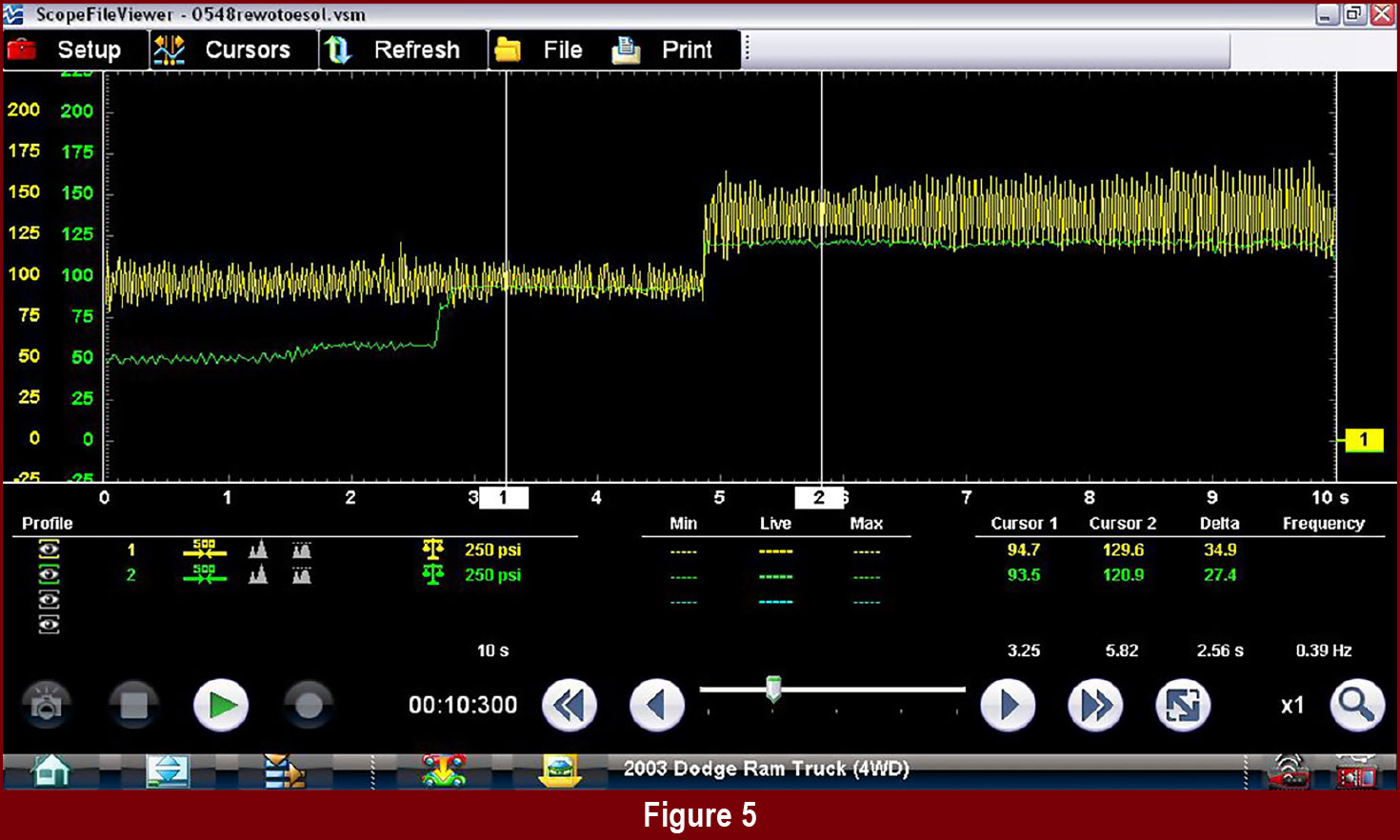
This has become an all-too common problem on the HotLine, and one that seems to trace back to a few aftermarket governor solenoids. The easiest fix has been to replace them with OE solenoids; the problem doesn’t seem to show up with the factory solenoids. With the new, factory solenoid in place, virtually all of these problem units begin shifting just fine.