Battery technology has changed over the years; choosing the right battery type for your application requires understanding the different options. In this article, we explore the terms and factors used to differentiate battery types and what the differences mean for servicing.
When discussing batteries, there are questions that arise:
- Which battery has the longest life, and what is the warranty?
- Can this type of battery be mounted in any position?
- Can this type of battery handle off-road shock abuse?
- Does this battery need a special charger or specific charging rates?
- How does battery type affect cost?
- Is this battery type maintenance-free?
- Does this battery offer enough cold cranking amps to start my engine in cold weather?
- Is reserve capacity important to my vehicle?
- What group size is my battery?
- Are the terminals the right type and in the correct location?
- Does my owner’s manual specify a specific battery type based on start/ stop feature?
- Does my vehicle require a battery relearning procedure?
Before one can enter a discussion about batteries, there is terminology that is used that must be defined. Here are some important terms:
- BCI Group number (Battery Council International)
- Amp-hour rating
- Cold cranking amps (CCA)
- Cranking amps (CA)
- Reserve capacity

The BCI group number refers to the battery’s physical size. All batteries in a specific group will have similar characteristics regardless of manufacturer.
Amp-hour rating refers to the steady current that a fully charged battery can deliver for 20 hours at 80 degrees Fahrenheit.
CCA refers to the number of amps a battery can deliver for 30 seconds at 0°F without the voltage dropping below 7.2 volts.
CA refers to the number of amps a battery can deliver for 30 seconds at 32°F without the voltage dropping below 7.2 volts.
Reserve capacity refers to the length of time in minutes that a fully charged battery can be discharged at 25 amperes before the battery voltage drops below 10.5 volts.
The most common types of 12-volt batteries are:
- Flooded lead-acid with caps & sealed lead-acid
- Valve-regulated lead-acid
- Absorbed glass mat (AGM) including spiral
- Gel
- Lithium
A 12-volt battery is made of six cells connected in series, each producing about 2.1 volts. Each cell has a positive and negative plate. The positive plates are derived from lead dioxide. Negative plates are derived from pure lead. A separator plate separates the positive and negative plates to prevent them from shorting out. Batteries must be able to deliver a burst of energy or high amperage when the vehicle starts. An electrochemical reaction occurs when the lead plates and sulfuric acid react to produce electricity.

FLOODED LEAD-ACID TYPE
Flooded lead-acid batteries use a liquid electrolyte, a mixture of sulfuric acid and distilled water, which flows freely in the cell. The lead plates are completely submerged in electrolyte. Flooded lead-acid type batteries allow the user to add distilled water to maintain proper electrolyte levels.
Each battery type has advantages and disadvantages.
The advantages of a lead-acid type battery are:
- More affordable
- Plentiful and fit most applications
- They can handle a steady high current discharge
- You can test each cell with a hydrometer if it has caps
- You can charge with an old-style traditional charger
The disadvantages are:
- They gas if charged too fast and may explode if exposed to a spark
- Must be mounted in a vertical position
- Should not be discharged more than 50 percent of their capacity
- Do not handle vibration and shaking well
- Not recommended for start/stop application
- Maintenance required; distilled water must be added
- Electrolyte will freeze in cold temperatures when the battery is discharged.
VRLA
Valve-regulated lead-acid (VRLA) batteries do not allow distilled water to be added. VRLA battery uses an internal oxygen recombination cycle to prevent electrolyte loss. Oxygen recombination simply means that the hydrogen gas created during the charging process, which normally exits a flooded lead-acid battery through the vent, recombines with oxygen to form water again, which is returned to the electrolyte. VRLA batteries incorporate a safety pressure relief valve to prevent over pressurization of the battery case.
AGM BATTERIES
Absorbed glass mat (AGM) batteries are considered a type of VRLA battery. The electrolyte does not flow freely in the cells; the electrolyte is suspended in fiberglass matting surrounding the lead plates. AGM batteries are equipped with a safety relief valve that opens if pressure exceeds the limits.
The advantages of an AGM battery are:
- No maintenance
- Can be mounted in any position
- Can be discharged more than lead-acid without damage
- Longer life span than flooded lead-acid type
- Can handle vibration & shaking better than flooded lead-acid type
- Works well in start/stop equipped vehicles
The disadvantages are:
- Heavier than a flooded lead-acid battery
- Shouldn’t be discharged more than 60 percent of its capacity
- Cost is slightly higher than an equivalent flooded lead-acid battery
- Requires different charging techniques.
GEL
Gel batteries are considered a type of VRLA battery; the electrolyte is in the gel form. The electrolyte has a silica additive that causes it to stiffen. Gel batteries are designed not to produce hydrogen gas during charging. Gel batteries are equipped with a safety relief valve that opens if pressure exceeds the limits.
The advantages of a Gel battery are:
- No maintenance
- Can be mounted in any position
- Tolerate excessive discharge and high heat
- Do not sulfate as fast as other battery types
The disadvantages are:
- Require different charging techniques to prevent damage
- Cost more than traditional flooded lead-acid batteries
LITHIUM
Lithium batteries may be referred to as LifePO (Lithium iron phosphate) and differ from other battery types. The cell voltage is approximately 3.2 volts, compared to 2.1 volts for a flooded lead-acid battery. Four cells are connected in series to obtain 12.8 volts, which is slightly higher than a flooded lead-acid battery at 12.6 volts. It is imperative that you choose a cranking type of lithium battery rather than a marine or solar type.
The advantages of a Lithium battery are:
- High storage capacity
- May last 3-5 times longer than traditional batteries
- Lighter in weight
- No maintenance
- Do not require venting
- Install in any orientation
- Can discharge more of their stored energy without damage than traditional batteries
- Faster charging
The disadvantages are:
- More expensive
- Vehicle coverage may be limited.
- Do not work as well in extreme cold.
- Charge rates are more specific.
BATTERY CHARGER SELECTION
With all the different types of batteries on the market, you must be careful when selecting a battery charger. Each battery type above requires a slightly different charging strategy. Improper charging techniques can damage batteries. Batteries are typically charged in three stages. These are the bulk stage, absorption stage, and float stage. The bulk stage is when the battery is low; it can accept large amounts of amps and higher voltage. The absorption stage begins when the battery reaches the absorption set point, and constant-voltage regulation is used to prevent gassing. The battery can come to a full state of charge in this stage. The float stage provides a low rate of maintenance charging; its purpose is to maintain the charge level without overcharging. Battery charging profiles change depending on battery resistance. Flooded lead-acid batteries have the highest resistance compared to other battery types. Gel and AGM batteries have lower resistance than flooded lead-acid batteries; therefore, traditional battery chargers should not be used.
Traditional, old-style battery chargers were unregulated, transformer-based chargers built to charge higher-resistance flooded lead-acid batteries. The charger consists of a wall-mount transformer and a diode. The transformer was designed to output 13-14 volts over a current range; the problem was that the voltage would rise to 17 to 18 volts when the charger was set to high amps and the battery was nearly full. A technician must monitor the charger voltage and turn the amp selection down a notch when the voltage starts to exceed 16 volts; the user must repeat this process until the battery is fully charged. If the user skipped this step, the battery would gas and start to lose electrolyte. This type of unregulated charger is not recommended for AGM, VRLA, Gel, or spiral batteries. AGM batteries should not be charged above 14.7 volts; 15 volts or more could damage the battery. If you use higher voltage, pressure may rise inside the battery, causing the safety valve to open. Gel batteries prefer to be charged at 13.8-14.4 volts. Higher voltages can open the safety valve. Only charge an AGM or gel-type battery using a temperature-sensing, voltage-regulated charger. Gel batteries maintain an absorption rate of 2.35 volts per cell and a float voltage of 2.25 volts per cell at 77 degrees Fahrenheit. AGM batteries maintain an absorption rate of 2.45 volts per cell and a float voltage of 2.27 volts per cell at 77 degrees Fahrenheit. This means the battery charger must charge each battery type differently.
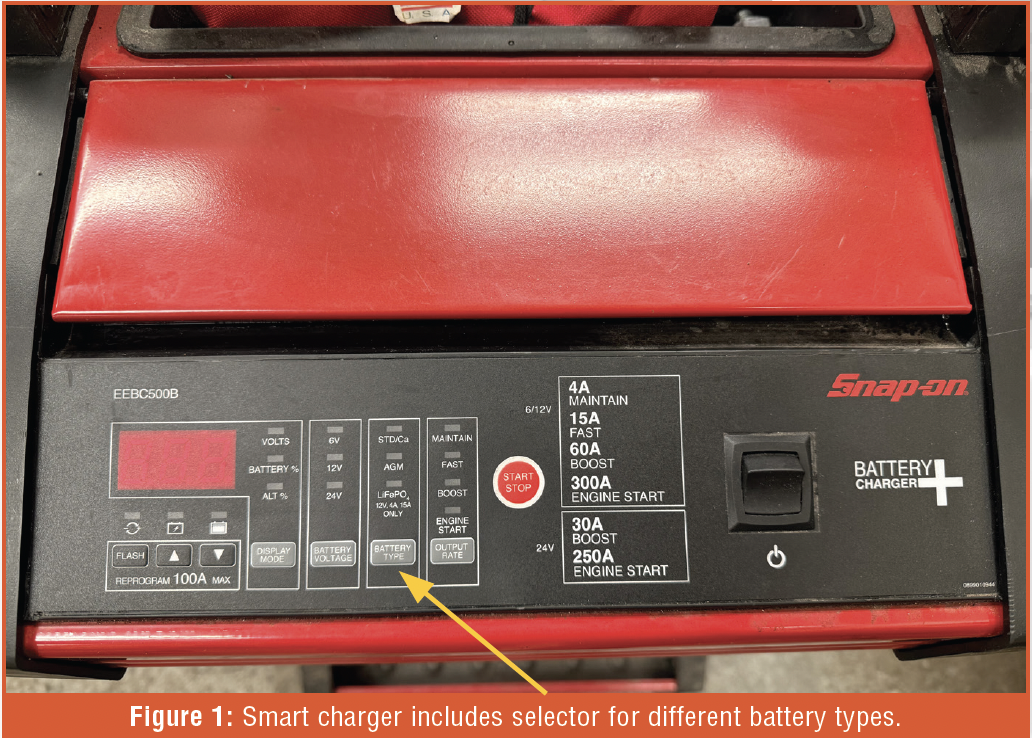 That brings us to smart chargers. What makes a charger a smart charger? Smart chargers prevent overcharging by employing adaptive charging algorithms, real-time monitoring, and automatic cut-off. Smart chargers use a microcontroller to detect battery voltage and adjust charging current. Smart chargers integrate voltage, current, and temperature sensors that allow them to adapt to battery chemistry, temperature, and state of charge. Smart chargers use a multi-stage charging system that includes bulk, absorption, float, and maintenance, and they are polarity-sensitive. Smart chargers should offer all the different battery types on the selector menu.
  Most smart chargers include Standard, AGM, Gel, and Lithium on the charge selector. Be careful and make sure you select the correct battery type because the battery charging profile will change with your selection (Figure 1).
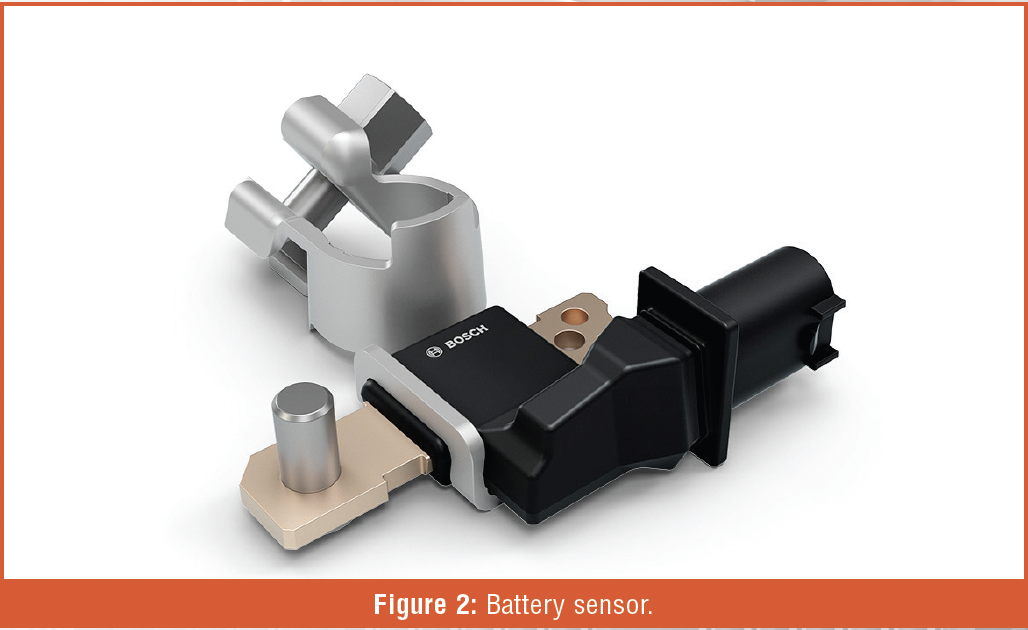
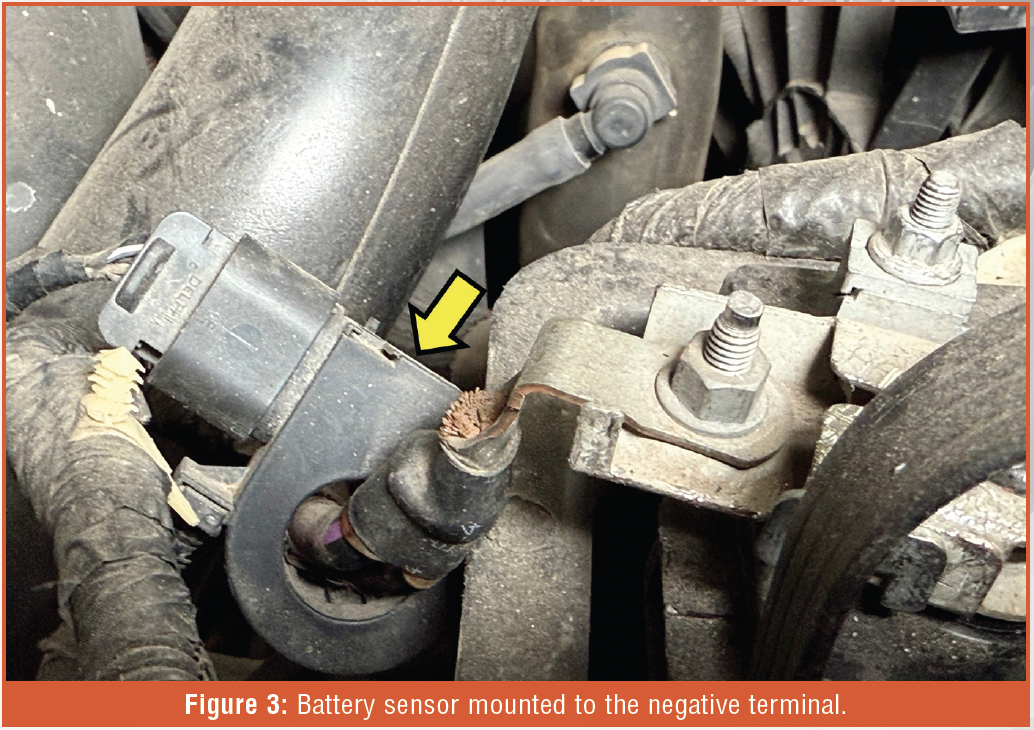
Newer vehicles may require a battery registration or a BMS (Battery management system) reset when replacing the battery. Flooded lead-acid, AGM, and gel all use different charging profiles. Without a reset, the alternator may overcharge or undercharge the battery. The electrical management system used on modern vehicles monitors battery state of charge, state of function, and state of health. A battery sensor is mounted to the negative terminal or around the negative cable to measure current entering and leaving the battery (Figures 2 & 3).
 The electrical management system controls the charge rate based on battery type, temperature, battery state of charge, and electrical loads. If the battery is charged in the vehicle with an external charger, it is imperative that the negative cable of the charger be placed on a good engine ground so the electrical management system can measure how much amperage is entering the battery. If you remove the cables from the battery and then charge it, the vehicle’s electrical management system will show the wrong state of charge.
In future articles, we will visit battery testing along with the 16- & 48-volt systems TESLA uses.