The transmission repair industry sure has a way of keeping its technicians humble. Sometimes, the fix to certain problems can seem to be so obvious until the performed repair doesn’t fix the vehicle. Things can easily go haywire at that point. The last thing a tech wants to do is throw parts at a problem. This is when it can be helpful to ask for advice from other professionals.
A 2019 Ford F-150 with a 3.5-liter engine and a 10R80 transmission arrived at the shop with codes P0735 Gear Ratio Error in 5th and P2704 Friction Element ‘E’ Apply Time. These are routine and common codes on a 10R80 indicating an issue with the ‘E’ clutch. On a short road test, it was confirmed that the transmission slipped in 5th gear. At this point, most shops would dive right in and sell the customer an internal inspection. That turned out to be the first mistake on this particular vehicle.
 Upon teardown of the transmission, the builder was unable to identify the cause of failure. Everything looked perfect, including the CDF drum and the ‘E’ clutch. An air check of the E clutch was performed, confirming the problem was elsewhere. Valve body and solenoid issues are also common. The transmission was re-assembled with a new valve body from the dealer and an updated CDF drum.
After the transmission was installed into the vehicle, a final road test was performed prior to delivery. To the technician’s surprise, the transmission still slipped in 5th! It also continued to set both P0735 and P2704 DTCs. Now, the PCM was suspected. The tech decided to take a scope capture of the computer command to shift solenoid ‘E.’ As you can see from the apply chart in Figure 1, SSE is commanded ‘on’ in 1st, 3rd, and 5th through 9th.

The scope was set to average DC voltage with the positive lead on the negative side of the solenoid ‘E’ circuit and the negative lead on a good ground. A snapshot of the scope recording has also been included (Figure 2).
Analyzing the scope capture, the computer command to shift solenoid ‘E’ looks identical on the 2-3 shift and the 4-5 shift. The transmission slipped on the 4-5 shift, but it did not slip on the 2-3 shift. This observation convinced the tech that the problem had remained inside the transmission. The transmission wouldn’t slip until after getting hot. This hot complaint suggested the transmission might have a cracked ‘E’ clutch drum or a cracked piston that may have been missed on the overhaul.
The transmission was removed and given to a different builder. The second builder also couldn’t find the cause of the failure. The ‘E’ clutch drum and piston showed no signs of a crack, but both were replaced. This was a precaution. Unfortunately, these changes didn’t fix the vehicle. The transmission continued to slip in 5th gear, setting the same codes as before the work.

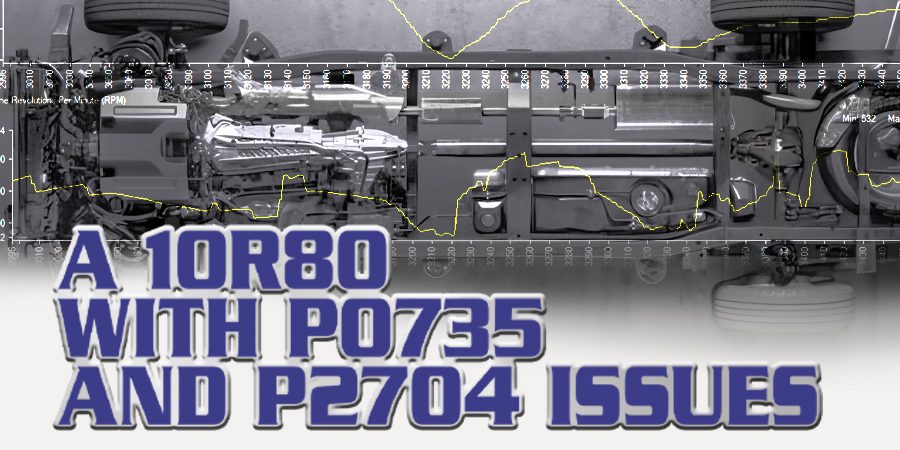
At this point, some data recordings were taken, and the problem was submitted to the Transmission Network Worldwide (TRNW). Upon analyzing the data recordings, the PCM appeared to apply 2nd gear immediately after the transmission slipped in 5th gear. Additionally, the PCM commanded shift solenoid ‘E’ on in 1st, 3rd, and 5th on the previous acceleration pattern but doesn’t appear to command shift solenoid ‘E’ on the next acceleration pattern (Figure 3). You can see the RPMs flare up in frame 3385 while it’s applying 5th gear. After the attempted shift, the commanded gear goes to 2nd. The throttle was held steady during this gear change. This observation made the range sensor become suspect, but the data recording revealed that the range sensor never changed state from the drive position. The computer command appears to be erratic and confused, but why?
It would have been easy to condemn the PCM at this time, but the tech was skeptical and hesitant. At this point, one of the TRNW members mentioned an engine misfire can cause the transmission to do strange things on later model units. Emission Mode $06 data was analyzed, and it confirmed the #1 and #5 cylinders were displaying misfire counts. The counts were not high enough and steady to set a P030x series misfire code. The rest of the cylinders were not incrementing misfire counts.
The #1 and #2 ignition coils were swapped, as well as the #5 and #6 coils, to help identify a possible faulty coil. If the misfires moved to another cylinder, the coils would be suspect. If the misfires remain on cylinders #1 and #5, then the spark plugs and/or injectors would be suspect. A road test revealed the misfires were still increasing on #1 and #5, which eliminated the coils as a possible cause of the misfires. A set of new spark plugs was installed, eliminating the misfires. In addition, the transmission complaint was no longer present after a hot drive. The spark plug replacement had miraculously and finally fixed the vehicle.

It’s hard to imagine an engine misfire caused by fouled spark plugs could cause the transmission to slip and set ratio error codes. Questions remain:
- Why did it only slip in 5th gear?
- Why did the transmission not slip in the other gears as well?
A tech would expect engine misfires to cause the transmission to slip randomly or in all gears. Unfortunately, a random transmission slip behavior was not present in this F-150. The slip was isolated to 5th gear only, which misled the technician and caused a misdiagnosis. These types of incidents can certainly degrade one’s confidence in their ability to diagnose a vehicle correctly the first time. Today’s technicians need to have an open mind to explore the not-so-obvious causes before going forward with the pattern failure fixes we all commonly experience.