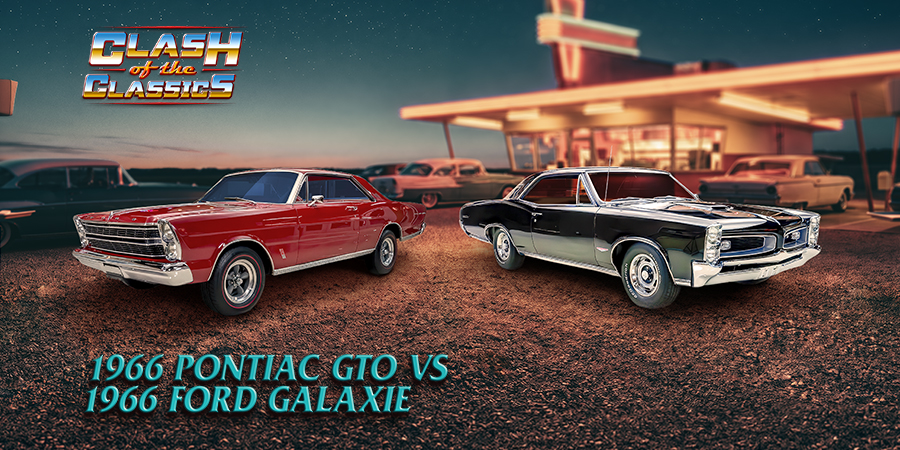
Welcome once again to Clash of the Classics. This month we head back to 1966 for a look at two cars that captured very different sides of American performance.
Very few models have blended V8 power, everyday usability, and mid-sixties swagger quite like these two. Both are symbols of American confidence — powerful enough to own the boulevard and stylish enough to turn heads at the drive-in.
Today we pit the original muscle car, the 1966 Pontiac GTO with its 389 V8 Tri-Power and Muncie 4-speed, against the full-size sleeper, the 1966 Ford Galaxie with its 390 V8 and Cruise-O-Matic 3-speed.
 1966 was an interesting year in America. The Interstate system was booming, The Beatles released Revolver, Batman hit TVs in color, and at the drag strips, what won on Sunday sold on Monday.
For me, 1966 is personal. My uncle Jim brought home a Montero Red ’66 GTO hardtop with a black interior and a Muncie 4-speed. That car is the reason I fell in love with Pontiacs.
It was also a great time in the industry. GM and Ford were locked in a horsepower war with no ceiling. The idea was simple: give the average guy supercar performance he could still afford to drive to work.
Two compelling expressions of that idea were the 1966 GTO and the 1966 Galaxie. Both were performance cars. Both were trimmed like premium models. And both tried to make everyday cars thrilling. Yet they approached it very differently. One was a mid-size missile, built light and lethal for the stoplight. The other was a full-size bruiser, built to carry five in comfort and still blow past almost anything on the highway. One became a legend, while the other remains an underappreciated alternative.
Looking back almost sixty years later, the GTO and Galaxie reveal a great deal about Pontiac and Ford during the golden age of performance.
 To understand these cars, it helps to remember the cultural context.
Muscle was moving mainstream. In 1964, Pontiac cheated GM’s ban on big engines in mid-size cars and created the GTO. By 1966, it was its own model, not just a Tempest option, and America couldn’t get enough.
At Ford, the full-size car still ruled. The Galaxie was the family car, taxi, and police cruiser. But Ford knew even family buyers wanted excitement. So you could order a Galaxie 500 two-door hardtop with the 390 FE big-block. It was the gentleman’s hot rod.
Visually, the GTO and Galaxie reflect two distinct philosophies.

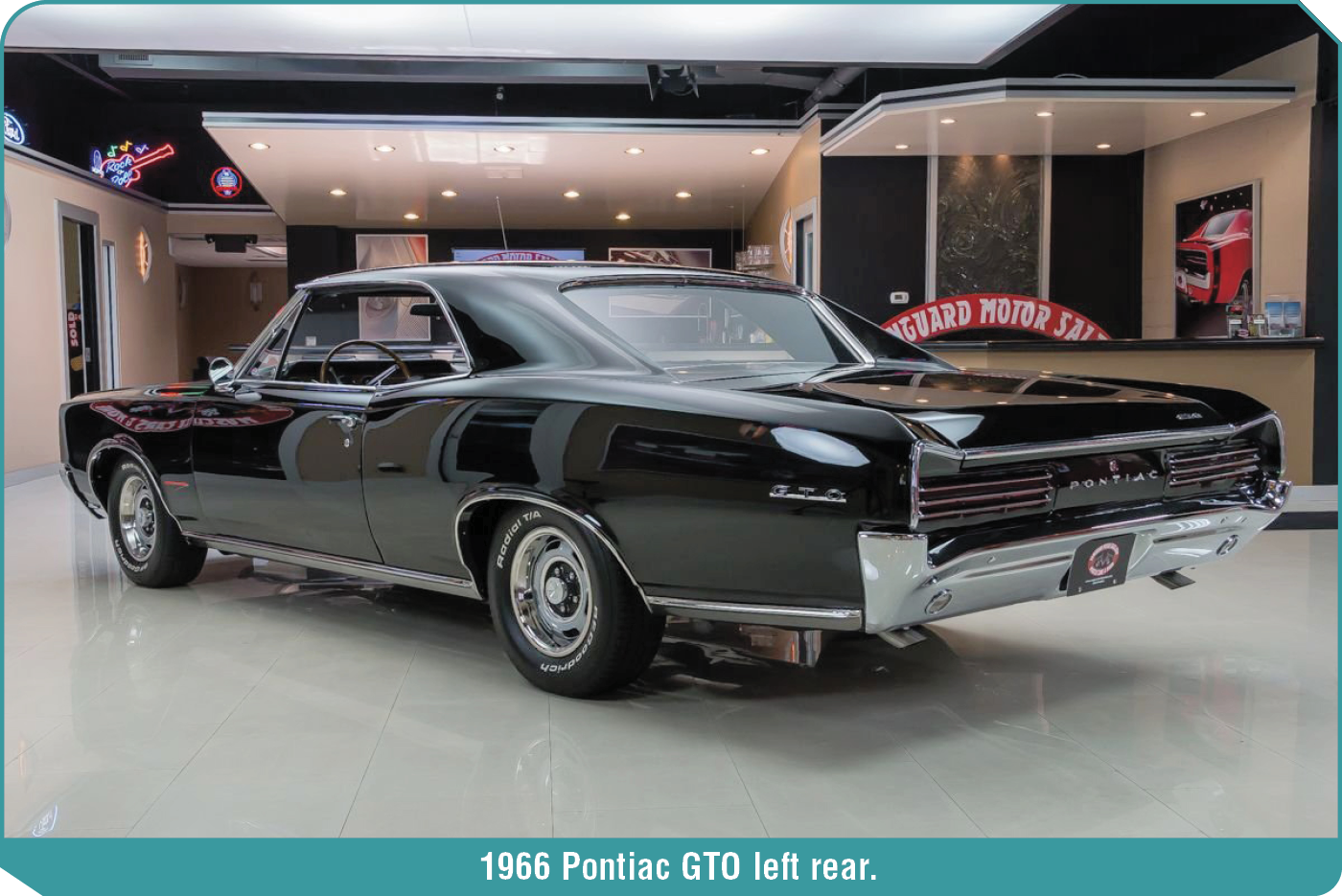
The 1966 Pontiac GTO is restrained aggression. Pontiac continued with the stacked headlights from ’65, redesigned the wire-mesh grille and smoothed out the body lines to give it a Coke-bottle profile. The subtle hood scoop, louvered taillights, and perfect fastback roofline make it look coiled. Our feature car, with Rally wheels, looks like it’s doing 60 mph standing still.
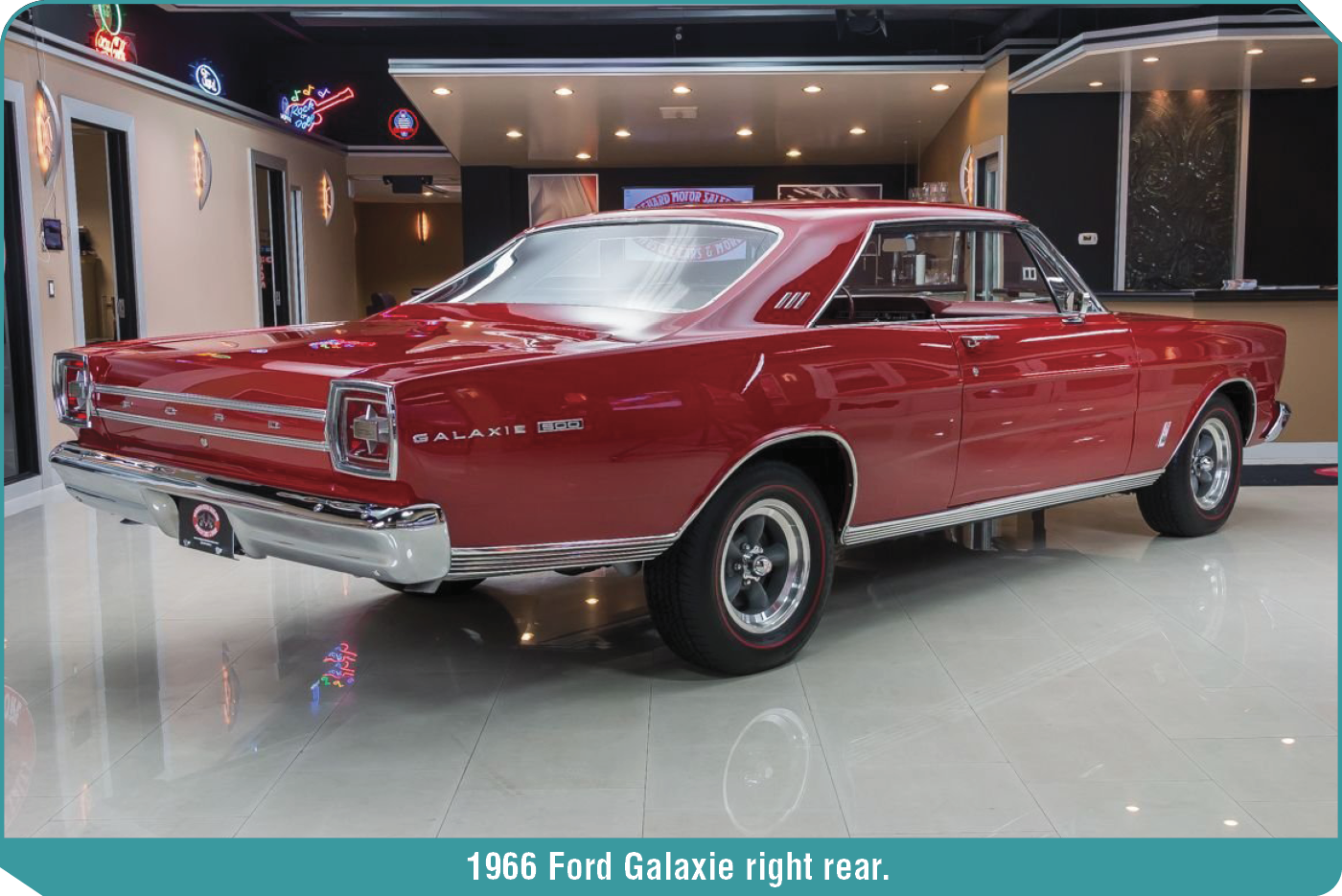
The 1966 Ford Galaxie is power and dignity. It retains the long, wide, formal roofline of Ford’s full-size platform. The front is bold with stacked headlights and a broad grille. The rear, with a broad stance and a clean decklid, looks stable and powerful — more luxury liner than performance car.
Where the GTO is lithe and muscular, the Galaxie is substantial and confident.
This reflects the brands. Pontiac, under John DeLorean, leaned toward youthful exuberance and Wide-Track attitude. Ford emphasized durability and comfort.
Inside the cabin, the two reveal different priorities.
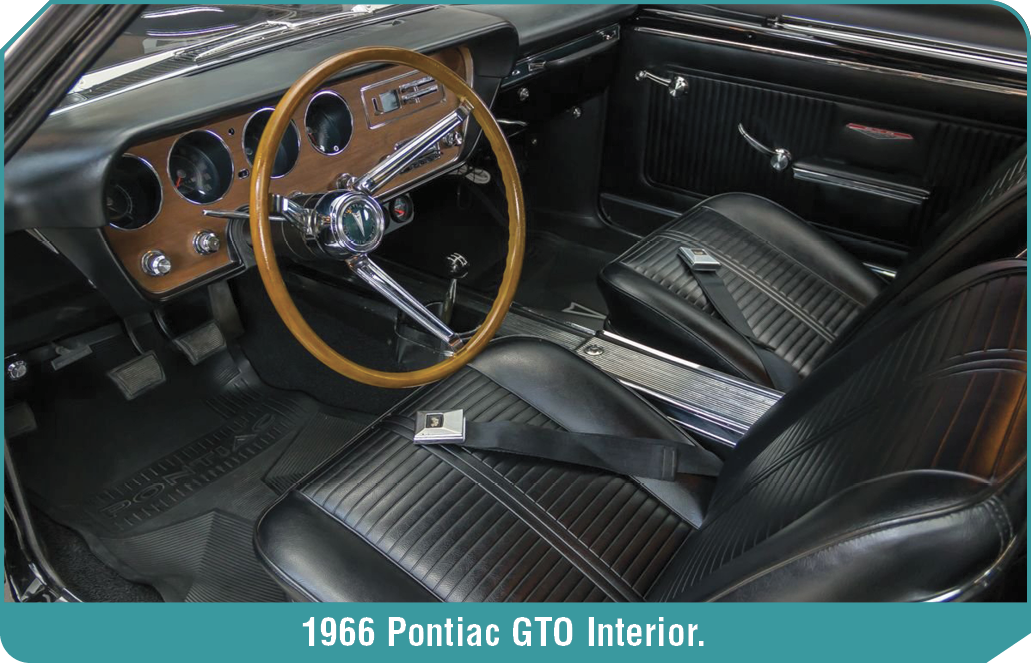
 The GTO was built as a cockpit. Walnut veneer on the dash, Rally gauges, engine-turned trim, and that Hurst shifter for the Muncie 4-speed all say driver’s car. Our feature car has Strato buckets in Morrokide vinyl. It wraps around you.
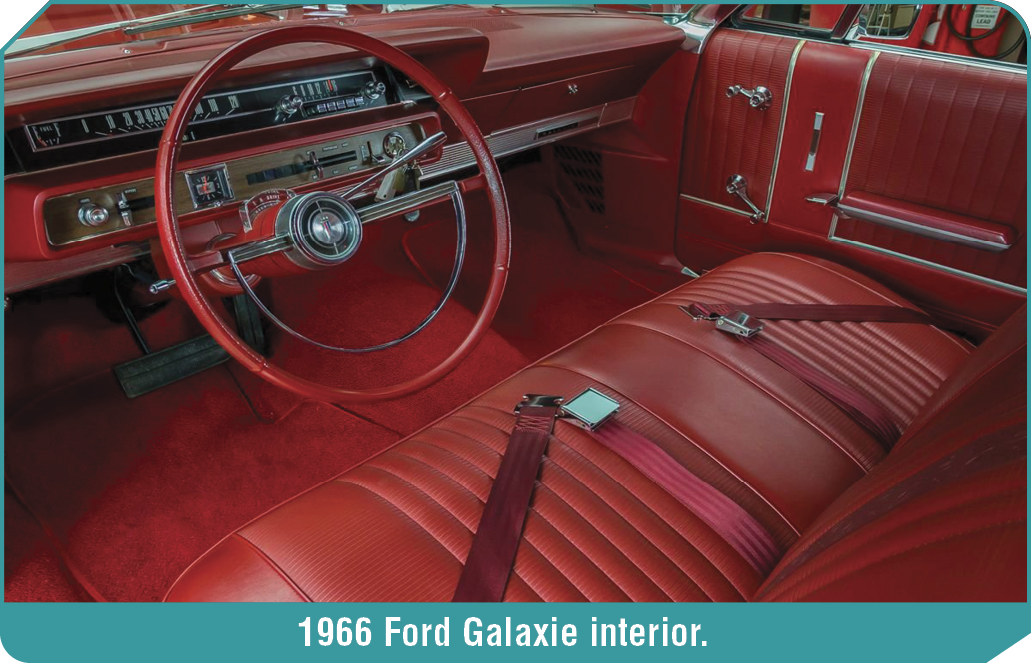
The Galaxie offered a more luxurious atmosphere. A broad, flat dash, easy-to-read gauges, and a big comfortable bench. Our 390 car has the Cruise-O-Matic on the column, leaving the bench wide open. The interior feels refined and mature — less frantic than the GTO but more comfortable.
Another advantage of the Galaxie was room. Full-size platform means limousine-like rear legroom and a trunk that swallows luggage. The Ford is the car you can live with. The Pontiac is the car you want to drive.
Under the hood, both delivered mid-sixties performance.
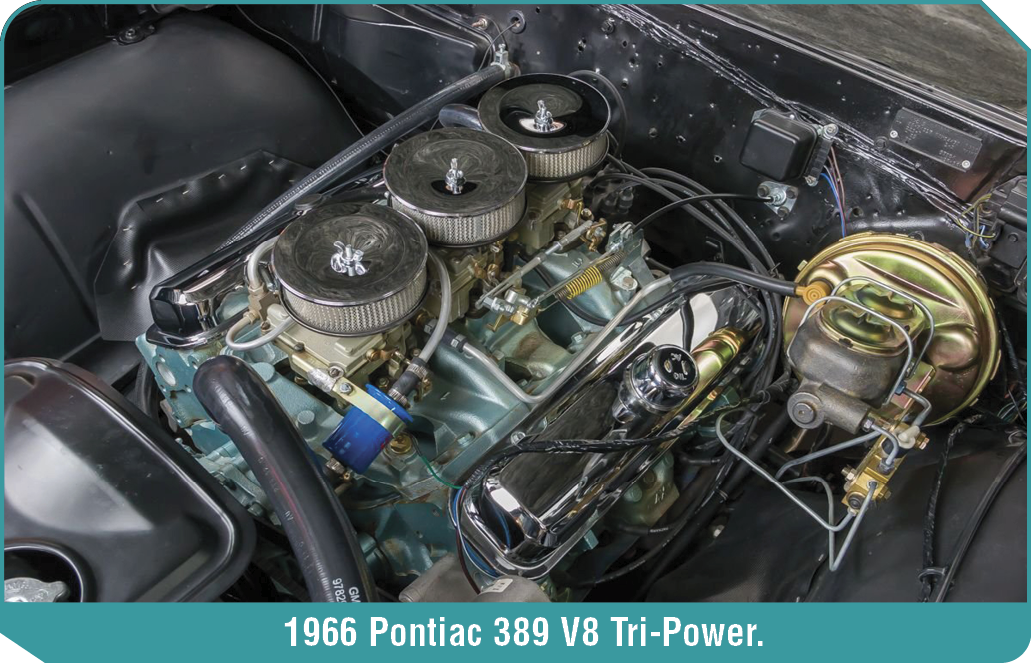
The GTO in this clash features the legendary 389 V8 with the iconic Tri- Power setup.
What makes this car special is the induction: three 2-barrel Rochester carburetors, more commonly known as Tri-Power, sitting atop that big V8.
Rated at 360 horsepower and 438 lb-ft of torque with Tri-Power, versus 335 horsepower with the single Carter AFB four-barrel, it was the engine to have. With 10.75:1 compression, it lives on premium and loves to rev. When the center carb is cruising and the front and rear open up, that roar is unforgettable.
Backed by the M21 close-ratio Muncie 4-speed and 3.55 Safe-T-Track rear, it’s a street brawler. Personally, I’ve always been a fan of the Muncie. That mechanical clunk from second to third as those three deuces open still gets me. It was one of the first units my father taught me how to rebuild.
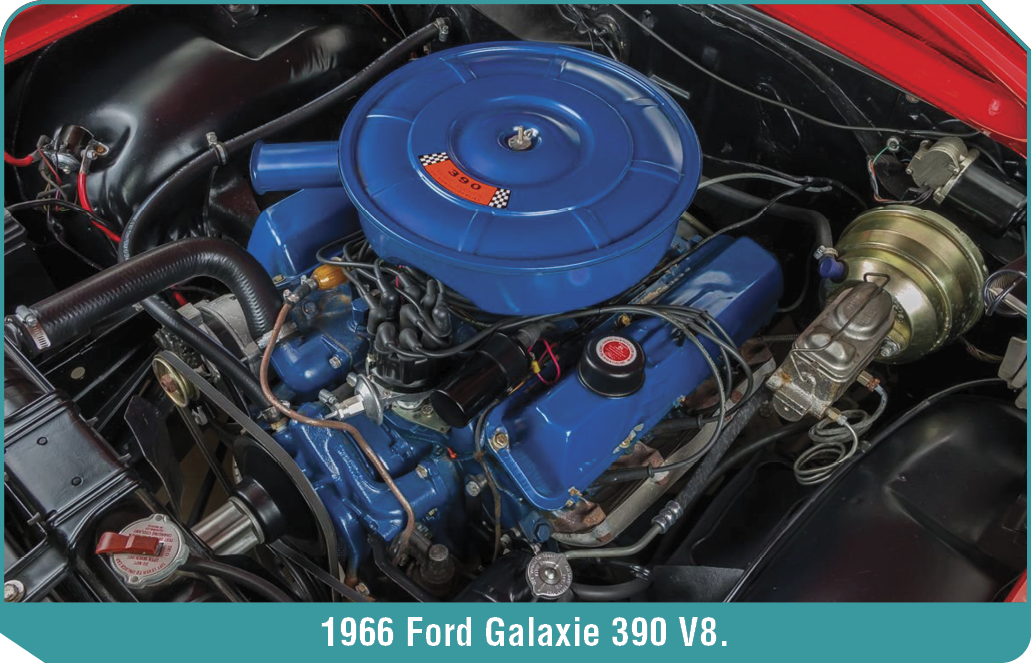
 The Galaxie offers its own muscle. The 390 FE big-block with 10.5:1 compression was rated at 315 horsepower with the four-barrel and 427 lb-ft at just 2800 rpm. It’s not a high-winder; it’s a locomotive.
Ford paired it with the durable Cruise-O-Matic 3-speed, no clutch to dump, just foot-to-the-floor and go.
On the road, the differences are clear. The GTO feels 500 pounds lighter — because it is. At about 3,500 pounds with a 115-inch wheelbase, it’s eager and instant on throttle.
The Galaxie, at nearly 4,000 pounds on a 119-inch wheelbase, favors smoothness. It settles into 70 mph with the 390 barely above idle. It’s not slow — about 8 seconds to 60 — but without drama. It breathes where the GTO shouts.
While both were marketed for performance, practicality mattered.
The GTO’s mid-size package meant tighter rear seat and decent trunk. The style and speed were worth it for most buyers.
 The Galaxie leaned toward practicality. More usable space and easier loading. The Galaxie behaved like a true family car that happened to be fast, while the GTO behaved like a factory hot rod that happened to have a back seat.
Sales tell the story.
The 1966 GTO was a massive success, with 96,946 units — the best-selling GTO year ever. But a Tri-Power, bucket-seat, 4-speed car was the one every kid wanted. The Tri-Power option was in its last year in ’66, which makes this setup even more desirable today.
Ford built about 225,000 Galaxie 390s across all body styles, but most were two-barrel automatics in four-door sedans. A two-door hardtop with the 390 four-barrel is much rarer today than you’d think.
Over time, the GTO became one of the most recognizable performance cars ever. Its status as the first true muscle car gave it mystique. Today it’s celebrated at shows and auctions worldwide.
 The Galaxie 390 occupies a quieter place. Because it was a full-size car, it never got the youth-market hype. Yet among enthusiasts who appreciate big Fords and FE power, the Galaxie has become highly respected.
Behind the wheel, both deliver relaxed mid-sixties charm.
The GTO feels light and alive. The Tri-Power 389 provides brutal acceleration, and its compact size makes it easy to place. People notice when a ’66 GTO rumbles by.
The Galaxie feels substantial. Its suspension favors comfort, and it cruises with confidence. Driving either today feels like stepping into a different era.
Among collectors, the GTO has achieved near-mythical status. Restored Tri-Power examples command strong prices and enjoy massive aftermarket support.
The Galaxie remains under the radar. That adds to its appeal. Because fewer people know it, finding one at a show feels like discovering a hidden gem. You can buy a beautiful Galaxie hardtop for less than half the price of a comparable GTO.
The 1966 GTO and 1966 Galaxie represent a fascinating chapter. Both blended practicality with performance in a way that defined the sixties. Both succeeded.
Today they remind us of a time when Detroit was willing to experiment — to blend torque with style and create vehicles that were as expressive as they were functional.
As I close for this month, I must admit I am biased toward the 1966 GTO.
I must also admit I am a huge fan of this ’66 Galaxie. I experienced a Wimbledon White XL survivor at Fabulous Fords Forever in So. Cal, and it was a highlight moment.
Now comes the time when we here at Clash of the Classics have to choose which car we like better and today the nod goes to the GTO. While both are iconic, it is the Pontiac Tri-Power that gets the checkered flag today.
As always, we’d love to hear from you, let us know which car you prefer and why.
Until next time when we take a ride on a classic highway, stay safe… stay timeless… stay classic.
About the Author
Donny Caccamise is an Automotive Technology Graduate and a Certified Master Technician with more than 40 years of automotive industry experience. Before retiring, he hosted the Nationally Syndicated Automotive Talk Radio Show “Horsepower for an Hour” airing on 161 AM and FM radio stations across the nation. He is a retired member of the ATRA Board of Directors, and retired transmission shop owner. Vintage and classic cars are his specialty. Contact Donny at donnycaccamise@gmail.com