A Nissan rolls into the shop with a familiar complaint. The customer says the transmission feels wrong. Maybe it surges on the highway. Maybe the RPM rises and falls at steady speed. Sometimes the complaint is harsh engagement, delayed response, or an unsettling jerk during acceleration.
For many technicians, the first instinct is predictable: the transmission is failing. But in today’s Nissan vehicles—especially those equipped with Continuously Variable Transmissions (CVTs)—that assumption can lead down an expensive and frustrating road. Increasingly, what feels like a transmission problem begins somewhere else entirely. It starts with an engine misfire.
For years, misfires were viewed almost exclusively as engine concerns. Rough idle, loss of power, ignition issues—solve the engine problem and move on. Modern drivetrains have changed that thinking. Engine and transmission systems no longer operate independently. They communicate constantly, sharing information and adjusting to one another in real time. That means when the engine stumbles, the transmission often stumbles with it.
The Transmission Depends on Trust
Modern Nissan transmissions rely heavily on stable engine torque. The engine control module (ECM) and transmission control module (TCM) exchange a steady stream of information involving load, throttle position, RPM, and torque demand. In a CVT, this communication becomes even more critical because ratio control depends on accurate torque calculations. In simple terms, the transmission expects consistency.
 A properly running engine delivers smooth, predictable power. A misfiring engine does not. When combustion becomes irregular, the transmission is suddenly forced to react to unstable input. The result is often a collection of symptoms that look suspiciously like internal transmission failure. That is where diagnostic trouble begins.
A vehicle experiencing intermittent misfire may surge, hesitate, or display delayed engagement. CVTs may begin hunting for ratio, producing fluctuating RPM or a sensation that the transmission cannot decide where to operate. To the driver—and sometimes to the technician—those symptoms sound like classic transmission failure. But appearances can be deceiving.
One of the most important lessons in modern diagnostics is this: A transmission cannot compensate for unstable engine torque. Ignoring that reality can lead to unnecessary repairs and costly mistakes.
When Misfires Become Mechanical Problems
The effects of misfires extend beyond drivability. Every combustion event creates torque. Under normal conditions, those torque pulses are smooth and controlled. A misfire interrupts that pattern, creating uneven torsional input that travels directly into the drivetrain. Inside a transmission, those disturbances matter.
Instead of receiving steady rotational force, internal components absorb repeated shock loading. Belts, pulleys, friction elements, and hydraulic systems must continually react to erratic input. An occasional misfire may create little more than a complaint. A long-term misfire can create wear.
Over time, technicians may encounter degraded friction materials, declining pump efficiency, and shortened component life. What began as an engine problem slowly evolves into genuine transmission damage.
More Misfires = More Heat
Heat often accelerates the process. Misfires increase thermal load throughout the drivetrain, and excessive temperature remains one of the most destructive forces inside any transmission. As temperatures climb, fluid begins to oxidize and lose viscosity.
In a Nissan CVT, fluid condition is not merely a maintenance concern— it is central to transmission function. Degraded fluid compromises hydraulic efficiency and weakens the belt traction necessary for stable ratio control. Once that happens, drivability complaints intensify and diagnosis becomes even more confusing.
The transmission may appear to be failing because, by this stage, it partially is. The key question becomes why.
The Electronics Can Be Misled Too
Modern vehicles do not simply respond to mechanical conditions—they interpret them. Misfires distort the data the control modules depend upon. Engine load calculations become inaccurate. Torque modeling loses precision. Adaptive learning strategies begin making decisions based on faulty information. The result can be misleading.
Technicians may encounter erratic solenoid behavior, pressure control irregularities, or transmission codes that point toward internal electrical faults. Yet the transmission itself may be functioning exactly as designed. It is simply reacting to bad information. This creates one of the most common and expensive diagnostic traps in the industry.
Many so-called “bad CVTs” are replaced not because the transmission failed first, but because unresolved misfire history altered adaptive strategy and created symptoms that mimicked failure. The transmission becomes the suspect while the engine remains the real culprit.
Following the Evidence
When drivability and shifting complaints appear together, diagnosis should begin with a simple question: Is the transmission reacting to a problem—or causing it?
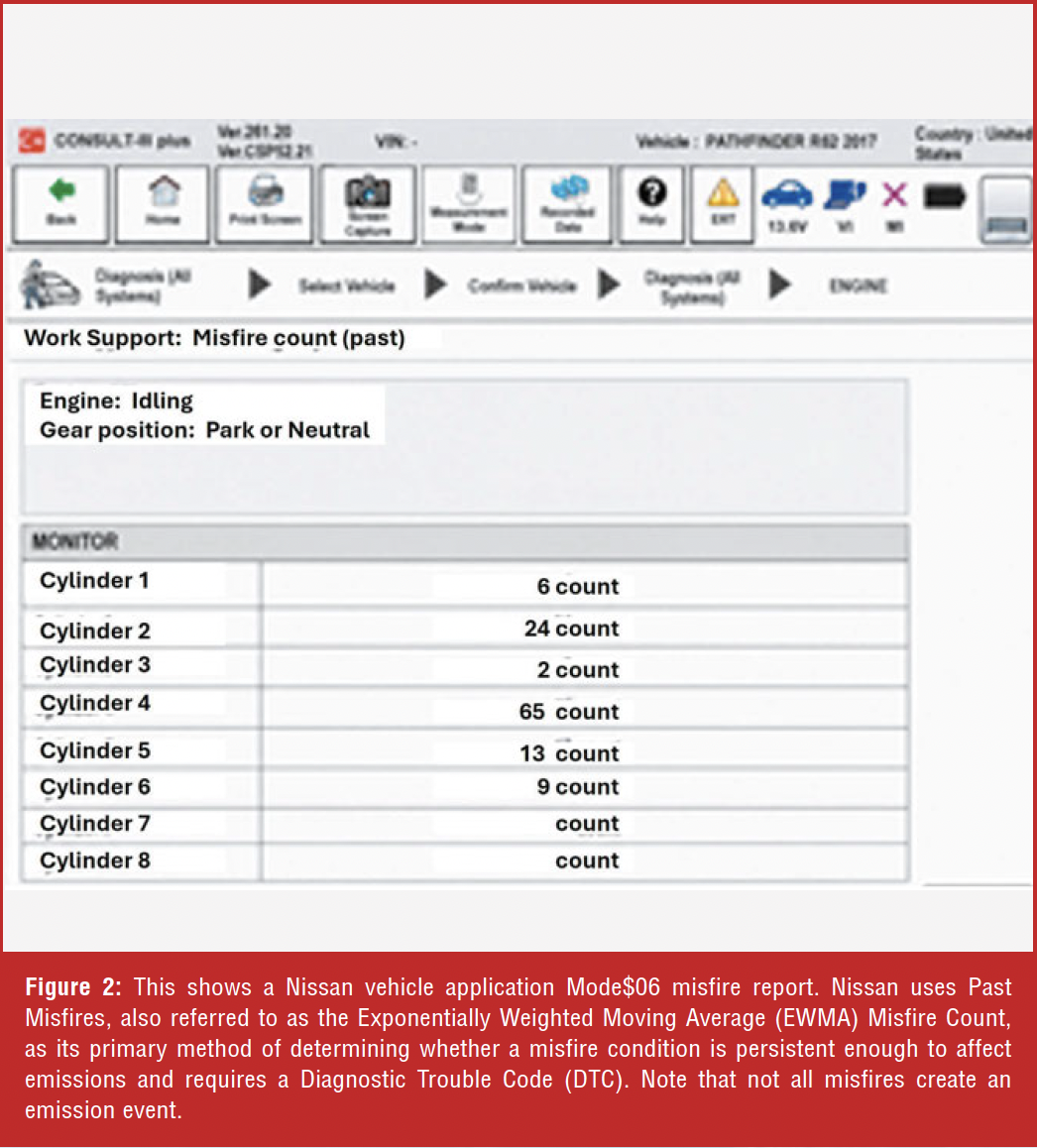
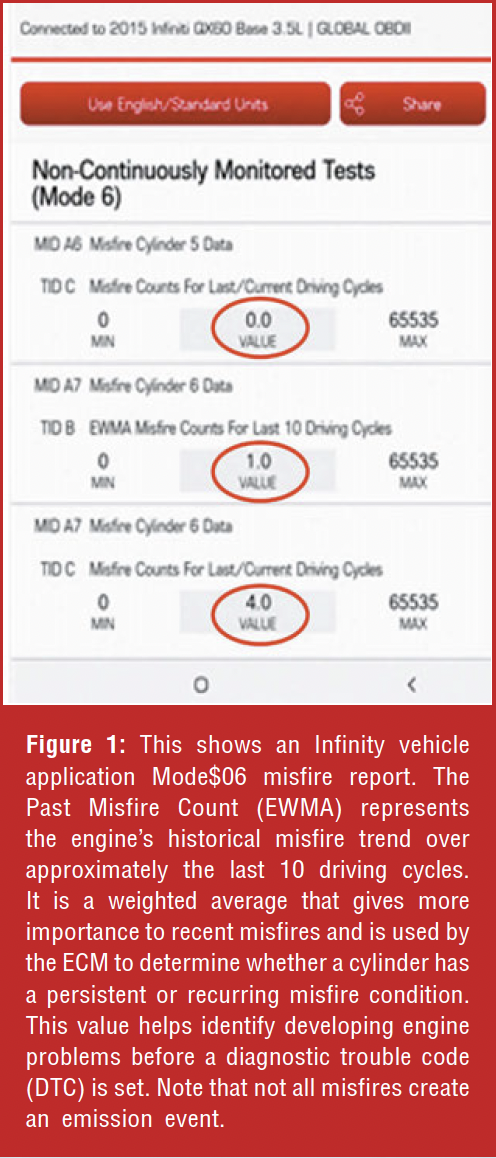 The answer often emerges through disciplined testing. Checking ECM and TCM codes is only the starting point. Misfire history, freeze-frame information, and Mode $06 data can reveal intermittent events that no longer trigger active fault codes (Figures 1 and 2). See the addendum for important information on Mode $06 data.
Ignition systems deserve careful inspection. Weak coils, worn plugs, and fuel delivery imbalances frequently hide behind complaints initially blamed on the transmission.
Engine integrity matters too. Low compression or valve leakage changes torque production in ways no adaptive strategy can fully overcome. Only after engine performance is verified should technicians move deeper into transmission diagnosis. Skipping that sequence invites misdiagnosis.
What the Shop Floor Teaches Us
Real-world cases make the lesson impossible to ignore. One 2017 Nissan Altima arrived with surging and unstable RPM at cruise speed. The dealership had already reached its conclusion: failed CVT. Yet the transmission showed no active fault codes.
 A deeper look uncovered stored misfire history on cylinder #3 and an ignition coil that failed intermittently under load. After replacing the coil and clearing adaptive memory, the transmission returned to completely normal operation. No CVT replacement. No overhaul. No transmission repair at all.
Another case told a different story. A 2016 Nissan Murano entered the shop with slipping and overheating complaints. Unlike the Altima, this vehicle had endured a prolonged unresolved misfire condition. Inspection revealed burnt CVT fluid and significant belt and pulley wear.
This time, transmission damage was real, but it was not primary failure. The misfire had created prolonged mechanical and thermal stress that eventually damaged the transmission itself. By the time repairs were considered, the warranty claim was denied because the damage originated from an unresolved engine issue.
Then there are the electrical ghosts. A 2018 Sentra produced erratic shifting and multiple solenoid-related codes that initially suggested internal electrical failure. Instead, diagnosis revealed a fuel injector causing misfire under load and corrupting sensor input.
The injector was repaired, the codes cleared and did not return, and the transmission was untouched. The vehicle was fixed.
Cases like these reinforce an uncomfortable but important reality: symptoms and causes are not always the same thing.
Why Documentation Matters
Transmission diagnosis does not end at repair. Warranty outcomes increasingly depend on proving causation.
Nissan warranty programs—including various CVT coverage extensions— typically protect against defects in components such as the transmission assembly, valve body, and torque converter. However, failures tied to pre-existing conditions or unresolved maintenance concerns often fall outside coverage. That distinction matters.
If documentation shows that an engine misfire contributed to transmission damage, the failure may be classified as secondary rather than defective. The result can be claim denial.
For technicians and rebuilders, documentation becomes more than paperwork—it becomes protection. Diagnostic codes, repair history, live data, and testing records may ultimately determine whether a repair is reimbursed or rejected.
The Bigger Picture
Engine misfires are no longer isolated engine events. In Nissan vehicles— particularly those using CVTs—they are drivetrain events with the potential to reshape diagnosis, repair decisions, and warranty outcomes. That reality challenges technicians to think differently. The temptation to condemn a transmission based solely on symptoms remains strong. Yet accurate diagnosis demands patience and a systems-based approach.
The transmission may be speaking loudly, but sometimes the engine started the conversation.
ADDENDUM
Mode $06 – Actual Misfire Counts
Mode $06 actual misfire counts represent only a snapshot of engine operation at the time the test is performed. The counts displayed by the scan tool are the number of misfires detected during that specific reporting interval and do not represent the total number of misfires occurring throughout the engine’s operation or during the entire trip.
Disconnecting the scan tool does not stop the engine from misfiring. If the underlying cause—such as ignition, fuel delivery, mechanical, or air-fuel control faults—remains unresolved, the engine will continue to misfire whether or not a scan tool is connected.
Therefore, documented Mode $06 actual misfire counts should be viewed as evidence of an ongoing engine performance problem, not as isolated events. The scan merely captures a portion of the misfire activity occurring at that moment. Unless the root cause is diagnosed and repaired, the misfires will continue throughout vehicle operation, producing repeated engine torque disturbances that can adversely affect transmission operation, diagnosis, and warranty evaluation.
The presence of documented Mode $06 misfires demonstrates that an unresolved engine performance condition existed before transmission installation. Unless the underlying cause is corrected, the engine will continue to produce intermittent torque disturbances during operation. Installing a remanufactured CVT into a vehicle with an unresolved engine performance problem subjects the transmission to operating conditions outside those expected for normal service and prevents a valid evaluation of transmission performance.
Pre-Existing Engine Performance Condition
The presence of documented Mode $06 engine misfires confirms that an unresolved engine performance condition existed prior to transmission installation. These misfires are not isolated events but evidence of an ongoing combustion irregularity that will continue until the underlying cause is diagnosed and repaired. As the engine continues to operate, it produces intermittent torque disturbances that are transmitted directly to the CVT.
A Nissan CVT is designed to operate with a properly functioning engine that delivers smooth and consistent torque. Installing a new or remanufactured transmission into a vehicle with unresolved engine performance faults subject the transmission to operating conditions outside those expected for normal service. These abnormal operating conditions can adversely affect transmission performance, adaptation, diagnosis, and long-term durability, while also compromising the ability to accurately evaluate the performance of a replacement transmission.
For these reasons, documented engine performance faults, including Mode $06 misfire activity, are considered pre-existing conditions and must be corrected before transmission installation. Failure to repair these conditions prior to installation may result in continued drivability concerns, inaccurate transmission diagnosis, and may affect warranty eligibility.