
If you run a transmission repair shop or manage a busy service center, the last few months have likely tested your inventory management skills. You are probably seeing higher wholesale fluid costs, tighter allocations from your distributors, and frustrating delays when trying to source specific ultra-low-viscosity (ULV) fluids for modern 10-speed rebuilds.
The 2026 lubricant shortage is not just a sensational headline; it is a very real supply chain disruption hitting the automotive repair sector where it hurts most—the fluids required to keep high-ticket repairs moving out the door. However, while the shortage of synthetic transmission fluids and engine oils is actively disrupting daily operations, it is not a permanent crisis.
For shop owners, service advisors, and lead technicians, understanding exactly what is causing this bottleneck is the first step toward managing customer expectations, protecting profit margins, and avoiding costly comebacks. Here is the operational breakdown of the 2026 fluid shortage, how the industry is fixing it, and what your shop needs to do right now.
The Root Cause: The Group III Base Oil Bottleneck
To explain the current price spikes to an agitated customer at the service desk, you need to understand the supply chain. The current shortage is fundamentally a base oil problem, specifically regarding Group III base oils.
As any master technician knows, a finished transmission fluid is a carefully balanced blend of base oil and additive packages (friction modifiers, anti-foam agents, antioxidants). The base oil makes up most of the volume. While older vehicles can get by on conventional Group I or Group II base stocks, modern high-performance and ultra-efficient transmissions demand Group III base oils. These are severely hydrocracked, highly refined stocks that offer the performance of a full synthetic.
Historically, the United States has imported roughly 44% of its Group III base oil from massive refining facilities in the Middle East (specifically Qatar, the UAE, and Bahrain). In early 2026, geopolitical conflicts and targeted attacks on regional energy infrastructure knocked a massive portion of this production offline. At the same time, severe shipping disruptions in the Strait of Hormuz trapped whatever oil was successfully refined.
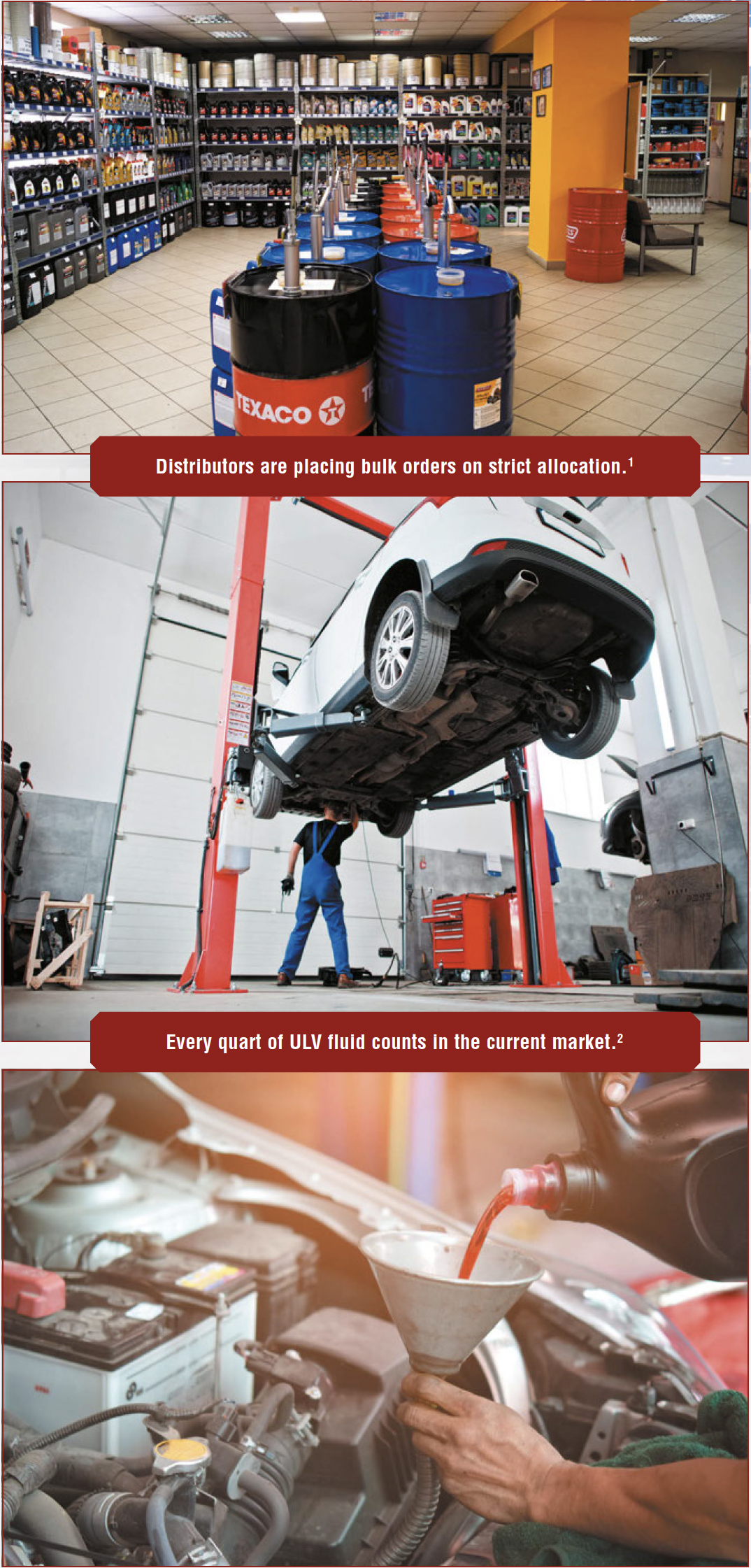 Because 60% of the world’s Group III base oil goes directly into automotive applications, the transmission and engine repair industries felt the impact almost instantly. Wholesale prices for full synthetic base stocks skyrocketed by over $5.00 a gallon, and major distributors were immediately placed on allocation.
The ULV Squeeze: Why 10-Speeds are Grounded
Not all fluids are equally affected. If you are servicing an older 4-speed that takes standard DEXRON III/MERCON, your distributor probably has drums readily available. The severe squeeze is happening at the bleeding edge of transmission technology: Ultra-Low- Viscosity (ULV) fluids.
Over the last several years, automakers like Ford and General Motors co-developed 9- and 10-speed architectures (like the Ford 10R80 and GM 10L90) designed to meet strict CAFE fuel economy standards. These transmissions are incredibly sophisticated, featuring tightly packed clutch arrays and highly sensitive valve bodies. To reduce internal parasitic drag, they require remarkably thin ULV fluids.
Creating a fluid thin enough to maximize fuel economy but robust enough to prevent metal-on-metal gear shearing requires the highest-quality Group III base oils. Because these base stocks are currently the hardest to source, ULV fluids—such as Ford MERCON ULV and GM DEXRON ULV—are the hardest products to keep on your shop’s shelves.
The Industry Roadmap to Recovery
The good news is that the lubricant industry is not sitting idle. Massive regulatory and production shifts are currently underway to stabilize the market.
The Independent Lubricant Manufacturers Association (ILMA) recently invoked emergency force majeure provisions with the American Petroleum Institute (API). This emergency flexibility allows fluid blenders to temporarily adjust their chemical formulations— substituting slightly different base stocks where safe—without losing their vital OEM certifications. Furthermore, manufacturers are actively prioritizing their production lines, pausing low-volume specialty fluids to maximize the output of critical transmission and engine oils.
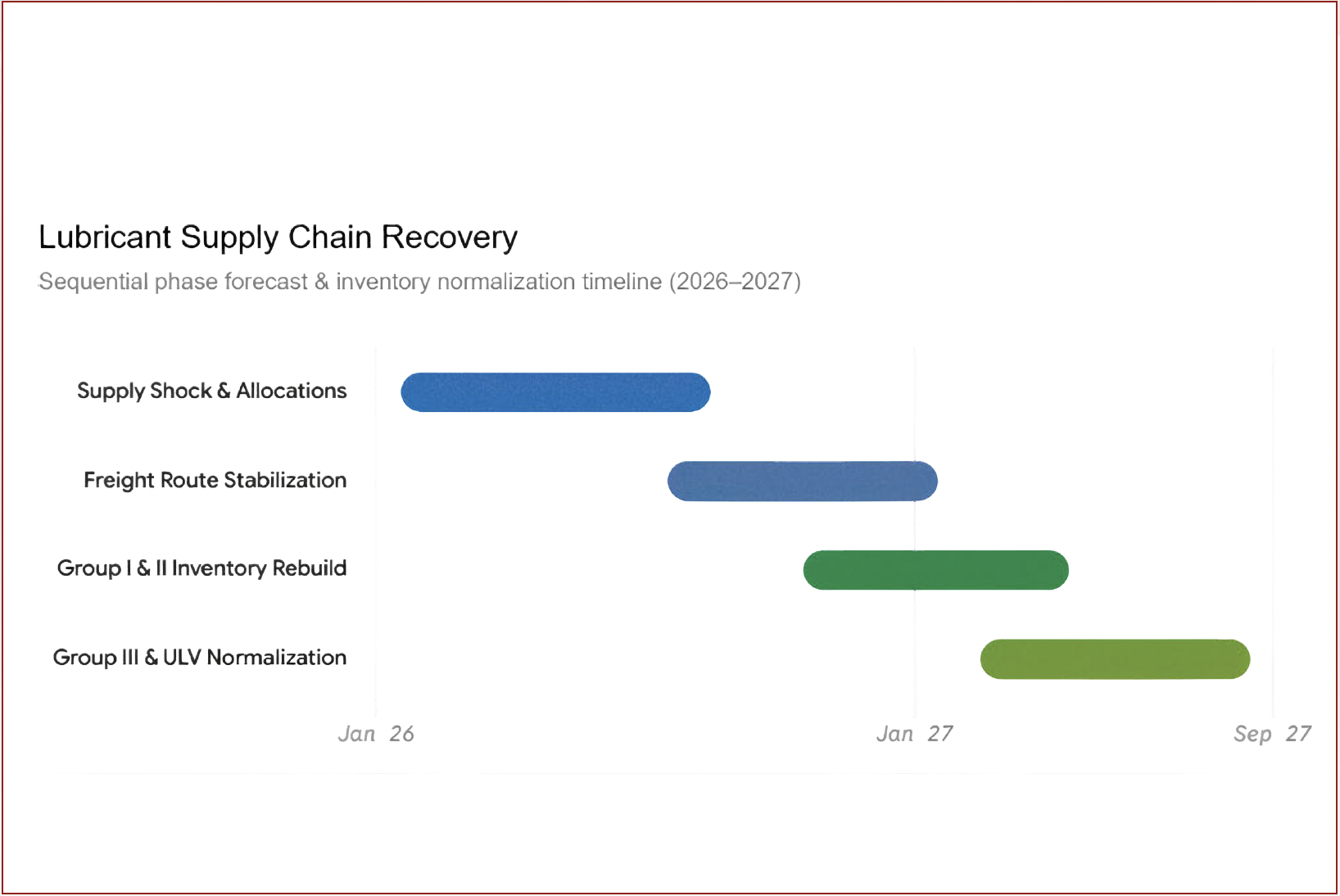
While these measures are preventing a total market dry-up, a full recovery will take time. The industry expects a phased stabilization roadmap stretching into mid-2027.
The Shop Takeaway: Expect distributor allocations for premium ULV fluids through the first half of 2027. Standard fluids will normalize much sooner.
Actionable Strategies for the Shop Floor
Waiting for the global supply chain to fix itself is not a business strategy. To keep your technicians turning wrenches and your bays profitable through 2027, you must adapt your operations immediately.
1. Master Your Distributor Allocations
Most major lubricant distributors have moved to an allocation model, meaning they will only sell you fluid based on your historical purchasing volume. You cannot suddenly order double your usual amount of MERCON ULV.
- Action: Audit your upcoming schedule daily. If you see a heavy run of 10-speed rebuilds or fluid exchanges on the books for next week, secure that specific fluid allocation today. Treat your ULV allocation like gold—do not waste it on a customer who might not show up.
 2. Segment Your Fluid Usage Strictly
During times of abundance, some shops adopt a “one premium fluid fits all” approach to simplify inventory, using a high-end multi-vehicle synthetic for almost every car that rolls in. That strategy will destroy your margins today.
- Action: Segment your fluids. Use standard, more widely available fluids (that still meet the vehicle’s spec) for older 4- and 6-speed units. Reserve your premium, constrained ULV fluids only for modern vehicles that explicitly mandate them.
3. Arm Your Service Advisors
Your service advisors are on the front lines of customer frustration. When a standard transmission fluid exchange suddenly costs 20% more than it did a year ago, customers will push back.
- Action: Train your advisors to explain “the why”. Have them briefly mention the global synthetic base oil shortage. Customers generally understand supply chain issues when you explain them transparently. More importantly, advisors emphasize that skimping on fluid quality to save $40 today could result in a $6,000 transmission replacement tomorrow.
4. Zero Tolerance for “Viscosity Matching”
 This is the most critical technical directive you can give your shop right now: Do not substitute fluids based on viscosity alone.
When the parts room is out of a specific OEM-mandated ULV fluid, a well-meaning technician might be tempted to grab a different brand’s ULV product or a generic 0W-20, assuming “thin is thin.”
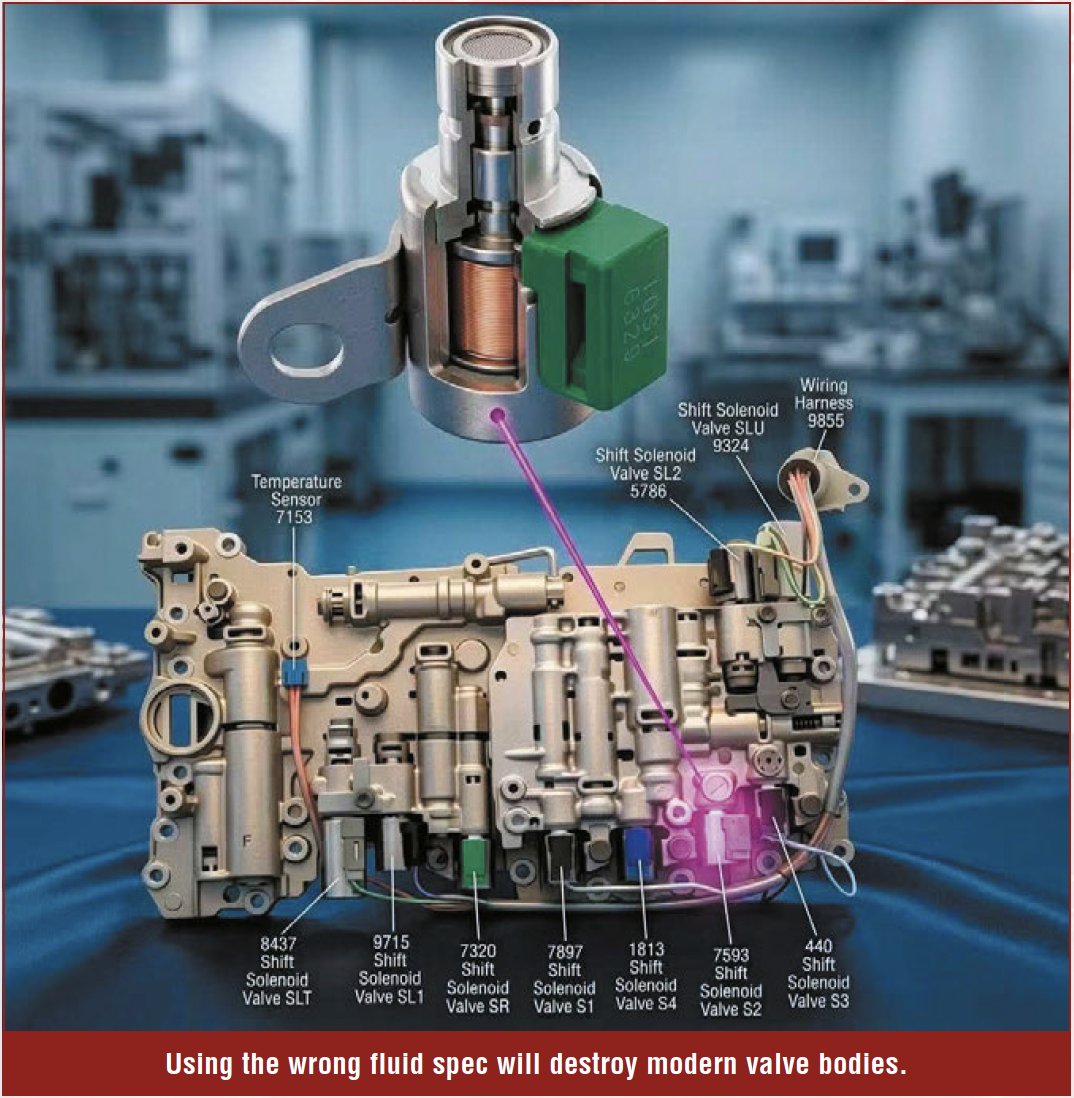
- Action: Enforce a zero-tolerance policy on unauthorized fluid substitutions. Modern transmission clutches and valve bodies require highly specific friction modifiers to engage properly. Pouring the wrong chemical package into a 10L90 will cause harsh shifting, torque converter shudder, and ultimately, catastrophic clutch failure. A comeback on a modern 10-speed will instantly wipe out a week of your shop’s profit. If you cannot source the exact mandated spec, turn the job down or delay it. It is not worth the liability.
The 2026 fluid shortage is a rigorous stress test for independent auto repair shops. However, by communicating transparently with your customers, closely managing your distributor allocations, and holding the line on strict OEM fluid specifications, your shop can navigate this bottleneck successfully and emerge stronger when the market normalizes next year.
1. Source: Sinopec / SAE 50 MOTOR OIL PRICE BY BARREL | $649.00 | 55 GALLON DRUM | FLORIDA
2. Source: McCormick Automotive Center / Transmission Fluid Change Services in Fort Collins – McCormick