Everywhere you look these days, people are talking about “shop culture.” Some shops proudly say they have a great culture. Others say they’re trying to improve theirs. Consultants teach it. Owners chase it. Employees look for it. Customers can feel it.
In fact, it’s the theme of this year’s Powertrain Expo. You won’t want to miss any of the management sessions because they’ll each deal with one or more of the points in this article.
But I think we sometimes misunderstand what culture really is.
- Culture isn’t a slogan on the wall.
- It isn’t free pizza on Fridays.
- It isn’t motivational posters, team shirts, or management saying, “We’re family here.”
These things may contribute to the atmosphere, but they don’t create culture.
Every shop already has a culture = whether intentional or accidental. The question is: What is that culture built upon?
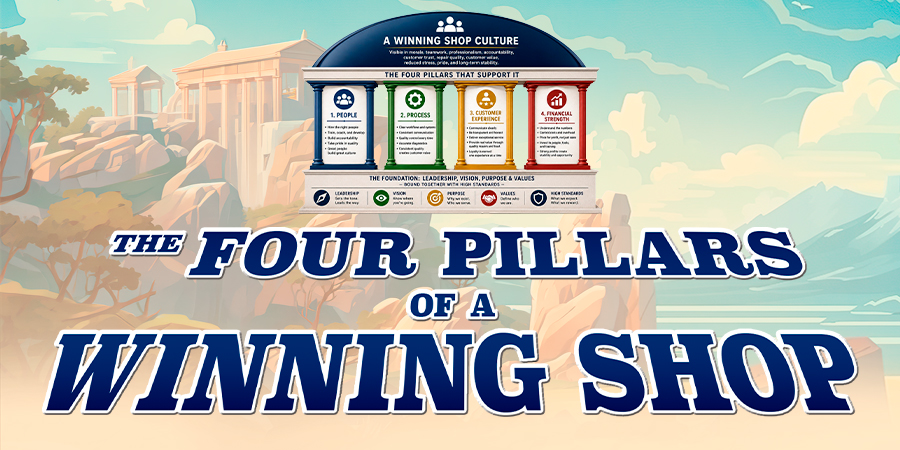
A Winning Culture is what naturally develops when the underlying structure of the business is healthy and aligned. Using a dome supported by four pillars serves as a great metaphor for this discussion. In this example, culture is not a pillar. Culture is the dome supported by four pillars.
I’ve come to believe that every successful repair shop rests on four foundational pillars. When those pillars are strong and working together, they support something much bigger than productivity or profitability alone – a winning shop culture.
But when one or more pillars weaken, cracks begin to appear in the culture overhead. Morale suffers. Communication breaks down. Stress rises. Customers feel it. Employees feel it. Eventually, the owner feels buried beneath it.
The four pillars are:
- People
- Process
- Customer Experience
- Financial Strength
And underneath all of them is the foundation: Leadership, Vision, Purpose, and Values bound together with High Standards.
Without that foundation, even the strongest pillars eventually begin to shift.
The Foundation Comes First
As with any building, without a solid foundation, the structure is jeopardized from the start. So, before we talk about the pillars, we need to talk about the foundation.
Leadership sets the tone. Leadership defines what matters, what behaviors are acceptable, what standards are non-negotiable, and ultimately what kind of environment people experience every day.
If leadership tolerates gossip, excuses, finger-pointing, chronic lateness, poor communication, or disrespect, those things become part of the culture.
If leadership demonstrates accountability, transparency, consistency, professionalism, and care for both customers and employees, those things become part of the culture too.
The foundation determines whether the structure above it stands strong or slowly sinks under its own weight.
Pillar One: People
The first pillar is people. That may sound obvious, but many shops still treat hiring as an emergency response rather than a long-term strategy. When someone quits, retires, or gets fired, panic sets in. The shop scrambles to fill the opening with whoever happens to fog a mirror and own a toolbox. Then months later the owner wonders why morale is poor, drama is high, production is inconsistent, and accountability is difficult.
Great cultures are built intentionally with the right people. Not perfect people. Not superstar people. The right people. People who are coachable. People who care. People who embrace accountability. People who understand that they are part of something bigger than themselves.
A winning culture requires both competence and character. You can sometimes train skills, but character is harder. The truth is that one toxic employee can damage an otherwise healthy culture faster than most owners realize. Negative attitudes spread quickly in a repair shop environment. Complaining becomes contagious. Cynicism grows. Standards slip.
On the other hand, strong people elevate everyone around them. And one of the greatest ways employees elevate the culture is by taking pride in the quality of the work they produce.
Quality repairs create confidence inside the shop. Technicians sleep better at night when they know the vehicle was repaired properly. Service advisors communicate more confidently when they trust the work leaving the bays. Managers spend less time putting out fires. Customers experience fewer breakdowns, fewer frustrations, and fewer repeat visits for unresolved problems.
Quality workmanship reduces stress throughout the entire organization. That’s why recruiting should never stop. Training should never stop. Coaching should never stop. Communication should never stop. Culture is built daily through people.
Pillar Two: Process
Even great people struggle inside broken systems. That’s where the second pillar comes in – Process.
One of the biggest stress creators in repair shops is uncertainty.
- Who’s doing what?
- What’s waiting for authorization?
- Did the parts arrive?
- Who talked to the customer?
- What was said?
- Was the inspection completed?
- Did anyone road test the vehicle?
- Why is that car still sitting there?
Without clear process, the shop becomes reactive instead of proactive. Everyone spends the day putting out fires. And when people spend all day fighting chaos, culture suffers.
Good process creates clarity. Now, when I say “process,” some people immediately picture bureaucracy, paperwork, and rigid systems that slow everything down. That’s not what I’m talking about. Good process actually creates freedom by systematizing flow.
Good process and systems reduce wasted motion, confusion, comebacks, interruptions, and unnecessary stress. This helps good people perform consistently at a high level. And perhaps most importantly, good process improves repair quality.
- Consistent diagnostic procedures reduce guessing.
- Thorough inspections uncover related concerns before they become bigger problems.
- Quality-control procedures reduce comebacks.
- Proper documentation improves communication between technicians, service advisors, and customers.
The most expensive repair is often not the one that costs the most upfront. It’s the repair that doesn’t fix the problem. Accurate diagnostics, proper procedures, and consistent quality control create value for the customer because they reduce wasted time, unnecessary expense, frustration, and repeat failures.
Think about the shops with the strongest cultures you’ve ever visited. Chances are they weren’t chaotic. They were organized. Predictable. Intentional. Everyone understood the workflow from the curb to the counter, to the bay, and back again.
Vehicles moved through the process efficiently. Communication was clear. Expectations were known. Problems were addressed early instead of becoming emergencies later.
That kind of operational consistency creates emotional stability inside the shop. And emotional stability is one of the hidden ingredients of a healthy culture.
Pillar Three: Customer Experience
The third pillar, Customer Experience, may be the most misunderstood.
Many shops still view themselves primarily as repair businesses. I understand that. After all, we repair vehicles. But, as I discussed in my previous article, I’ve become increasingly convinced that every business serving consumers is really in the hospitality business – especially ours.
Think about what customers experience when they bring us their vehicle.
- Fear
- Uncertainty
- Inconvenience
- Confusion
- Financial anxiety
- Loss of transportation
- Distrust from past experiences elsewhere.
Customers don’t wake up excited about transmission repairs or automotive service, in general. And unlike many retail purchases, they usually don’t know whether the repair recommendations are reasonable, necessary, or even accurate.
That means trust becomes everything A winning shop culture understands and accepts this. It understands that customer experience is not just about fixing cars. It’s about reducing fear and its byproducts. That happens through communication, transparency, empathy, professionalism, and consistency.
Customers want to know:
- What’s wrong?
- Why did it happen?
- What will it take to fix it?
- How long will it take?
- What will it cost?
- Can they trust you?
And ultimately, customers want value. Not necessarily the cheapest price, but Value. Their experience is what they’ll use to determine if they got value.
They want confidence that the repair was accurate, necessary, and performed correctly. They want reliability. They want durability. They want honesty. They want to know if their money solved the problem rather than simply buying another temporary inconvenience.
When customers feel informed and respected, trust grows. When trust grows, loyalty grows.
And here’s an added benefit. Employees tend to enjoy their jobs more when customers are happy. Good customer relationships reduce tension inside the shop. Employees experience fewer confrontations, fewer misunderstandings, and fewer emotional collisions throughout the day. In many ways, healthy customer relationships become emotional fuel for the team.
That’s why customer experience doesn’t just affect sales. It affects culture.
Pillar Four: Financial Strength
The fourth pillar is financial strength. This is often the least discussed pillar in culture conversations, yet it may be the pillar that ultimately determines whether the other pillars survive long-term.
If you’re reading this while you’re at Expo, be sure to attend my session Friday morning at 11:30, Winning Culture from the Curb and Back Again – How Understanding Profitability Creates Winning Teams.
Weak finances create pressure. Pressure affects decision-making. Under financial stress, owners become reactive. They cut corners. Delay investments. Postpone training. Underpay employees. Ignore equipment needs. Accept the wrong customers. Tolerate the wrong employees. Eventually, desperation begins driving decisions instead of leadership.
Employees feel this pressure too. In shops with poor financial health, tension rises quickly. Everyone feels rushed. Mistakes increase. Patience disappears. Trust erodes.
Ironically, financial weakness often leads directly to declining repair quality and reduced customer value. Shops begin making short-term decisions instead of long-term decisions. Corners get cut. Inferior parts get used. Proper diagnostic time gets squeezed. Training gets postponed. Quality-control steps get skipped. That eventually damages both the customer experience and the culture inside the building.
Healthy finances create stability. Financial strength allows a shop to:
- invest in training,
- purchase better equipment,
- attract stronger employees,
- improve customer experience,
- maintain quality,
- stand behind repairs,
- and plan.
But financial strength also requires education and transparency. One of the biggest disconnects inside many shops is that employees often don’t understand how the business actually works financially. Some assume that gross profit on one large job equals pure profit for the owner.
They don’t see:
- overhead,
- insurance,
- utilities,
- equipment,
- taxes,
- software,
- benefits,
- training,
- advertising,
- building costs,
- comebacks,
- interruptions,
- or unproductive time.
Without understanding financial reality, employees sometimes create their own narratives – and those narratives are usually inaccurate. That’s why I believe owners should help employees understand the business side of the operation. Not necessarily every detail, but enough to understand where paychecks come from.
Profit is not the enemy. In fact, profit is what allows the shop to survive, grow, improve, reinvest, and create opportunities for everyone. A financially healthy shop creates a healthier culture.
The Dome of a Winning Culture
When these four pillars are strong and aligned, they support something powerful overhead:
A winning culture.
That culture becomes visible in:
- morale,
- teamwork,
- professionalism,
- accountability,
- customer trust,
- consistency,
- repair quality,
- customer value,
- reduced stress,
- pride,
- and long-term stability.
Customers feel it almost immediately when they walk through the door. Employees feel it every day they come to work. Owners feel it when the business begins operating with momentum instead of constant resistance.
But here’s the important part. The dome only remains strong when the pillars underneath it stand strong.
- You can’t neglect people and expect culture to thrive.
- You can’t tolerate broken processes and expect morale to remain healthy.
- You can’t ignore customer experience and expect loyalty to grow.
- You can’t operate without financial clarity and expect long-term stability.
Culture is not magic. Culture is structural. And like every structure, it requires intentional design, ongoing maintenance, and constant reinforcement.
Because in the end, winning shop culture isn’t built by accident. It’s built on a solid foundation and pillar by pillar.
About the author — Thom Tschetter has served our industry for over four decades. His article topics come from our readers and Thom’s years as a speaker, writer, certified arbitrator, business consultant, and his own in-the-trenches experiences. Thom owned a chain of award-winning transmission shops in Washington State, and ATRA presented him with a Lifetime Achievement Award for his years of training for the transmission industry.