
I had a conversation with one of my best clients that stopped me in my tracks – not because it was unusual, but because it revealed something he’d never considered. He told me he’d had four employees quit in the past month.
Four. Think about it. You could hear it in his voice: concern, frustration, maybe even a little fear. He asked the question most shop owners ask when this happens: “Am I doing something wrong?”
While that’s a logical place to start, that’s when I asked him a different question. “What if you’re not doing something wrong… what if you’re doing something right?”
There was a pause – the kind that tells you the conversation just took a turn. So, I asked him one more question. “Were you happy with their performance?”
He didn’t hesitate. “Not really.” Then he added something that told me everything I needed to know: “I was actually planning on replacing them soon… and letting one go at the end of the month.”
And there it was. Four employees quit… and the shop owner was already thinking about moving on from them and at least one of them right away. That’s not a crisis. That’s alignment.
In our industry, we talk a lot about misdiagnosis. A bad diagnosis leads to the wrong repair, wasted time, lost money, and frustrated customers. But there’s another kind of misdiagnosis that happens every day in our shops: we misdiagnose people problems.
We see employees leaving and assume something must be broken, something must be wrong, something must be fixed. But what if the opposite is true? What if what you’re seeing isn’t a failure of leadership – but a result of leadership?
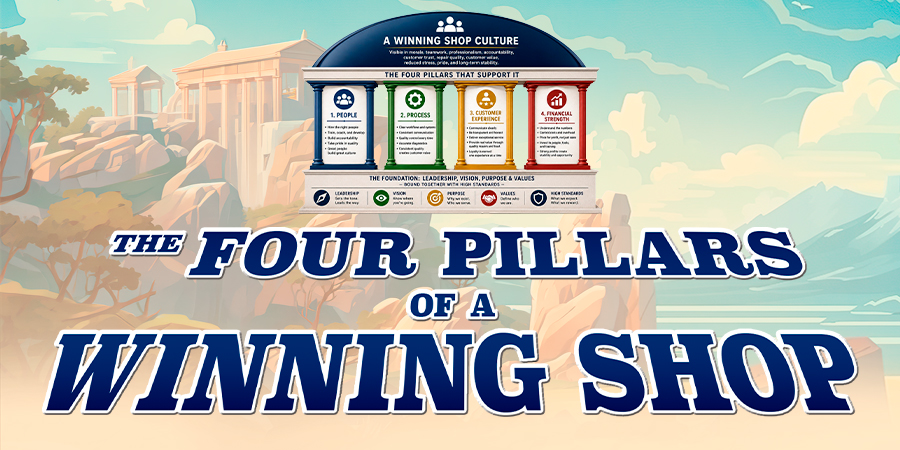
Let’s connect this to the idea we’ve been talking about in recent columns: Winning Shop Culture. A winning culture isn’t built on slogans, mission statements, or posters in the breakroom. It’s built on clear expectations, consistent accountability, and aligned behavior.
And here’s the part that makes people uncomfortable: a real culture pushes the wrong people out. Not because you’re harsh. Not because you’re unfair. Not because you’ve “changed.” But because the standards become real.
Many shop owners operate in what I call aspirational culture. They say things like, “We’re customer-first,” “We’re about quality,” or “We hold ourselves to a higher standard.” But in practice, wrong jobs get pushed through, wrong behavior gets tolerated, and wrong attitudes stick around – sometimes for years.
Why? Because accountability is uncomfortable. Because compassion gets confused with tolerance. Because we don’t want to lose people. So, the culture becomes a suggestion instead of a standard. Then something changes.
In my client’s situation, there was indeed a change. He didn’t become a different person, in fact, he’s one of the more compassionate shop owners I know. But he started doing a few key things differently: setting clearer expectations, following through on those expectations, and addressing performance issues instead of working around them.
In other words, he started living his culture instead of just describing it. And when that happens, something predictable occurs. Not everyone comes along for the ride.
When standards rise, two things happen: your best people lean in, and your misaligned people lean out. Sometimes quietly. Sometimes suddenly. Sometimes all at once – like four employees in a month.
That doesn’t mean you’re losing your team. It means your team is revealing itself, and you’re on the threshold of cultural evolution.
Let’s flip the perspective for a moment. What would have happened if those four employees had stayed? They would have continued delivering mediocre performance, creating ongoing frustration for the owner, dragging down productivity and morale, and negatively impacting the customer experience. All that comes with a hidden cost to profitability.
And maybe most important – what message would that send to your best people? Because – make no mistake – your top performers are always watching. They’re asking themselves, “Is this really the standard?” “Does performance actually matter here?” “Why am I working harder than the person next to me?”
When poor performance is tolerated, your best people don’t feel supported. They feel alone. And eventually… they leave.
Here’s where this ties directly into the idea of Locus of Focus. In the previous article, we talked about internal vs. external focus – owning what we can control while staying aligned with the needs of the customer and the team. This is one of those moments.
Because when employees leave, it’s easy to shift to an external focus: “The job market is tough,” “People just don’t want to work,” or “Nobody has work ethic anymore.”
Or we swing too far the other way: “This is my fault,” “I must be doing something wrong,” or “I’m failing as a leader.”
But the real answer is often somewhere in between. A healthy internal focus asks,
- Am I clear in my expectations?
- Am I consistent in holding them?
- Am I aligned with the culture I say I want?”
If the answer is yes, then sometimes the right outcome is simple: People leave.
Now let’s address something important. My client is a compassionate leader. In fact, if anything, he admitted he tends to keep people too long. That’s not uncommon.
Many shop owners pride themselves on loyalty and giving people chances – and that’s a good thing… until it becomes a liability. Because there’s a difference between helping someone succeed and protecting them from accountability. A winning culture requires both compassion and standards – not one at the expense of the other.
Here’s something I’ve observed over the years. When a shop owner finally starts enforcing standards, the first sign of progress often looks like a problem. Increased turnover. Pushback from employees. Temporary disruption.
It feels like things are getting worse. But the system is recalibrating. The culture is becoming real. The expectations are no longer optional. And the people who don’t fit that environment start making decisions – sometimes before you have to.
I told my client something that seemed to surprise him. “You may have just saved yourself months, or even years of difficult decisions.”
Think about it. He was already planning to replace underperformers and let at least one person go immediately. Those are hard conversations. They take time. They create stress. But instead, the situation resolved itself – not by accident, but because the culture created clarity.
This might be one of the most important mental shifts a shop owner can make. Your job is not to keep everyone. Your job is to build a culture that supports your customers, create an environment where great employees thrive, and set standards that produce consistent results.
When you do that, you won’t keep everyone. And that’s not a failure. That’s leadership.
Let’s bring this full circle to the theme we’ve been building: Winning Culture – from the curb to the front office to the shop and back.
The customer experience doesn’t start at the service counter. It starts with the mindset of the team, the alignment of the culture, and the standards behind every decision. If your internal culture is misaligned, your external experience will be inconsistent.
If your internal standards are unclear, your customer promise will be unreliable. And if your team isn’t aligned, the customer will feel it – almost every time.
So, the next time you find yourself in a situation like my client – people leaving, turnover increasing, things feeling unsettled – ask a different question. Not, “Am I doing something wrong?” But, “Am I finally doing something right?”
And then take it one step further. Is your culture clear enough, strong enough, and consistent enough that the right people want to stay and the wrong people choose not to?
In business, just like in diagnostics, the goal isn’t to eliminate symptoms. It’s to understand them and fix the cause. Sometimes turnover is a symptom of dysfunction. But sometimes, it’s a sign that the system is finally working. And when that happens, the job of the leader isn’t to panic. It’s to stay the course.
Because a winning culture doesn’t just attract the right people – it also has a way of letting the wrong ones walk themselves out the door. And that’s not something to fear. That’s something to build on.
The theme of this year’s Powertrain Expo is Winning Culture… from the curb to the front office to the shop and back.
The Expo is in San Antonio, Texas on August 26th – 30th. You don’t want to miss out, so make your reservations today.
I hope to see you in my session “Winning Culture” at 11:30 on Friday the 29th. In this session we’ll talk about how profitability contributes to a winning culture, and how to instill a profitability mindset in your team while preserving a customer-first service culture.
About the author — Thom Tschetter has served our industry for over four decades. His article topics come from our readers and Thom’s years as a speaker, writer, certified arbitrator, business consultant, and his own in-the-trenches experiences. Thom owned a chain of award-winning transmission shops in Washington State, and ATRA presented him with a Lifetime Achievement Award for his years of training for the transmission industry.