Let me start with a question I’ve asked in shops all over the country: When something goes wrong in your business – a missed deadline, an upset customer, a comeback, or even just a slow day – where does your mind go first?
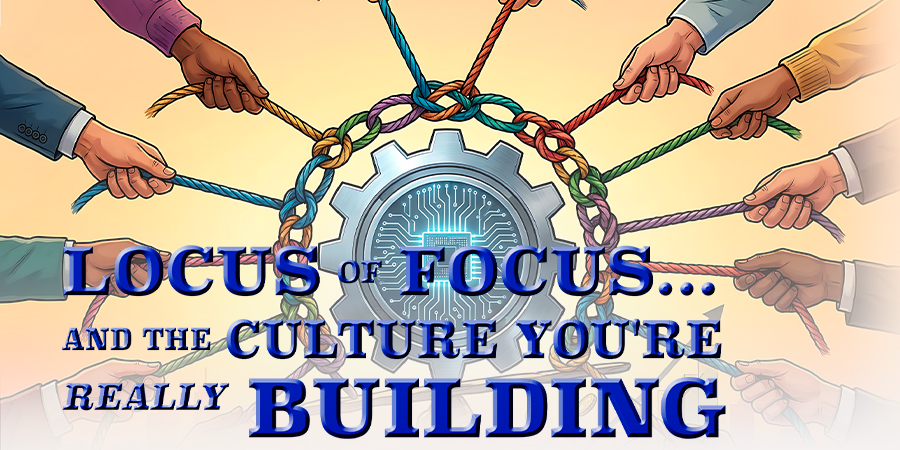
Do you look outward… or inward? It’s a simple question, but it sits right at the intersection of two powerful ideas: locus of control and what I like to call locus of focus. And if you’re serious about building a shop culture that’s both team-centered and customer-centric, how you answer that question matters more than you might realize.
What’s locus of control and why does it matter? An external locus says things happen to me: the economy, the parts supplier, the customer, the technician, the weather. An internal locus says things happen because of me: my decisions, my systems, my communication, my leadership.
Most leadership teachers will tell you – correctly, for the most part – that an internal locus of control is the healthier, more productive mindset. People who take ownership tend to perform better, solve problems faster, and grow more consistently.
But in the real world of a shop environment – where success depends on people working together, systems working consistently, and customers feeling confident – this idea gets a little murkier.
Because if we’re not careful, internal locus of control can quietly drift into something unintended. It can become micromanagement. It can become blame dressed up as accountability. It can even isolate people into their own silos, where “I did my job” becomes the finish line.
Advisors sell, builders build, installers install, and somewhere along the way… the customer gets lost.
That’s where we need to introduce a companion idea: locus of focus. If locus of control answers the question, “Who’s responsible?” then locus of focus answers, “What am I paying attention to?”
In a healthy, high-performing shop culture, you need both concepts working together. You want your people to have an internal locus of control – to take ownership of their role, their decisions, and their outcomes. But you also want them to maintain an external locus of focus – keeping their attention on the people they serve… And that includes more than just the paying customers. It includes the people standing right next to them.
If you’ve been following this column, you’ve heard me say before: we’re not just in the repair business – we’re in the hospitality business. That may sound like a stretch to some, but it becomes crystal clear when you think about what your customers are actually experiencing.
Nobody shows up at your shop excited about what’s about to happen. They arrive with questions, concerns, and often a fair amount of anxiety:
- How much is this going to cost?
- How long will it take?
- Can I trust these people?
That uncertainty creates tension. And your culture either reduces that tension… or adds to it.
Now here’s where the connection to locus of control becomes real.
If your team operates with a purely internal mindset – “I did my job” – you can still fail the customer. Because the customer doesn’t experience your shop in departments or job descriptions. They experience the entire journey – from the curb, to the counter, to the bay, and back again.
Every handoff matters. Every interaction counts. So, while each individual must take ownership, their focus must extend beyond themselves. The real question isn’t just, “Did I do my job?” It’s, “Did what I did help create a great experience for the customer?”
And that brings us to one of the most powerful shifts you can make in your culture: Start treating your teammates like customers. Not in a superficial sense, but in a practical, operational way. Because in reality, that’s exactly what they are. Each role in your shop serves the next role in line.
- The technician depends on the service advisor for clear, accurate information.
- The advisor depends on the technician for precise diagnostics and communication.
- The parts process depends on both.
- And ultimately, the customer depends on all of it working together.
When one link breaks, the entire experience suffers.
So, the mindset becomes this: I own my role completely, and I serve the next person in line exceptionally. That’s where internal locus of control and external locus of focus come together in a way that builds culture – not as a concept, but as a daily practice.
Of course, like most things in business, it’s easy to get this balance wrong.
Some shops lean too far into an external locus of control. Everything becomes someone else’s fault. Parts didn’t arrive. The customer didn’t approve. The rebuilder dropped the ball. The installer messed up. When that mindset takes hold, ownership disappears, and improvement stalls.
On the other end of the spectrum are shops that emphasize internal control but forget about external focus. People take responsibility – but only for their own piece. “I did my job” becomes the standard. And while that may sound like accountability, it often results in silos, miscommunication, and a fragmented customer experience.
The sweet spot lives somewhere in the middle. It’s a culture where every individual thinks, I am fully responsible for my role… and I understand how my role impacts everyone else.
When that awareness is present, something starts to change. Communication improves. Friction decreases. Accountability becomes less about enforcement and more about alignment. And the customer experience becomes more consistent – not because of rules, but because of shared understanding.
Let’s consider an even bigger question. Can an organization itself have a locus of control?
The answer is yes – and it absolutely should. A shop with an internal locus of control doesn’t ignore external realities. It simply refuses to be defined by them. It doesn’t blame the market; it adjusts its strategy. It doesn’t blame customers; it improves communication. It doesn’t blame employees; it strengthens systems and training.
In other words, it asks a better question: Given the reality we’re in… what can we do about it? That mindset, when modeled consistently, becomes a leadership multiplier because your team will mirror what you demonstrate.
If your default response is external – blaming circumstances or people – they’ll do the same. If your default is internal – taking ownership and looking for solutions- they’ll begin to adopt that approach as well. And if you combine that ownership with a clear, consistent focus on serving others, something even more powerful happens.
When people begin to think beyond themselves, you’ll see it in the small moments.
- A comeback isn’t just defended- it’s examined. Not with blame, but with curiosity: What can we learn, and how do we take care of the customer right now?
- A delay isn’t just explained – it’s communicated. Who needs to know? What expectations need to be reset? How do we prevent this next time?
These responses don’t happen by accident. They’re the result of a culture where ownership and awareness coexist.
And like any culture, it’s shaped by the questions you ask, the language you use, and the behaviors you reinforce.
- Instead of asking, “What happened?” you begin asking, “What could we have done differently?” That subtle shift moves the conversation from explanation to improvement.
- Instead of focusing solely on individual performance, you connect each role to its impact – on the next person in line, on the overall customer experience, and ultimately on the success of the business.
- Instead of celebrating only productivity, you start recognizing the moments that truly define your culture: great handoffs, clear communication, a teammate stepping in to help, or a situation where a customer’s experience was recovered and restored.
Those are the moments that reinforce external focus. Those are the moments that build trust.
In the end, an internal locus of control gives your team power. It tells them they’re not victims of circumstance – they have influence, responsibility, and the ability to improve outcomes. But an external locus of focus gives that power direction. It ensures that ownership doesn’t turn inward in a way that isolates, but outward in a way that serves.
The reality is that you can’t control everything that happens in your shop. None of us can. But you can control how you respond. And you can absolutely control how well you serve the people around you – your customers, your teammates, and your community.
If you’ve heard me speak, you’ve probably heard this before:
The shop only wins… when the customer wins. And the customer wins when the team works together. And the team only works together when each person owns their role – and focuses on serving the next person in line.
That’s the loop. That’s the culture. Not just where control lives… but where your attention goes, every single day. Because where your focus goes, your culture follows.
The theme of this year’s Powertrain Expo is Winning Culture… from the curb to the front office to the shop and back.
The Expo is in San Antonio, Texas on August 26th – 30th. You don’t want to miss out, so make your reservations today and catch the early-bird savings.
I hope to see you in my session “Winning Culture” at 11:30 on Friday the 29th. In this session we’ll talk about how profitability contributes to a winning culture, and how to instill a profitability mindset in your team while preserving a customer-first service culture.
About the author — Thom Tschetter has served our industry for over four decades. His article topics come from our readers and Thom’s years as a speaker, writer, certified arbitrator, business consultant, and his own in-the-trenches experiences. Thom owned a chain of award-winning transmission shops in Washington State, and ATRA presented him with a Lifetime Achievement Award for his years of training for the transmission industry.