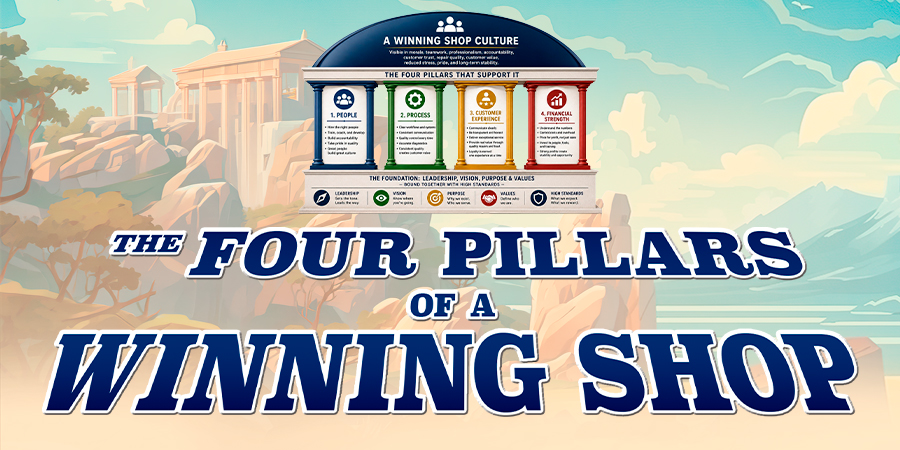
Every shop has a culture. The question is whether it’s intentional or accidental. In other words, are you creating the culture you want… or living with the one that developed by default?
That’s an important distinction. Because culture isn’t just some feel-good management concept. It affects:
- productivity,
- employee retention,
- stress levels,
- communication,
- customer trust,
- repair quality,
- profitability,
Ultimately, it affects whether people enjoy coming to work or dread pulling into the parking lot every morning.
Over the past several months, I’ve written a series of articles about the importance of a Winning Shop Culture. It was the theme of the Powertrain Expo. Some of you asked, “Okay, I get it, but how do we build it?”
This article is the answer. This is a practical 49-day operating plan to help shop owners begin building the foundation of a winning shop culture one week at a time over just 7 weeks. Will your culture be perfected in seven weeks? Of course not. If culture transformation were that easy, every shop in America would already look like a combination of Disneyland and a championship NASCAR team.
But you can establish momentum, improve communication, reduce stress, create clarity, and begin changing the trajectory of your business.
The key is implementation – one step, one conversation, one week at a time.
IMPROVE COMMUNICATION AND ESTABLISH A ROADMAP
This first week is critical because communication is the delivery system for culture. Most shop problems are communication problems wearing work clothes. When communication breaks down:
- Customers become frustrated.
- Employees become stressed.
- Departments become disconnected.
Confusion creates stress. Clarity creates confidence. So, this first week is about creating better communication.
Start by holding a team meeting introducing the 49-day culture improvement plan. You can sign-up for a FREE step-by-step companion workbook of this plan and a facilitator’s guide to help you with the team meetings and implementation steps at www.CoachThomMarketing.com.
Explain to the team:
- Why culture matters
- Why you’re implementing the process?
- What the weekly roadmap looks like
- What improvements you hope to accomplish
- How the team will participate – mutual expectations
Also explain that this is not a one-time meeting. You’re beginning a process that includes weekly team meetings designed to improve communication, reduce stress, improve operations, and create a stronger work environment for everyone involved.
Encourage the team to participate in the discussions and share their ideas, concerns, observations, and suggestions without fear of criticism, ridicule, or punishment.
If employees believe honesty will be punished, they’ll stop communicating honestly. And once that happens, leadership loses visibility into the problems affecting morale, productivity, workflow, and customer experience.
The objective is to build involvement, consensus, ownership, and commitment.
Explain that each weekly meeting will:
- Review progress from the previous week.
- Introduce this week’s focus.
- Identify problems and opportunities.
- Reinforce the long-term vision.
These meetings aren’t lectures, but collaboration to improve the daily work experience for everyone.
Establish two critical communication habits.
1. Morning Huddles – Five to ten minutes before work begins review:
- workflow priorities,
- delivery commitments,
- staffing concerns,
- special jobs,
- customer situations,
- parts status,
- and production goals.
This is not a complaint session. It’s a preparation session. The objective is clarity.
2. End-of-Day SITREP Meetings may become one of the most valuable habits your shop ever develops. “SITREP” stands for Situation Report.
- delayed parts,
- wrong parts delivered,
- approvals are still pending,
- unfinished diagnostics,
- sublet concerns,
- vehicles blocking workflow,
- scheduling problems,
- or anything that could disrupt tomorrow.
Too many shops discover major problems during the next morning’s huddle when everybody is already under pressure. That’s backwards. Problems identified at 5:00 PM are often manageable. Problems discovered at 8:00 AM become stress multipliers.
For example, if the wrong part arrived late in the day, maybe the correct part can still be ordered for overnight delivery. But if nobody communicates the issue until the following morning, the entire production schedule might be affected. Winning culture and communication reduce surprises.
DEFINE THE CULTURE YOU WANT
Now that communication systems are beginning to improve, Week 2 defines expectations. This is where many businesses unintentionally fail. They say they want:
- professionalism,
- teamwork,
- accountability,
- great customer service,
- and positive attitudes.
But what exactly do these things mean? If culture isn’t clearly defined, employees will create their own version of it. And trust me… that can become an interesting social experiment.
This week, define:
- your non-negotiable values,
- customer experience expectations,
- communication standards,
- professionalism expectations,
- and accountability standards.
Keep it practical. Employees need clarity. The goal is to answer this question: “What does winning culture actually look like here?”
Another important part of defining culture is helping employees understand how the business works financially. This is one of the most overlooked leadership opportunities in our industry.
Many employees genuinely do not understand:
- where profit comes from,
- how overhead works,
- how mistakes affect profitability,
- how workflow affects productivity,
- or how every role influences the financial health of the business.
And honestly, why would they? Nobody ever taught them.
Left unexplained, employees often create their own assumptions. That’s dangerous.
Years ago, I asked a group of employees, “Where does your paycheck come from?” One person correctly answered, “From profit.” Technically accurate but functionally incomplete.
Sometimes employees think profit is simply whatever money remains after the owner buys another fishing boat or a diesel pickup. But in the trenches, business is far less glamorous.
Shops operate with:
- significant overhead,
- expensive equipment,
- rising costs,
- payroll burdens,
- insurance expenses,
- training expenses,
- software subscriptions,
- utilities,
- taxes,
- and enormous operational responsibility.
That’s why sharing some basic financial understanding with the team can be healthy. Not necessarily every private detail, but enough understanding to create perspective.
Help employees understand:
- how sales create gross profit,
- how gross profit covers overhead,
- how productivity affects profitability,
- how comebacks hurt everyone,
- and how customer satisfaction ultimately drives the entire business.
Understanding how profit works helps create ownership mentality. When employees understand how the business actually functions, they begin seeing themselves as contributors to the mission instead of merely occupants of the building. And that changes culture dramatically.
EVALUATE CURRENT REALITY
Week 3 is honesty week. Now that communication is improving and expectations are becoming visible, it’s time to identify what currently damages morale and productivity.
Ask questions like:
- What creates daily frustration?
- Where does communication break down?
- What operational bottlenecks create stress?
- What recurring behaviors hurt teamwork?
- What causes customer dissatisfaction?
- What slows production?
This must not become a blame session. You’re identifying obstacles, not villains. Sometimes culture problems are people-problems. Sometimes they’re system problems. And often they’re both. But don’t fix the blame – fix the problems.
I once worked with a shop owner who believed his techs had an attitude problem. After spending several hours observing the operation, I discovered:
- dispatching chaos,
- poor workflow process,
- constant interruptions,
- unclear priorities,
- delayed parts,
- abounding disorganization.
Honestly, the technicians were dealing with it better than most people would.
Sometimes what appears to be a bad attitude is actually organizational exhaustion. This requires brutal honesty. You cannot improve what you refuse to acknowledge.
ESTABLISH ACCOUNTABILITY
Week 4 is focused on reinforcing standards consistently. This is where many culture initiatives quietly collapse because establishing standards is easy. Enforcing them consistently is harder. A Winning Culture cannot survive where standards become optional.
- clarify individual responsibilities,
- address recurring issues quickly,
- eliminate double standards, recognize ownership mentality,
- and stop avoiding difficult conversations. Employees notice everything.
- They notice favoritism.
- They notice tolerated negativity.
- They notice inconsistent leadership reactions.
- They notice when standards apply differently depending on who caused the problem.
And once employees stop believing leadership means what it says, culture begins deteriorating rapidly.
Accountability should never mean humiliation. The purpose is improvement – not public executions. Focus on improving the performance without attacking the performer.
REDUCE OPERATIONAL CHAOS
There’s no “fun” in dysfunction. Week 5 focuses on systems because operational dysfunction eventually becomes cultural dysfunction. Many shops unintentionally normalize chaos. They wear busyness like a badge of honor. Overwhelmed doesn’t coexist with efficiency.
One technician once told me, “I don’t mind working hard. I just want to stop feeling like every day is a fire drill.”
Look for ways to:
- improve workflow,
- reduce interruptions,
- clarify responsibilities,
- improve scheduling realism,
- organize workspaces,
- improve dispatching,
- and identify and address production bottlenecks.
One of the best ways to reduce chaos is to involve the people experiencing it daily. The people working inside the process every day often see inefficiencies leadership misses. Encourage employees to discuss:
- workflow bottlenecks,
- equipment limitations,
- organizational problems,
- recurring interruptions,
- inefficient processes,
- and things that create unnecessary stress.
Notice how all these steps keep connecting? That’s because culture is not separate from operations.
- Healthy systems reduce unnecessary stress.
- Reduced stress improves communication.
- Improved communication improves culture.
- A Winning Shop Culture drives operations.
INVEST IN YOUR PEOPLE
By Week 5, you should notice that the shop is gaining structure and clarity. It’s time to invest intentionally in the team.
This week:
- begin regular training,
- recognize improvement publicly,
- discuss growth opportunities,
- cross-train where appropriate,
- and create development goals.
People want progress – especially good employees. One of the biggest reasons talented employees leave businesses is because they stop feeling challenged, appreciated, or developed.
Winning cultures create growth environments, and growth environments improve retention.
Recognition matters too. Not fake recognition – non-participation trophies for showing up with matching shoes. Real recognition for specific accomplishments.
“Great job handling that difficult customer.” “Excellent diagnostic process.” “I appreciate how professionally you managed that situation.”
Recognition fosters repetition.
REINFORCE AND PROTECT THE CULTURE
This final week is really the beginning of the long-term process because culture must be nurtured continually.
This week:
- review progress,
- celebrate improvements,
- revisit values,
- reinforce expectations,
- address remaining obstacles,
- and continue communication routines.
Most importantly, leadership must model the culture personally. Employees watch leadership constantly – especially during stressful moments. Anybody can appear positive when business is easy. Real culture appears:
- during pressure,
- during mistakes,
- during difficult customers,
- during staffing shortages,
- during financial stress,
- and during exhausting weeks.
Leadership behavior becomes organizational permission. If leadership panics, explodes, gossips, blames, or avoids accountability, eventually the team will too.
But when leadership models calm consistency, professionalism, ownership, communication, and respect, those behaviors begin spreading throughout the organization. A Winning Culture is contagious. What are you spreading?
FINAL THOUGHTS
Can a Winning Shop Culture truly begin transforming in 49 days? Absolutely. Because 49 days of intentional action creates momentum.
The important thing is to begin now! Every day your culture is either improving intentionally or developing accidentally.
The best shops build environments where:
- customers trust,
- employees grow,
- communication improves,
- stress decreases,
- teamwork strengthens,
- and people genuinely want to succeed together.
That kind of culture does not happen by default. It happens by design – from the curb to the bay, and back again.
Don’t forget to sign-up for your FREE Implementation Workbook and Facilitator’s Guide at www.CoachThomMarketing.com; click on the request form, and type “GEARS GUIDES” in the message box. No strings attached, and we won’t call you unless you ask us to.
We wish you the best in building a Winning Shop Culture.