Here’s something for you to think about: Your fuel pressure gauge is basically worthless, because fuel pressure doesn’t matter. Actually, let’s modify that slightly: Fuel pressure is necessary, but measuring fuel pressure is a worthless test in most cases.
Here’s why: Correct fuel pressure is required for injection pressures to be correct. But fuel volume is required to maintain the appropriate fuel pressure, so you should be measuring fuel volume rather than fuel pressure.
Take an imaginary vehicle that starts and runs fine at idle. You install a fuel pressure gauge and the pressure is within specifications. Yet the vehicle exhibits low power on heavy acceleration. This low power could easily be a fuel pump problem, but the pressure was good. So how could it be a fuel pump problem?
What could be happening is the fuel pump is able to supply enough fuel to maintain pressure when engine demand is low. But when demand is high, the pump volume is insufficient to maintain adequate pressure.
The second issue is when a vehicle cranks but won’t start. In that case, a fuel pressure gauge can provide a quick check to see if there’s any fuel available to the engine. In this case, no fuel pressure equals no fuel volume.
From this point you’ll need to investigate the fuel pump and its circuitry. What happens if the problem is intermittent? A fuel pressure test is worthless if the engine starts every time at the shop.
Measuring fuel volume is a great test and is often the test that follows the one we’re going to look at. Measuring fuel volume is an acceptable first test, but may be difficult on some vehicles.
That means there has to be an alternative test. That test involves measuring fuel pump current and watching the results on an oscilloscope. Think of this like an EKG for your heart: Your heart is working because you’re still alive, yet a doctor can observe anomalies that may cause trouble before your heart actually fails.
Basically, an EKG machine is an oscilloscope. With that in mind, you can employ some of the same technology used in an EKG to testing fuel pumps.
To do that, you’ll need a few things. First, you’ll need a digital oscilloscope or DSO. A DSO should be a fixture in your shop. Second, you’ll need a low current probe. Current probes have many uses other than fuel pump analysis and are relatively inexpensive. Third, you’ll need to understand the system, which, in this case, is the fuel pump.
The setup for this test is relatively simple: You connect the current probe, sometimes called an amp clamp, to your DSO, and then clamp the current probe around one of the wires to the fuel pump.
The beauty of this test lies in the physics of electricity: current is the same everywhere in the circuit. What that means is you can clamp the probe anywhere in the circuit and observe the current flow. So you can choose a test point based on ease of access.
This is different than measuring voltage, where you’d actually need access to the fuel pump to measure the voltage. In most cases, a fuse or fuel pump relay is a much easier point to connect to the circuit, and lends itself very well to a current test.
Once you’ve connected your current probe, you’ll energize the fuel pump and examine the current waveform on your scope (figure 1). The waveform shown is from a good fuel pump on a vehicle with a fuel pressure specification of 40 PSI.
 There are two main things to look for in this capture: First, is the average current draw appropriate for the fuel pressure specification? Second, is the capture pretty? Let’s address each aspect separately.
The current the fuel pump draws is directly proportionate to the amount of work it’s performing. In other words, the higher the fuel pressure is, the higher the current draw should be. A failing pump, or other fault in the fuel delivery system, will usually cause fuel pump current to decrease.
The chart (figure 2) shows some baseline specifications of how fuel pressure relates to fuel pump current. Using this and the waveform, you can see that average fuel pump current is about five amps, which is acceptable for a fuel pressure specification of 40 PSI.
Second, is the capture pretty? A better way to say this may be, is the signal uniform? Look at the “humps” as the current rises and falls. These humps are caused by the brushes moving from one commutator segment to the next. This current fluctuation is normal and, if all brushes and segments are good, all of the humps should be relatively uniform.
So, if the fuel pump’s current draw is where you expect it to be and the signal is uniform, then the fuel pump should be okay. If you have any doubt, you should check the fuel volume to confirm adequate pump operation.
One of the biggest advantages of checking the current is that, just like a doctor administering an EKG, you can see problems that aren’t occurring right now. For example, a vehicle cranks but won’t start, but when it gets to your shop, it starts every time you turn the key. Where do you go next?
A fuel pump is nothing more than an electric motor. It has brushes and commutator segments, just like a starter motor, and they can wear out. Sometimes you can identify worn brushes in a starter motor with the old “hit-it-with-a-hammer” test. The hammer test, although sometimes effective, doesn’t always work. But you should be able to see variations in the brush contacts by watching the current humps.
Next we’ll look at a car that cranked but won’t start. The customer had the vehicle towed in and now it starts every time. Currently the vehicle runs perfectly and has no diagnostic trouble codes.
The technician removed the fuel pump relay and installed a fused jumper wire. Then he measured the current at the jumper wire (figure 3). The fuel pressure specification is 65 PSI.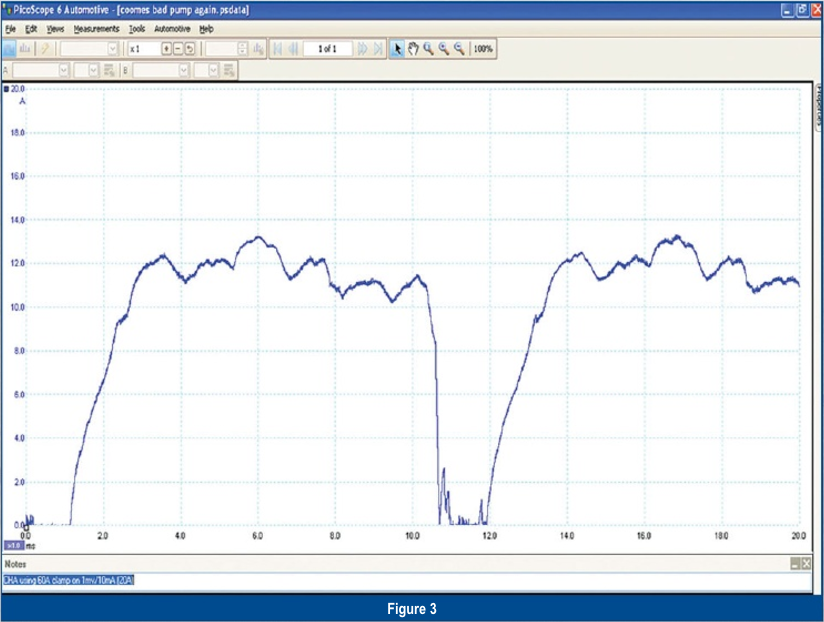
Based on the waveform, the pump is bad. But let’s take a moment and analyze the signal. Step 1: How is the fuel pump current? In this case, the pump is averaging about 11 amps, which is acceptable for this pump. In fact, a fuel pressure gauge would indicate the pressure is fine. If we went a step further, fuel volume would also pass.
Step 2: Is the capture pretty? No, it isn’t. So the pump failed step 2, but why? And how does the failure relate to the problem of intermittently cranking but not starting?
Even though the pump is supplying fuel and the vehicle is running right now, the waveform shows a hidden fault. You can see brush and commutator segment contact, but every 8th hump is missing. This is a classic example of brush contact that’s become bad enough to cause a problem. Once the pump is running it functions okay, but if it were to stop spinning directly on the bad spot, it won’t spin the next time you try to start the engine.
To summarize, there’s nothing wrong with a fuel pressure gauge. But a current probe can offer a much better look inside the fuel pump’s operation; sort of a fuel pump EKG.
The current test is also easier, quicker, and cleaner to perform than a fuel pressure or volume test. So keep your gauge and volume testers to back up diagnosis any time you feel it’s necessary, but always reach for your current probe first.