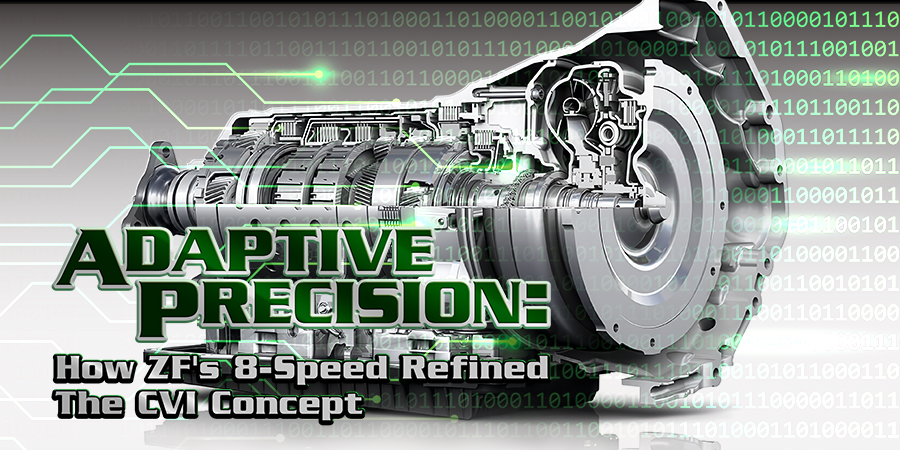
This is a follow-up to my last article “Adaptive Precision: How ZF’s 8 Speed Refined the CVI Concept” Gears Magazine, May 2026.” It would be nice to use the same explanation of how the 9HP adapts and the process to achieve that adaptation as the 8HP, but while these two transmissions may share the same ZF DNA, they do not “think” the same way. And by “think”, I mean how that adaptation is dictated by design. Each transmission has unique engineering problems to solve. The 8HP’s clutch-to-clutch design adaptation is refined and predictable. The 9HP, on the other hand, is one of synchronization and controlled stability.
Two Transmissions. Two Adaptation Philosophies.
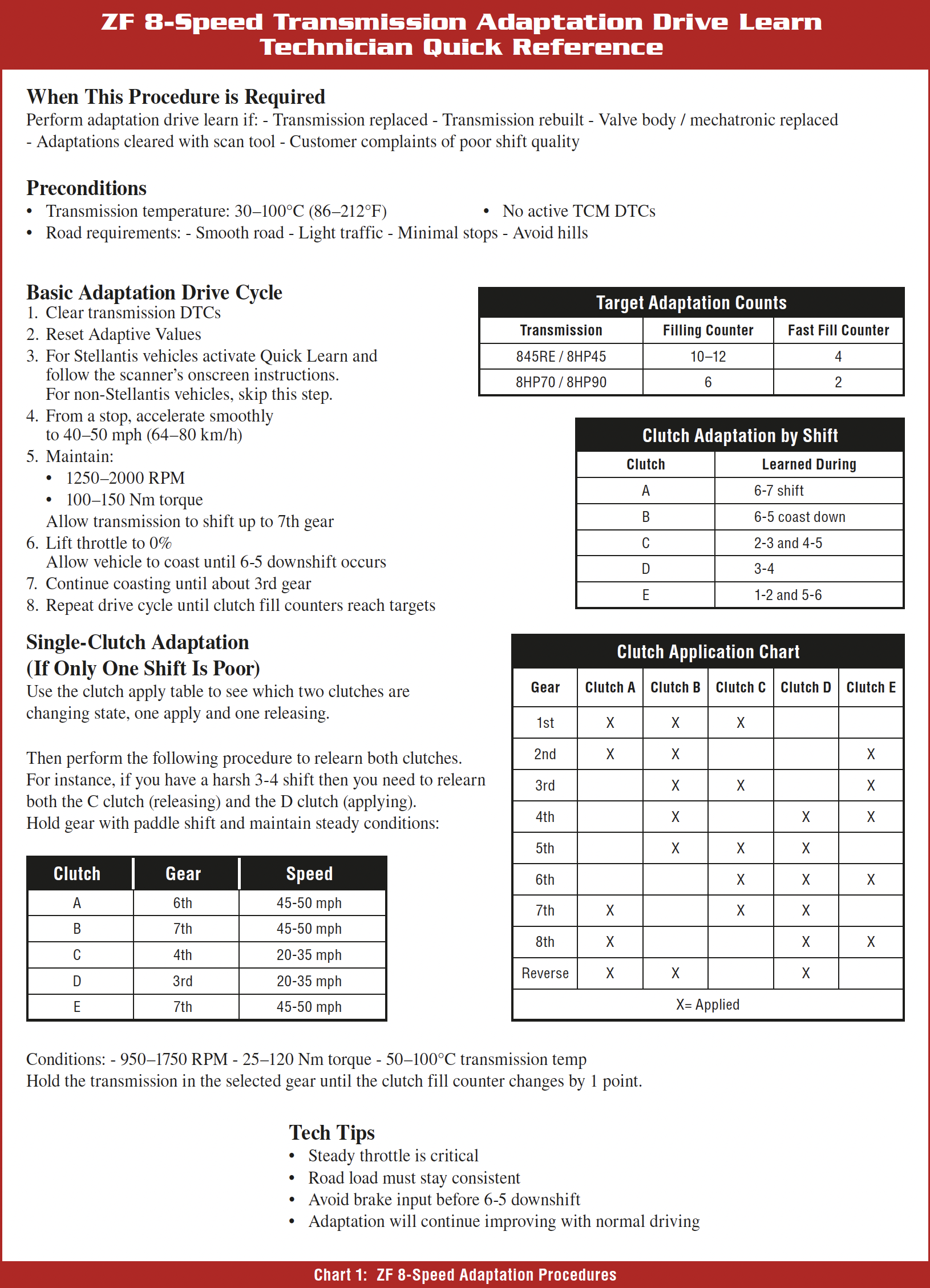
For an in-depth explanation of the 8HP adaptation, read the previous article. But to summarize the process;
The 8HP continuously manages:
- Clutch fill pressure,
- Fill time,
- Correction frequency.
- Shift response
And it dynamically updates its learned baseline values. This means that the 8HP is constantly refining clutch control in real time.
The 9HP also adapts, but not with the same continuously managed pressure model. Its strategy is more event-driven and condition-based. The TCM evaluates:
- Shift timing
- Ratio change
- Turbine speed response
- Clutch overlap
- Pressure deviation

But its adaptation strategy is more reliant on predetermined shift models and validation windows. The 9HP behaves more like “Did the shift happen inside the acceptable window?” And the 8HP behaves more like “How much pressure and time did this exact clutch need right now?” It’s a huge philosophical difference. The 9HP is trying to fit the shift sequence into a predetermined box. Depending on throttle and load, that box changes its dimensions. At times, the box is roomy; in other cases, it can be much more restrictive.
The 8HP Separates Pressure Adaptation and Time Adaptation.
The 8HP adaptation structure is elegantly divided into two independent categories:
Pressure Side
- Clutch Filling Pressure
- Fast Filling Counter
Time Side
- Clutch Filling Time
- Clutch Filling Counter
ZF essentially separated hydraulic volume correction from the clutch timing correction. That allows the 8HP to identify whether the problem is leakage, clearance, viscosity, air in the drum or circuit, or friction wear. The 9HP doesn’t expose adaptation in that same granular format. Its adaptive strategy is more integrated into:
- clutch torque capacity models
- shift phase control
- ratio monitoring
- pressure ramp control
You can see the difference in scan data; the 8HP gives you meaningful clutch adaptation numbers. You can see the TCM is adapting, and once you’re accustomed to the data, you can better understand the health of the clutch and the hydraulics.
The 9HP Blends Them Together
The 9HP, on the other hand, often gives you generic adaptation status, counters, or “learned values” without the same diagnostic transparency. You’re observing how its TCM is trying to fit the shift into a predetermined box.
At times, this can lead a tech to feel a disconnect between the data on the scan tool and the transmission’s actual performance. The 8HP appears to rely more heavily on continuously refined fill models, while the 9HP places greater emphasis on validating shift execution within predefined operating windows before updating adaptation values.
The 8HP’s adaptive logic predicts clutch behavior before the shift occurs. Its learned fill-pressure baseline already compensates for clutch wear, seal leakage, fluid viscosity, clutch drain-back, and hydraulic leakage. By the time the shift occurs, the TCM has already compensated for the variables.
The 9HP tends to react after observing:
- Flare
- Tie-up
- Ratio error
- Apply Delay
It corrects on future shifts based on previous events. Sounds familiar to the old CVI system, doesn’t it? This is why the 9HP can feel inconsistent or indecisive during relearn periods.
Why the 9HP Relearn Feels so Different
The 8HP adaptation is comparatively forgiving. After reading the previous article, you may not think so, but side by side with the 948TE/9HP48, we find the 9-speed is extremely sensitive to:
- Temperature
- Torque
- Turbine Speed
- Road Smoothness
- Throttle stability
- Traffic interruptions
The 9HP needs very stable synchronization conditions before it finalizes its calculations. This means that the conditions for each clutch adaptation need to be held within acceptable ranges longer than the 8HP did. So why does the 948TE/9HP48 require different processes than the 8HP? The 9HP is a mechanically far more complex design. In two words, Dog Clutches. The 9HP uses two hydraulically actuated dog clutches that do not contain traditional synchronizer assemblies. Instead, the TCM uses engine torque management and friction clutch control to synchronize component speeds before engagement.
This means the engagement and disengagement of the dog clutches are subject to more restrictive parameters. This also means the shift elements must synchronize speed precisely, resulting in extremely tight timing windows. This process is highly dependent on accurate speed prediction.
That last point is emphasized by the system’s response to TPMS status, tire pressure, and wheel-sensor RPM. When wheel speed RPM data becomes questionable, the TCM will inhibit the upper gears when at speed. Field experience has shown that wheel-speed plausibility issues can significantly affect dog-clutch synchronization and shift scheduling.
This means that the 9HP doesn’t merely affect feel; it can also affect:
- Gear engagement completion
- Dog clutch synchronization
- Shift abort logic
- Neutral events
- Harsh re-engagements
The 8HP can tolerate adaptation drift much better; the 9HP has less forgiveness. That’s why small hydraulic problems in a 9HP often create disproportionately ugly symptoms.
Dog clutches?
If you’ve never been inside a 948TE/9HP48, then you may not quite understand what the dog clutches are and how they work. Unlike friction disc clutches, dog clutches are more akin to manual transmissions, where a gear is mechanically connected to or disconnected from a hub (Figure 1 & 2).
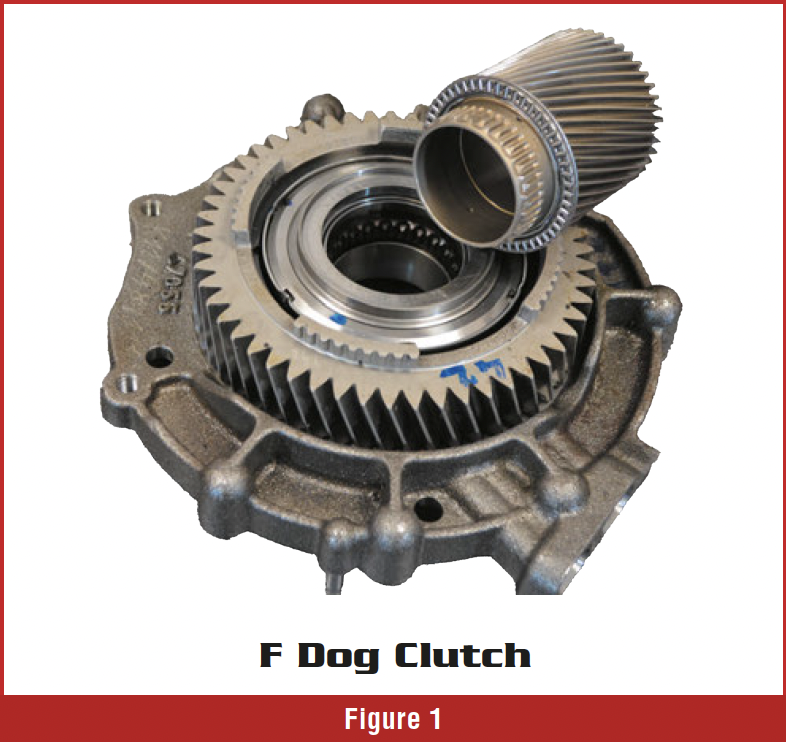 The difference in the 9-speed is that there is no traditional synchronizer assembly; instead of coupling to a hub, it uses a sun gear engaging a ring gear. The engagement of a dog clutch can be thought of as a form of speed shifting. That’s where you shift a manual transmission without using the clutch; instead, you try to match the engine speed (input) to the expected RPM once the shift is complete. At lower RPMs, this can be easily achieved, but at higher RPMs, the timing and RPM difference are greatly reduced. The 9HP is kind of doing the same thing, but instead of fine-tuning the input shaft speed, it tries to make the dog clutch engage quickly to minimize gear clash. At light throttle it’s pretty successful, but at higher speeds or downshifts under power, the shift window timing is very tight. This is why timing errors are much less forgiving. Synchronization is much more critical than the friction clutch-to-friction clutch shift. The adaptation stability is critical.
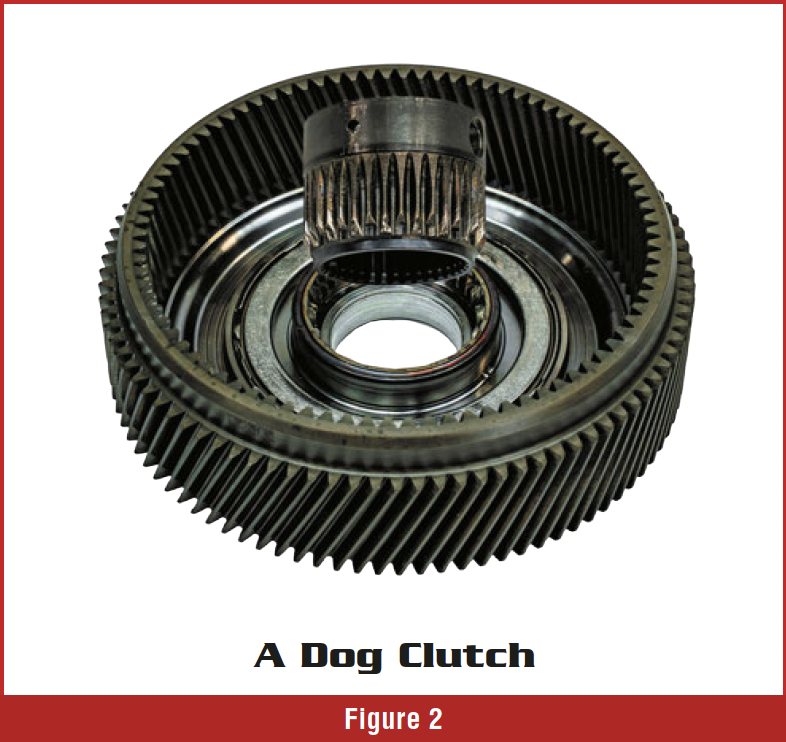 Dog clutch operation is less concerned with clutch wear and more dependent on input torque, timing, and road speed. The process is not about adapting for clutch overlap but instead more digital in nature; the clutch is either on (engaged) or off (disengaged). This means that the relearn process can be finicky with;
- Rough roads
- Throttle movement
- Torque fluctuations.
Rapid changes in these areas can cause the relearning process to abort, forcing you to spend more time driving and training the TCM.
If the process is similar, why does it require more time to complete? While much of the terminology is the same as with the 8-speed, the key factor behind the longer learning time is how the 9-speed learns. The 9HP often learns by holding operating states rather than repeatedly cycling shifts.
Where the 8HP learns through repeated shift events, the 9HP often learns by locking the transmission into a single gear, holding a stable throttle, and maintaining precise load conditions for extended periods. This is a very different behavior and reflects the engineering priorities.
Unlike the 8HP, the 9HP relearn process relies heavily on:
- maintaining specific gears manually,
- long steady-state driving periods,
- stable turbine speed,
- stable torque input,
- and smooth road conditions.
This means during the drive cycle relearning, maintaining consistency in throttle, speed, and load is imperative to completing the adaptation in the least amount of time. After all, time is money, and unlike Evel Knievel, you are paid for completing the job, not merely attempting it.
Different clutch groups are learned under different conditions:
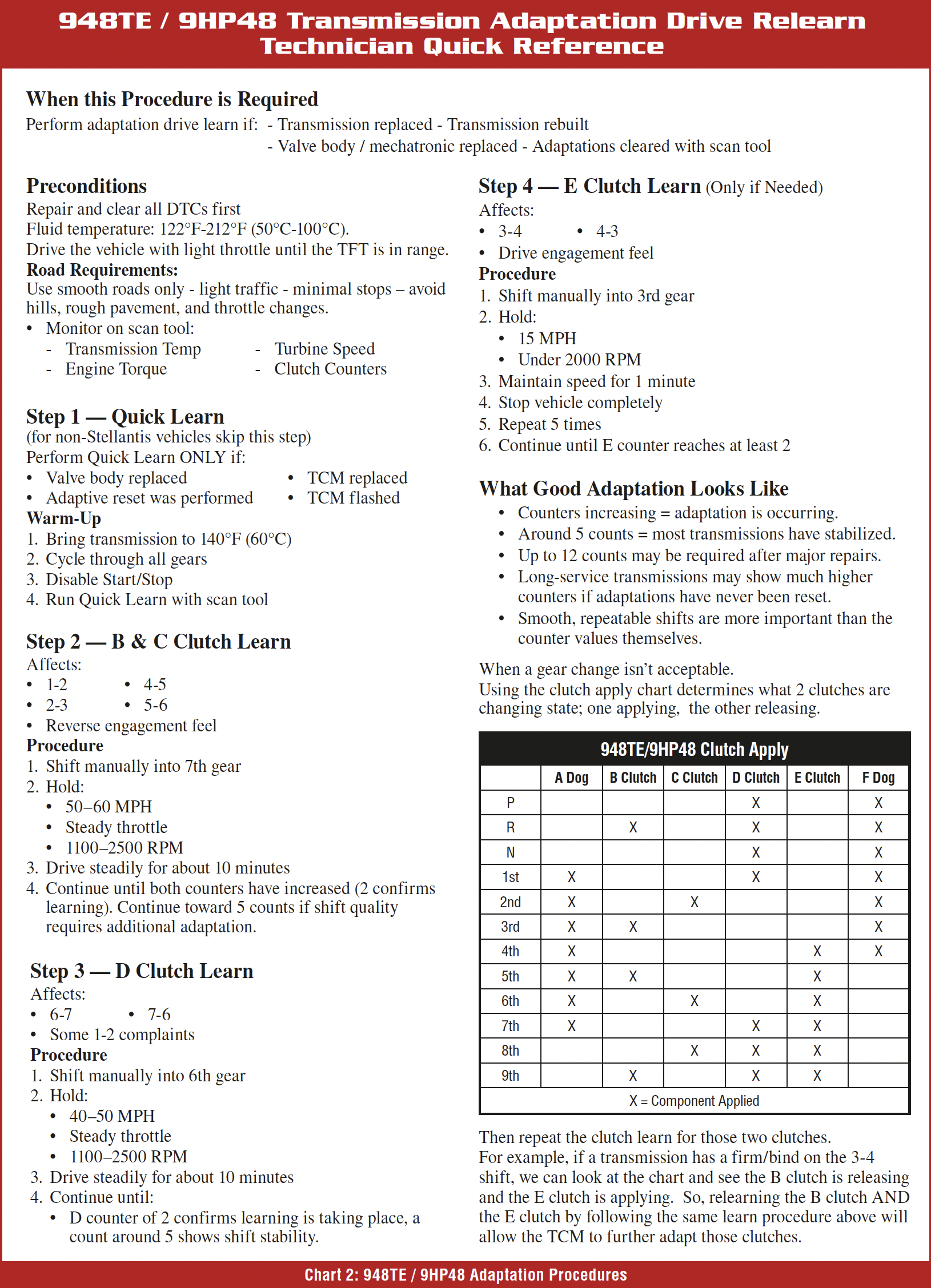
- B/C clutches in 7th gear
- D clutch in 6th gear
- E clutch at very low speed in 3rd gear
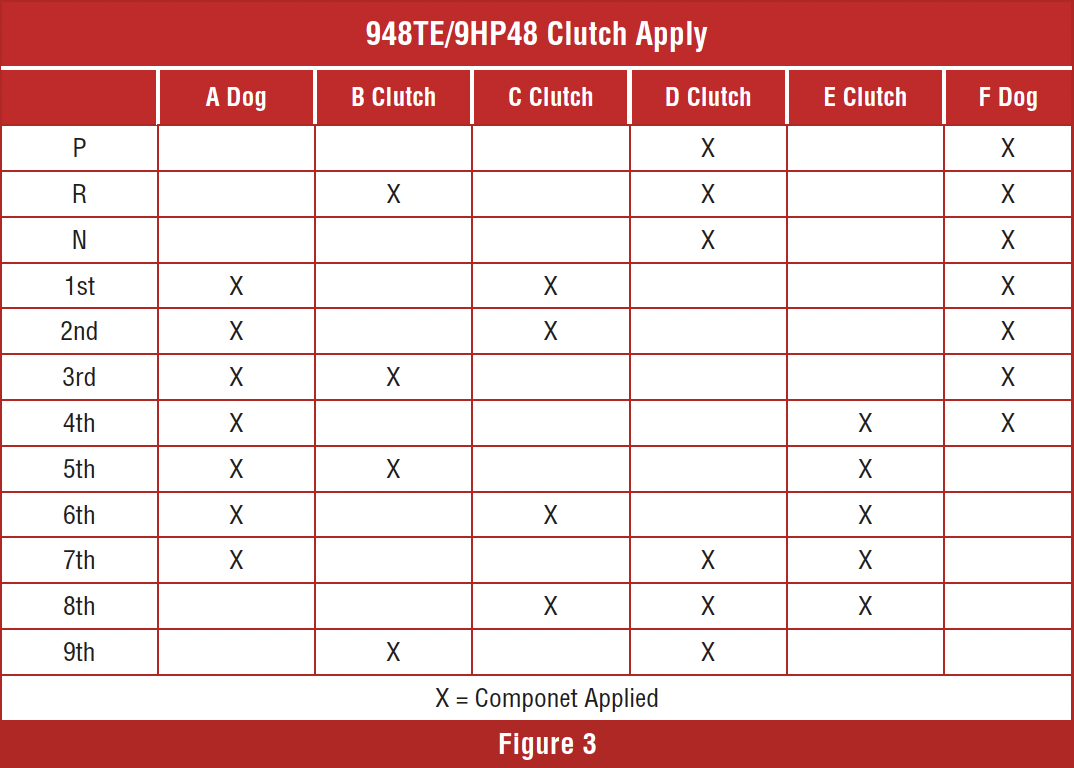 Looking at the clutch apply chart (Figure 3), you can see the gears where specific clutches are adapting, but are not applied in that gear. The TCM is evaluating clutch fill characteristics and adjusting pressure and timing values to compensate for wear and hydraulic variation.
Take notice that there is no adaptation learning for the A and F dog clutches. No adaptation memory cells are maintained for the A and F dog clutches. Their operation relies primarily on a synchronization strategy rather than on the adaptive clutch fill routines used for friction clutches.
Chrysler’s adaptation procedure specifically targets the B, C, D, and E friction clutches, which is why the adaptation drive cycle focuses on obtaining filling-counter values rather than evaluating dog-clutch engagement.
When we look at how the 9HP adapts, we see that the transmission prioritizes synchronization stability over shift-event adaptation. This is very different from the 8HP drive cycle relearn. If you attempt to use the same process between the two transmissions, you’ll end up with different results.
Diagnostic Data: 8HP vs 9HP
The scan tool diagnostic data between the two platforms is not the same. The 8HP gives you the data to see the health of the clutch and the hydraulics. You can see and evaluate:
- Filling pressure
- Filling time
- Fast fill counters
- Clutch counters
Those values allow you to determine whether the clutch is stable, and if the TCM is still searching for the optimum apply time and pressure. The values can also indicate whether a clutch is experiencing fluid leakage or air is trapped in the system. Perhaps from drain back when the clutch is disengaged. And you can get a better-informed idea of whether the clutch is physically worn when the time adjustment has been increased but the pressures haven’t changed in a corresponding manner.
The 9HP is much less transparent, and depending on the scan tool in use, you may:
- Not get all learned values.
- Not identify which clutch is unstable.
- Only get offered reset/relearn routines.
This leads you to diagnose symptoms instead of adaptive behavior. The dog clutch data is generally less informative than the friction clutch data; there’s no overlap adaptation, and pressure doesn’t adjust in the same manner as the friction clutch.
Quick Learn
If you’re working on a Stellantis North American product (i.e., Chrysler/ Dodge/Ram/Promaster/Jeep), you can start with the quick learn. For all other applications of the 8HP/9HP, adaptation is relearned only through the drive cycle.
Like the 845RE/850RE/8HP70, the quick learn establishes a baseline for pressure and time but does not adapt the transmission. It’s merely a starting point to begin the adaptive road test. Chrysler’s adaptation strategy is built around Filling Counter and Fast Filling Counter values. A count of zero indicates no learning has occurred. Chrysler considers adaptation to begin improving shift quality once the counters reach two, with diminishing returns beyond approximately five counts.
On the 948TE, quick learn and garage shifts are even more critical because:
- The friction clutch baseline values established during Quick Learn help support the synchronization strategies used elsewhere in the transmission.
- Clutch kiss points matter more.
- Shift phase timing is narrower.
In addition, the 9HP is more sensitive to:
- Battery voltage
- Fluid temperature
- Throttle consistency
- Start/stop interruptions during relearn (Note: Disable start/stop on any vehicle, any brand, that you’re performing adaptive learning)
The vehicle status and environment are very critical to adaptation. Remember, on the 9HP, the adaptation relies on the stability of the vehicle and the road. Weak batteries and erratic throttle can not only delay adaptation, but, on the 9HP, also cause it to abort until the next drive cycle. This TCM gets frustrated easily.
So why the change if the 8HP system is more forgiving and has a more appealing result?
The answer comes down to packaging. The 8HP, in its longitudinal configuration, provides more room to fit clutches and gears. The 9HP, on the other hand, being FWD and transversely mounted, is confined by the size of the engine compartment. Looking at the physical dimensions of the transmission, you find it’s not much larger than many 3 and 4-speed models from years ago. You can also say that, like the shift adaptation, the transmission design itself was forced to fit into a box of a specific size. Because of the compactness and complexity of squeezing 9 gears into the small space available, the adaptation is also more complex.
So, with two different ZF designs and two different adaptation requirements, you can’t let yourself be fooled into thinking the post-repair road test is the same. Understand they are different and plan accordingly. The 8HP adapts through repeated shift events. The 9HP adapts during long, steady-state driving conditions. This means you shouldn’t try to induce more shifting; instead, allow the TCM to perform its fine-tuning while maintaining a single gear.
As a safety reminder, anyone performing the post-repair road cycle adaptation should read and familiarize themselves with each transmission’s process before the test drive. Please don’t read and drive.
(The adapatation procedures for both transmissions are in the next two charts.)