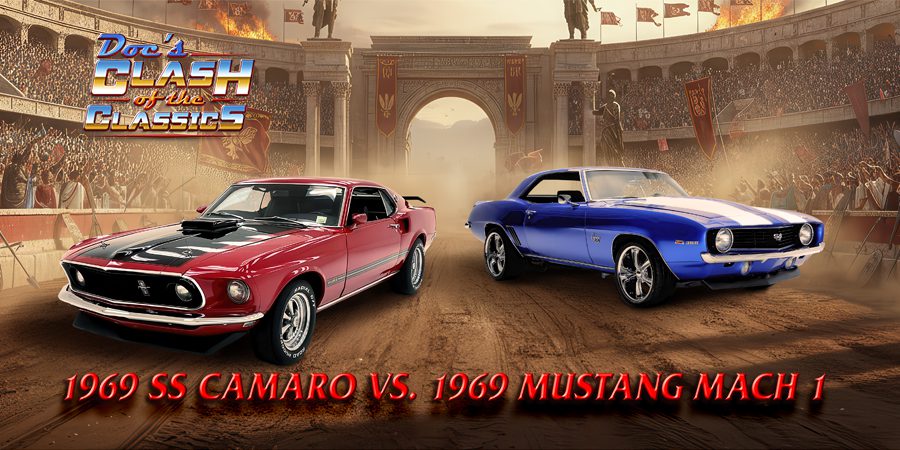
Welcome, once again to Clash of the Classics. This month we’ll head back to 1969 for a look at two cars that defined a decade. Very few models have had the impact these two designs have had on our American culture. Both cars represent symbols of freedom and individuality while brilliantly combining style and performance. The 1969 Camaro SS 396 and the 1969 Mustang Mach 1 go head-to-head today for a showdown that promises to be informative as well as entertaining.
1969 was an interesting year in our nation, Apollo 11 landed on the moon with Neil Armstrong becoming the first person to walk on its surface, the Woodstock Festival happened in New York, while at the same time there were thousands across the country protesting the Vietnam conflict. It was also a time when Ford and Chevy were competing for dominance in the muscle car arena.
Few rivalries in the muscle-car era were as powerful or as personal as the battle between Chevrolet and Ford in 1969. Cars weren’t just machines—they were extensions of identity, symbols of competition, and the pulse of American youth culture. At the center of that rivalry were two titans: the 1969 Chevrolet Camaro SS 396 and the 1969 Ford Mustang Mach 1 351. Both cars came from brands that refused to finish second, both were engineered for speed, and both earned reputations that have outlasted their own era.

More than 55 years later, the question still stirs the same debate in car clubs, garages, and show fields: Which car was truly better? The answer isn’t simple—because the very things that separated these two cars are also what made each unforgettable.
I think most of us would agree, the late 1960s marked the era of bold, muscular automotive design. Automotive manufacturers weren’t afraid to try new ideas regarding styling and power. The late 1960’s saw many aggressive new styling cues but the Camaro SS 396 and 351 Mach 1 Mustang approached aggression in two very different ways.
 Chevrolet redesigned the Camaro for 1969, sharpening every visual line. The car looked compact, dense with muscle, and lowered to the ground like a predator ready to strike. A wide, chiseled grille with recessed headlights, dramatic front fenders, and a sculpted rear quarter gave it one of the most aggressive silhouettes of its time. Even at rest, the SS badge on the grille and rear panel—paired with the cowl-induction hood and hockey-stripe graphics — announced performance without apology.
The Camaro’s style was confrontational. It didn’t just look fast; it looked dangerous. Built during the golden age of horsepower and high-octane design, the ’69 SS Camaro captured the essence of performance, youth culture, and automotive rebellion.
Ford took a different visual approach. The Mustang Mach 1 stretched lower and longer than its predecessors, emphasizing aerodynamics and elegance within its aggression. The satin-black hood treatment with a functional scoop, front chin spoiler, rear spoiler, and rear window slats gave it unmistakable character. The Mach 1 looked less like a street brawler and more like a polished competitor built for high-speed dominance. Where the Camaro showed force, the Mach 1 showed command.
Years ago, we interviewed Jay Leno on our Horsepower for an Hour radio broadcast and we asked him to characterize the ongoing feud between these two cars. I believe he said it best when he replied; “The Camaro is raw and muscular whereas the Mustang is more sleek and purposeful”.
 One thing seems certain, both are among the most iconic shapes in muscle-car history. Choosing between them isn’t about aesthetics—it’s about personality.
Beginning with the interior, the Camaro offered a cockpit-style dashboard angled toward the driver. Gauges were bold and performance-focused, especially with the optional console-mounted instrument cluster. The seating position sat low, adding to the sense of connection with the road. The interior reflected the Camaro’s mission: performance first, comfort second.
Ford, on the other hand, aimed for premium performance. The Deluxe Mach 1 interior included wood-grain trim, high-back bucket seats, thick steering wheel, and optional Rally Pack gauge cluster. The cabin carried a mix of luxury and racing heritage— proof that a performance car didn’t have to be stripped down.
 Under the hood, the Camaro SS trim offered several V8s, but the jewel was the 396-cubic-inch big-block V8, with outputs officially ranging from 325 to 375 horsepower depending on configuration. Like many muscle-car engines of the era, horsepower figures were widely believed to be underrated. The 396 delivered massive torque and violent acceleration, particularly with the higher-performance L78 version. Chevrolet paired it with heavy-duty suspension, power disc brakes, and optional close-ratio Muncie 4-speed, creating a true street and drag-strip weapon. To sum it up, the Camaro SS 396 was about one thing above all: domination through raw power.
Much like the Camaro, Ford also offered several engines for the Mach 1, but the 351—available as Windsor early in the year and Cleveland later— became the most balanced configuration. Rated at 290 horsepower, the 351 was lighter on the nose, and more responsive than the heavier big-blocks. The Mach 1 351 felt confident not only in a straight line, but also through turns and highway sweepers. It was the configuration that best expressed Ford’s engineering goal: speed with control. While power and acceleration are important in a muscle car, sheer power doesn’t always equal the best driving experience.
Chevrolet reinforced the SS package with stiffer springs, upgraded shocks, a front stabilizer bar, and power-assisted disc brakes. The car was certainly fast in a straight line but not the most nimble in terms of handling. The weight of the 396 up front made the SS harder to hustle into corners and more sensitive to heat buildup in demanding conditions. In an era before traction control, anti-lock brakes, and computerized tuning, the Camaro SS delivered power in its purest, most unfiltered form and when driven in its element—full-throttle acceleration— the SS delivered an experience few cars of the era could match. It wasn’t subtle; it was spectacular. That raw character is a major reason enthusiasts still cherish the ’69 model today.
 The 1969 Mach 1 showcased one of the most performance-tuned factory suspensions Ford had produced to that point. Designed to match the capability of the Mach 1’s 351 engine, the suspension system blended muscle car firmness with real-world drivability. Up front, Ford used an independent coil-spring suspension with heavy-duty shock absorbers and a thicker-than-standard anti-roll bar, giving the Mach 1 sharper steering response and greater stability through corners compared to the base Mustang. The optional Competition Suspension package further enhanced body control with stiffer springs and shocks for drivers seeking a track-ready feel.
 At the rear, the Mach 1 relied on a proven live-axle setup with multi-leaf springs, but its unique damping rates and upgraded hardware allowed it to handle high torque without excessive wheel hop. Gas-charged shocks became available later in the production year, improving performance under demanding driving conditions. Together, the system provided the balance that muscle-car fans wanted: firm control under acceleration and braking while still offering comfortable highway cruising. The 1969 Mach 1’s suspension not only supported its bold performance image, it helped establish the model as one of the most respected handling cars of the classic muscle-car era.
 Many modern owners say the Mach 1 with the 351 V8 under the hood is the configuration that “feels right” behind the wheel.
As you may have noticed up to this point in our research, these cars are not only competitors, they also compliment one another. Each model has built a fierce reputation and following but in different arenas and for different reasons:
- Camaro SS 396 became a feared presence at street races and drag strips. Its torque and gearing made it the terror of stoplight competitions.
- Mustang Mach 1 351 earned admiration from drivers who wanted a car that looked menacing yet could handle curvy roads and long highway stretches without compromise.
- The SS 396 commands respect for being one of the most desirable Camaros ever built and a top performer among Chevy loyalists.
- The Mach 1 351 remains one of the best-driving classic muscle cars and is celebrated for being the most complete version of the Mach 1 formula—not just the most powerful. Today, both cars are royalty in the classic-car world. Each have developed a cult-like following that seems to grow in popularity with every passing year. Two of the largest Classic Car events that happen annually here in America are the Fabulous Fords Forever event in Southern California and Hot August Nights in Reno Nevada. We’ve covered both these shows at various times throughout the years and it is always a treat to see and experience some of the finest Mustangs and Camaros anywhere.
Now, it’s time to try and choose which car we like better. The only problem is, how can one choose between these two titans? If it’s the surge of torque and big-block fury you seek, the Camaro SS 396 is probably the choice for you. However, for those who prefer a muscle car that performs everywhere, not just in a straight line, the Mach 1 Mustang may be a more suitable choice.
Regardless of which car you prefer, the fact remains both cars are legends. They weren’t built to be alike—they were built to compete. Their differences made the rivalry unforgettable, and their strengths ensured both would earn a permanent place in automotive history. More than half a century later, the debate continues not because the question needs settling—but because reliving it keeps the golden age of American muscle alive.
For us here at ATRA’s Clash of the Classics, it’s the Mach 1 that gets the checkered flag. The SS Camaro is a true icon and worthy of all admiration, however, the Mach 1 has a feel of class that makes it irresistible.
As always, we’d love to hear from you, let us know which car you prefer and why.
Until next time when we take a ride on a classic highway, stay safe… stay timeless… stay classic!
About The Author
Donny Caccamise is an Automotive Technology Graduate and a Certified Master Technician with more than 40 years of automotive industry experience. Before retiring, he hosted the Nationally Syndicated Automotive Talk Radio Show “Horsepower for an Hour” airing on 161 AM and FM radio stations across the nation. He is a retired member of the ATRA Board of Directors, and retired transmission shop owner. Vintage and classic cars are his specialty. Contact Donny at donnycaccamise@gmail.com.