Welcome, once again to Clash of the Classics. This month we’ll head back to 1968 for a fresh look at two of my all-time favorite cars, the Pontiac GTO and the Dodge Charger.
For those of us who are old enough to remember that far back, you may recall, 1968 was a bit of a tumultuous time here in America. The Vietnam conflict was raging on, Richard Nixon defeated Hubert Humphrey to become the next president, and Martin Luther King was assassinated which led to riots in more than 100 cities.
Despite all the tumult, there were a few standout moments in 1968, two of them were the 1968 Pontiac GTO and the 1968 Dodge Charger. Let’s begin with an overview of the GTO.
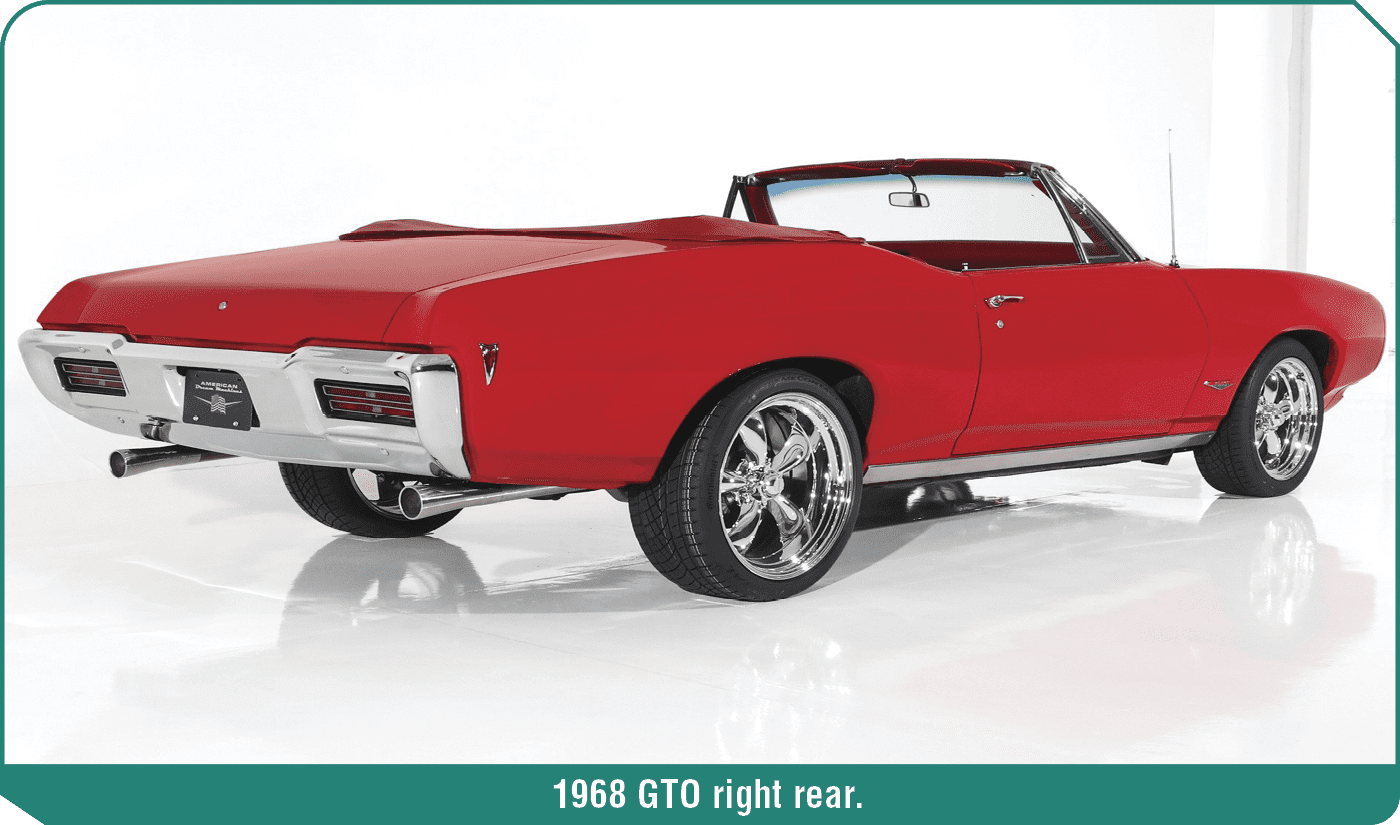 When Pontiac rolled out the redesigned GTO for 1968, the American muscle car landscape was already a battlefield of horsepower and attitude. But Pontiac’s latest move wasn’t just about muscle—it was about sophistication, style, and the subtle menace of those mysterious hideaway headlights. The 1968 GTO wasn’t just a performance car; it was a statement of dominance wrapped in curves and chrome. The GTO had already made a name for itself by 1968. Introduced in 1964 as an option package for the Tempest, it essentially launched the muscle car movement by dropping a big V8 into a midsize body. But by the time 1968 arrived, Pontiac knew the market demanded more than brute power—it wanted presence. That year, the GTO moved to the new GM A-body platform, featuring a shorter wheelbase (112 inches), wider stance, and a sleek, sculpted design. The boxy lines of earlier models were gone, replaced with a flowing “Coke-bottle” profile that screamed motion even at a standstill. One of the defining visual cues was the unique front bumper—a body-colored, flexible urethane nose that could withstand minor impacts without denting or chipping. Integrated into that bumper was the GTO’s most striking option: hideaway headlights.
 The hideaway headlight setup added an unmistakable mystique to the ’68 GTO. Instead of traditional exposed lamps, the car’s headlights were hidden behind vacuum-operated doors that matched the Endura bumper perfectly. When off, the front end appeared as a seamless, menacing mask. When the lights flipped open, they gave the GTO a dual personality—part gentleman, part street brawler.
This option, priced around $52, wasn’t just a gimmick. It elevated the GTO’s design to rival European GT cars and made the Pontiac stand out in a crowd of chrome-heavy muscle machines. Today, enthusiasts and collectors often cite the hideaway headlights as one of the most desirable features of the 1968 model year.
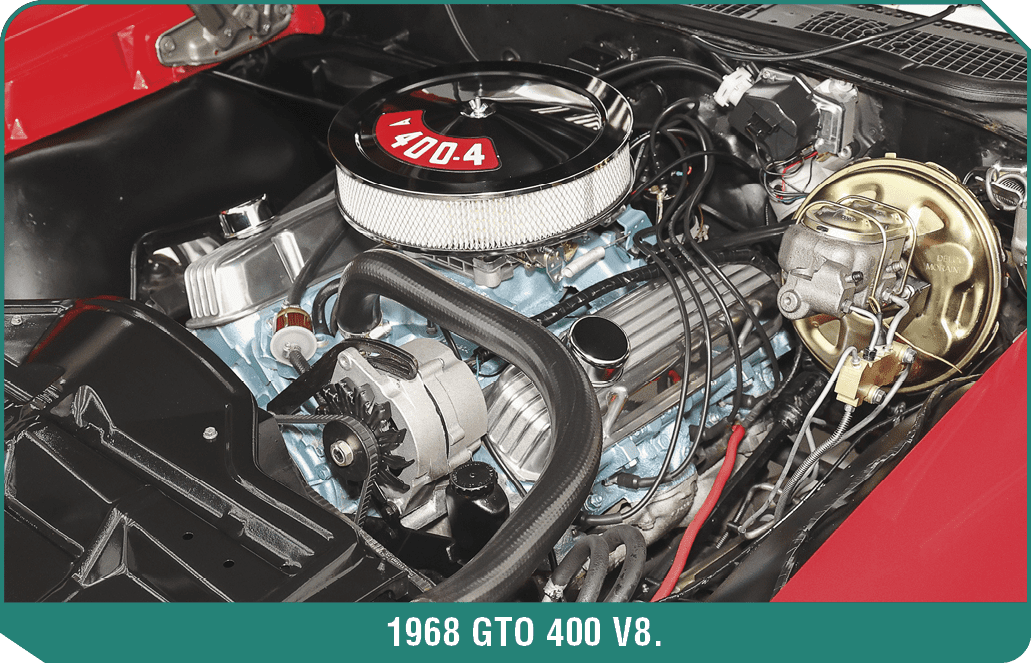 Of course, looks alone don’t make a GTO. Under the hood, Pontiac offered plenty to back up the car’s aggressive face. The base engine was the 400-cubic-inch V8 rated at 350 horsepower and a stump-pulling 445 lb-ft of torque. For those seeking even more thrill, options included the 400 HO (High Output) producing 360 horsepower, and the legendary Ram Air package with functional hood scoops and a more aggressive camshaft.
Transmission choices ranged from a standard three-speed manual to a four-speed manual or a THM 400 automatic. Rear-end ratios and suspension options could be tailored to the driver’s taste—whether that meant a smooth cruiser or a stoplight terror. With the right setup, a 1968 GTO could rocket from 0 to 60 mph in around 6 seconds, an impressive feat for a street car in its day.
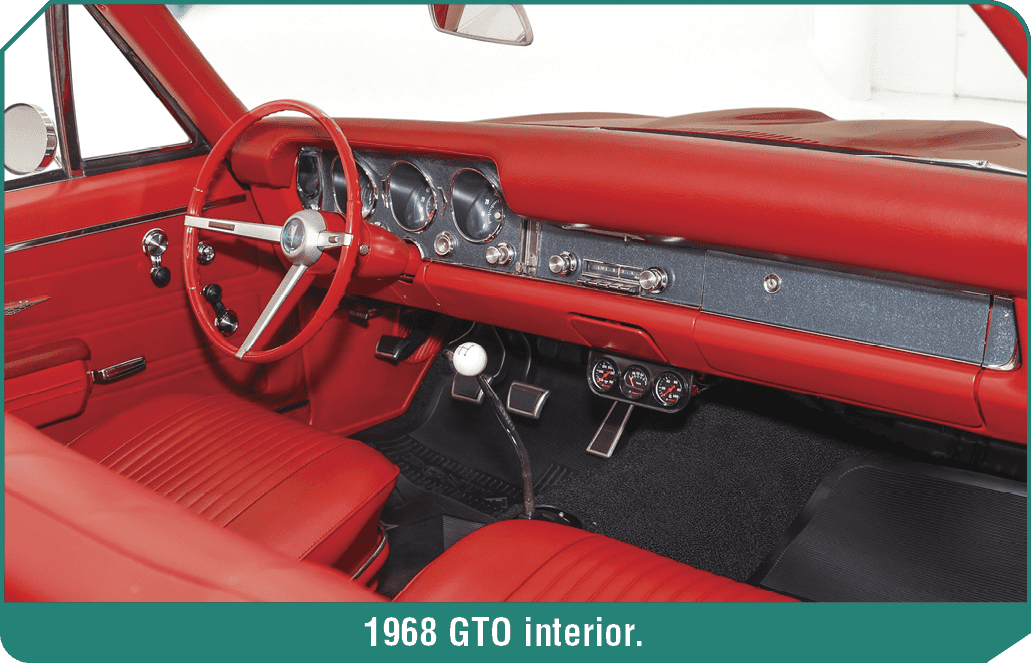
The interior of the 1968 GTO was every bit as driver-focused as its exterior was bold. The cockpit featured deeply set gauges, a woodgrain dash, and a floor-mounted shifter positioned within easy reach. Pontiac’s attention to detail extended to comfort as well—bucket seats, optional center console, and even an available 8-track stereo system brought luxury to the muscle car world.
Buyers could also choose from a variety of interior trims and colors, ensuring that no two GTOs looked quite alike. Whether dressed in black vinyl or parchment leatherette, the cabin provided an ideal blend of style and sportiness.
The 1968 GTO wasn’t just a pretty face—it was a performer. Magazines of the time, including Car and Driver and Motor Trend, praised its balance of power and handling. The Endura front end reduced weight slightly, and the new suspension geometry gave the car a more composed ride than its predecessors. On the drag strip, the GTO proved its mettle, running quarter-mile times in the low 14-second range with the Ram Air engine option.
But more than numbers, the GTO embodied the spirit of the late 1960s—a time when Detroit dared to blend muscle with modern design. It was the kind of car that could look right at home parked at a drive-in diner or tearing down Woodward Avenue at midnight. Though the GTO would evolve through the early 1970s, many enthusiasts consider 1968 to be one of the high-water marks of the brand. It was the first year for the sleek redesign, the debut of the Endura bumper, and the introduction of those unforgettable hideaway headlights. By 1969, minor updates followed, but the essence of what made the ’68 special remained— power, style, and a hint of mystery.
The 1968 Pontiac GTO with hideaway headlights represents more than just a model year—it’s a defining moment in automotive design. It marked the point where muscle cars grew up, trading brute force for balance and sophistication without losing their edge. The hideaway headlights, subtle yet striking, symbolized that transformation perfectly.
Over half a century later, the ’68 GTO still turns heads—just because it can.
 Now let’s look at the 1968 Dodge Charger.
As we mentioned earlier, by 1968, Detroit’s horsepower wars were in full swing. Every automaker wanted to build the car that defined American muscle—something that looked mean, went fast, and turned heads on Main Street. Dodge, already a fierce competitor with its Coronet-based performance cars, decided to raise the stakes. The result was the 1968 Dodge Charger R/T 440, a bold, beautiful, and brutal machine that blended refined styling with raw, unfiltered power. It wasn’t just another muscle car—it was the car that made Dodge a legend.
The 1968 model year marked a complete redesign for the Charger, and it was a game-changer. Gone were the squared-off lines of the 1966–67 models. In their place was one of the most striking silhouettes in muscle car history—a sleek, fastback body with hidden headlights and a “Coke-bottle” profile that oozed aggression. The recessed grille and full-width taillights gave the Charger a menacing presence, especially when viewed in a rearview mirror.
 Designer Richard Sias’ work on the new Charger was revolutionary. The roofline flowed gracefully into a tunneled rear window, a feature that became an instant design signature. While the previous Charger had struggled to stand out, the 1968 model exploded onto the scene with style, substance, and a look that was pure muscle. The R/T (Road/Track) package made the Charger even more formidable. Standard R/T upgrades included heavy-duty suspension components, front disc brakes, bumblebee tail stripes, and aggressive badging that left no doubt about the car’s intentions.
Under the hood, the Charger R/T came standard with the mighty 440-cubic-inch Magnum V8, a powerhouse that produced 375 horsepower and 480 lb-ft of torque. This engine was a masterpiece of Mopar engineering: a high-compression big block with forged internals, a Carter four-barrel carburetor, and a deep, guttural exhaust note that announced its presence long before it appeared.
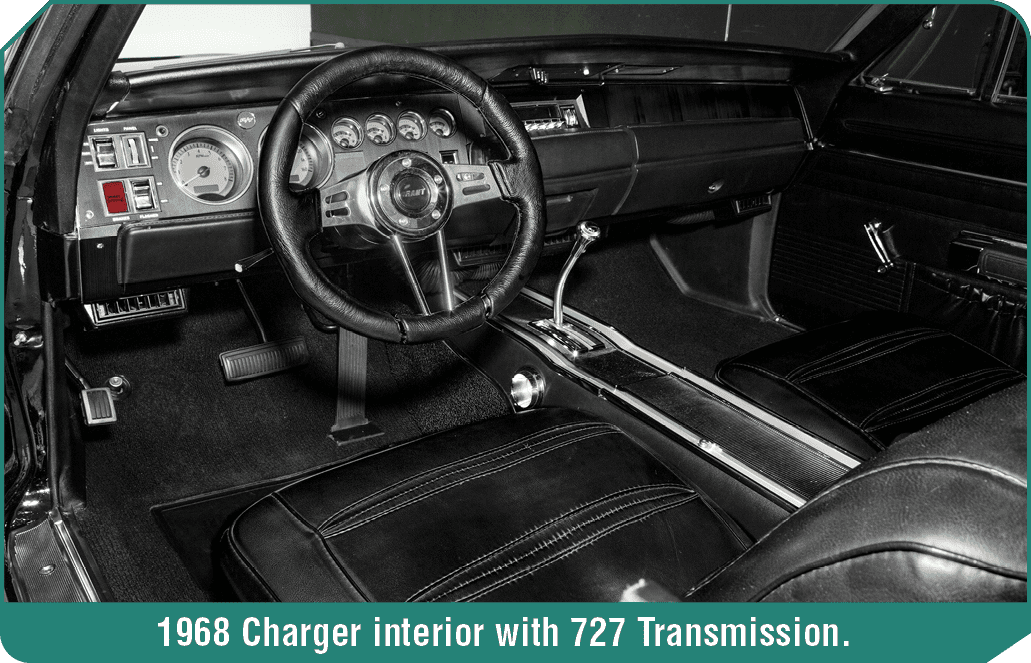 For the truly fearless, Dodge offered the legendary 426 Hemi as an option. But for most buyers, the 440 Magnum struck the perfect balance between street drivability and sheer power. With a four-speed manual or a Torqueflite 727 transmission, the 440 Charger R/T could launch from 0 to 60 mph in just over six seconds and cover the quarter-mile in the low 14s.
In 1968, those numbers meant you were running with the top dogs—Chevelle SS396s, GTOs, and Mustang 428 Cobra Jets. And more often than not, the Charger came out ahead.
The Charger’s design wasn’t just about looks—it was about identity. The hidden headlights, operated by a vacuum system, gave the front end a clean, aggressive face when closed, and a sinister glare when open. Out back, the full-width taillight panel glowed red across the entire rear fascia, a feature that became instantly recognizable on dark streets and at stoplight duels.
Inside, the Charger offered a level of sophistication rare for a muscle car. The interior was driver-focused, with deeply set round gauges, bucket seats, and an optional center console. Unlike many muscle cars that felt stripped-down, the Charger blended comfort with performance. Power windows, woodgrain trim, and even air conditioning could be ordered, allowing buyers to have luxury without giving up speed.
The Charger R/T’s heavy-duty suspension and wide track gave it a confident, planted feel on the road. Though it was no lightweight at nearly 4,000 pounds, the car handled surprisingly well for its size, especially compared to some of its musclebound rivals. The torsion-bar front suspension and leaf-spring rear setup delivered a mix of control and comfort that made the Charger more than just a drag-strip star—it was a legitimate highway cruiser.
And of course, the sound was unmistakable. Few cars can match the deep, throaty growl of a 440 Magnum breathing through dual exhausts. It was a noise that stirred something primal—a mechanical symphony that captured the spirit of the late 1960s. If the Charger R/T wasn’t already iconic, Hollywood made sure it would never be forgotten. In 1968, the same year the redesigned Charger hit showrooms, audiences watched Steve McQueen chase a black Charger R/T through the streets of San Francisco in the movie Bullitt. That high-speed pursuit became one of the most famous car chases in film history—and cemented the Charger’s reputation as the ultimate bad-boy muscle car.
The car’s image as a rebel machine carried through pop culture for decades, appearing in everything from The Dukes of Hazzard to Fast & Furious. But it all began with the 1968 R/T—the car that looked mean, went fast, and changed Dodge’s image overnight.
Dodge sold over 96,000 Chargers in 1968, an astounding success compared to previous years. Of those, roughly 17,000 were R/T models, making them highly desirable today. Collectors prize originality, matching-numbers drivetrains, and of course, the 440 Magnum or 426 Hemi under the hood.
As is the case with the GTO, the 1968 Charger R/T remains a masterpiece of American design—a car that perfectly captured the blend of performance, style, and swagger that defined the golden age of muscle.
Now comes the hard part, those readers who follow our monthly battles know that there must be a winner in todays contest. The problem is, how does one choose between these two titans.
While both of these cars are truly iconic, it is the GTO that gets the checkered flag today. While the Charger is certainly worthy of admiration, it is the uniqueness of the GTO that puts it over the finish line first for us.
As always, we’d love to hear from you, let us know which car you prefer and why.
Until next time when we take a ride on a classic highway, stay safe… stay timeless… stay classic!
About the Author
Donny Caccamise is an Automotive Technology Graduate and a Certified Master Technician with more than 40 years of automotive industry experience. Before retiring, he hosted the Nationally Syndicated Automotive Talk Radio Show “Horsepower for an Hour” airing on 161 AM and FM radio stations across the nation. He is a retired member of the ATRA Board of Directors, and retired transmission shop owner. Vintage and classic cars are his specialty. Contact Donny at donnycaccamise@gmail.com