Operational excellence is the heartbeat of every thriving business, and it begins with leaders who refuse to settle for average results. It’s more than a corporate slogan; it is a disciplined way to build momentum, remove friction, and help people perform at their best. Having established the cultural desire to win in the previous chapter, the next question is clear: what specific tools can help your team rise to a higher standard and stay there?
The answer lies in adopting practical methodologies that create clarity, inspire action, and turn improvement into a shared mission. Proven tools are available for management teams, operations staff, and business leaders who want to strengthen execution, energize their people, and build a culture where progress is expected, measured, and celebrated.
1. The DMAIC Approach: Transforming Chaos into Clarity
When faced with entrenched organizational problems, leaders often ask, “How do you transform chaos into clarity?” DMAIC provides a structured, data-driven problem-solving method that supports Six Sigma and continuous improvement efforts. DMAIC stands for Define, Measure, Analyze, Improve, and Control. This sequential framework gives teams a practical roadmap for addressing complex operational challenges with confidence, discipline, and purpose.
- Define: Clearly and objectively outline the specific problem and desired outcome. For example, if customer orders are late, define the exact delay, affected process, and expected service target before proposing solutions.
- Measure: Establish data-backed baselines so the team understands current performance. A warehouse team, for instance, might measure average pick time, error rate, and daily throughput before changing the workflow.
- Analyze: Look beneath surface symptoms to identify the root cause of inefficiency. Teams should examine whether delays come from unclear roles, poor handoffs, inadequate training, equipment constraints, or process design.
- Improve: Once the root cause is clear, take focused action to solve the problem. Small, tested changes—such as reassigning a handoff point or simplifying an approval step—often create faster gains than waiting for a perfect solution.
- Control: Put systems in place to sustain improvement. Owners, checkpoints, standard work, and follow-up metrics help ensure that progress becomes the new operating standard.
DMAIC is a strong foundation for continuous improvement because it turns problem-solving into a repeatable management discipline. Used consistently, it helps teams move from reaction to control, from frustration to focus, and from scattered effort to measurable progress.
2. Kaizen Principles: The Power of Incremental Growth
There is an adage that states, “If you want to travel far, start small.” This sentiment captures the value of Kaizen. Rooted in Japanese industrial philosophy, Kaizen emphasizes continuous, incremental improvement rather than waiting for large, disruptive overhauls. It reminds leaders that meaningful transformation is built one better choice, one better process, and one better habit at a time.
To effectively infuse Kaizen Principles into your daily, ground-level operations, you must adopt the following habits:
- Identify system bottlenecks and eliminate steps that add no value to the customer. A team might reduce repeat data entry, shorten a material handoff, or remove an approval that does not improve quality or control.
- Encourage every member of the organization—from leadership to the front line—to contribute improvement ideas. The people closest to the work often see the most practical opportunities to simplify it.
- Review workflows regularly and identify where small, low-cost changes could improve speed, quality, safety, or cost. Consistent review turns improvement into a habit rather than a special project.
Long-lasting improvement rarely comes from one dramatic leap forward. It is usually built through steady, deliberate progress that compounds over time and creates confidence across the organization.
3. Focus on Key Metrics: The Organizational Compass
As management expert Peter Drucker is often paraphrased, success must be measured, not guessed. In business, numbers help leaders understand “What’s Working”, what is slipping, and where attention is needed. Key metrics serve as an organizational compass, giving teams the confidence to make decisions, celebrate wins, and correct course before problems become patterns.
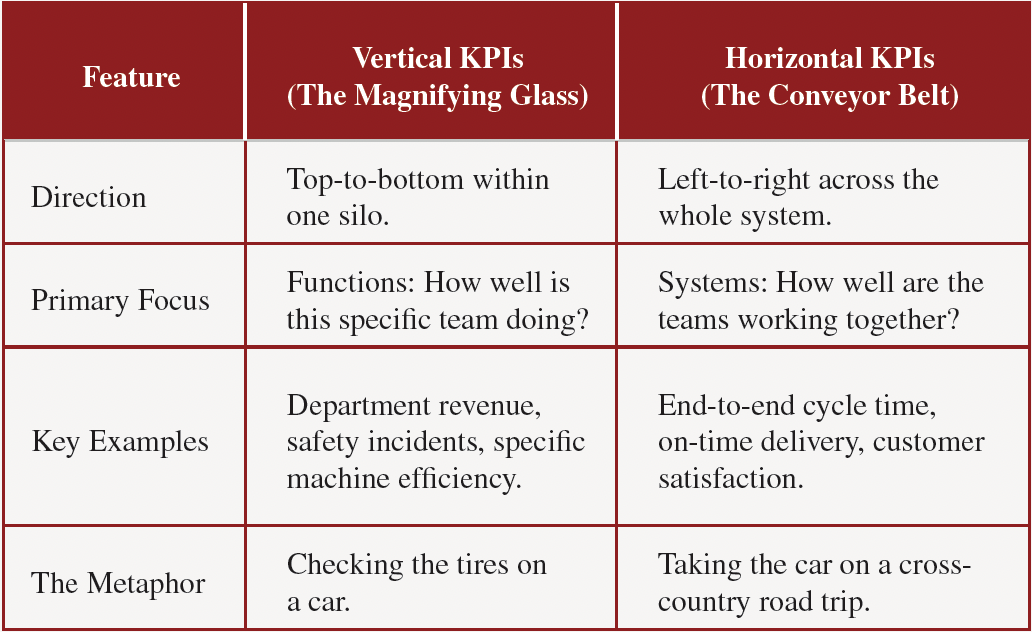 However, organizations can easily become overwhelmed by data. To avoid confusion, leaders should prioritize both vertical and horizontal KPIs to see detailed performance and broader system health.
- Vertical KPIs: These metrics help leaders drill into specific areas of the business, such as production efficiency, order accuracy, safety incidents, or departmental revenue growth. They reveal how individual functions are performing within the larger operation.
- Horizontal KPIs: These metrics give leaders a broader view of organizational performance, such as customer satisfaction, end-to-end cycle time, on-time delivery, or overall process flow. They show how well the system performs across departments.
The rule is simple: track what truly matters, not merely what is easy to calculate. When the organization focuses its attention and energy on the right indicators, performance conversations become clearer, improvement becomes easier to manage, and teams gain visible proof that their efforts are moving the business forward.
4. Eliminating Waste with TIM WOODS
As highlighted in the foundational chapters on Lean methodologies, many operational inefficiencies stem from waste. To improve flow and unlock capacity, teams should examine each process through the TIM WOODS framework: Transport, Inventory, Motion, Waiting, Overproduction, Overprocessing, Defects, and Skills.
- Defects: Locate exactly where systemic errors and quality failures are forcing costly, time-consuming rework.
- Skills: Assess whether people’s talents, knowledge, and capabilities are being fully used in the right roles and improvement efforts.
Every form of operational waste drains resources, time, and energy that could be invested in serving customers, developing people, and winning in the marketplace. The leadership challenge is to remove what does not add value, simplify the work, and create more capacity for the activities that matter most.
Reflection and Call to Action
As you reflect on the tools and methodologies presented in this chapter, ask yourself a direct question: are you leading your team with a clear plan for winning, or are you hoping performance will improve on its own? Winning cultures do not drift into greatness. They are built by leaders who choose discipline, equip their people, and stay committed to continuous improvement when it would be easier to accept the status quo.
As a leader, remember this operational truth: what you tolerate within your organization often becomes the accepted standard. Begin the transformation by applying the principles outlined above, measuring progress, and modeling the discipline you expect from the team. When leaders demonstrate commitment, teams begin to believe that excellence is not just expected—it is achievable.
If you are ready to elevate your team’s performance, choose one process today that is slow, wasteful, or frustrating. Establish its baseline, assign an owner, apply DMAIC and TIM WOODS, and review progress within a defined timeframe. Decisive action creates momentum, and momentum inspires belief. When your team sees improvement taking shape, they begin to understand that winning is not an accident; it is the result of disciplined action repeated over time.
Operational excellence is not an optional luxury reserved for large corporations; it is a practical advantage for organizations that want to compete, adapt, and improve. Equip your team with the right tools, commit to disciplined execution, and build a culture where success is pursued with purpose and pride. This is how organizations grow stronger, teams grow more confident, and leaders create the ultimate Winning Culture!