An early model Ford Transit Connect comes in with the check engine light on. Perhaps it was recently purchased, and the new owner got it for a low price because the transmission keeps going into failsafe. Checking codes, you may find P0732 (2nd gear ratio) and/or P0733 (3rd gear ratio). You check the fluid, and it looks pretty fresh. Maybe the seller has changed the fluid (something we’ve seen since the early days of automatic transmissions, new fluid, and, if equipped, a new modulator too). Seldom have these repairs worked, but they do help us understand the situation. This is a problem, and now it’s been brought to you. Often in the case of recent purchases, the new owner doesn’t know the history, or if it’s from a used car lot, they won’t either, as they bought it through wholesale.

 On further inspection, you see that the pan has little to no debris, and it’s thought that the case or drum is worn and leaking. So often, the transmission gets rebuilt with the servo pin bore getting reamed out and a bushing installed. All the common wear points were addressed, and a very confident tech found on the road test the P0732 or P0733, or both, have returned.
When Ford came out with the Transit Connect in 2010, it used two reliable, proven designs in its powertrain offering: the 2.0 Duratec gasoline engine and the 4F27E transmission. The 4F27E was already ten years old, and the 2.0 Duratec was only a year newer. This means that the engine and transmission have had many major and minor issues resolved through redesigns and material changes as needed. By the time the Transit was offered (2010 in North America), it was logical that the vehicle be offered with a proven powertrain. In North America, the 2.0 Duratec and 4F27E combination was available in the Ford Focus as far back as 2001.

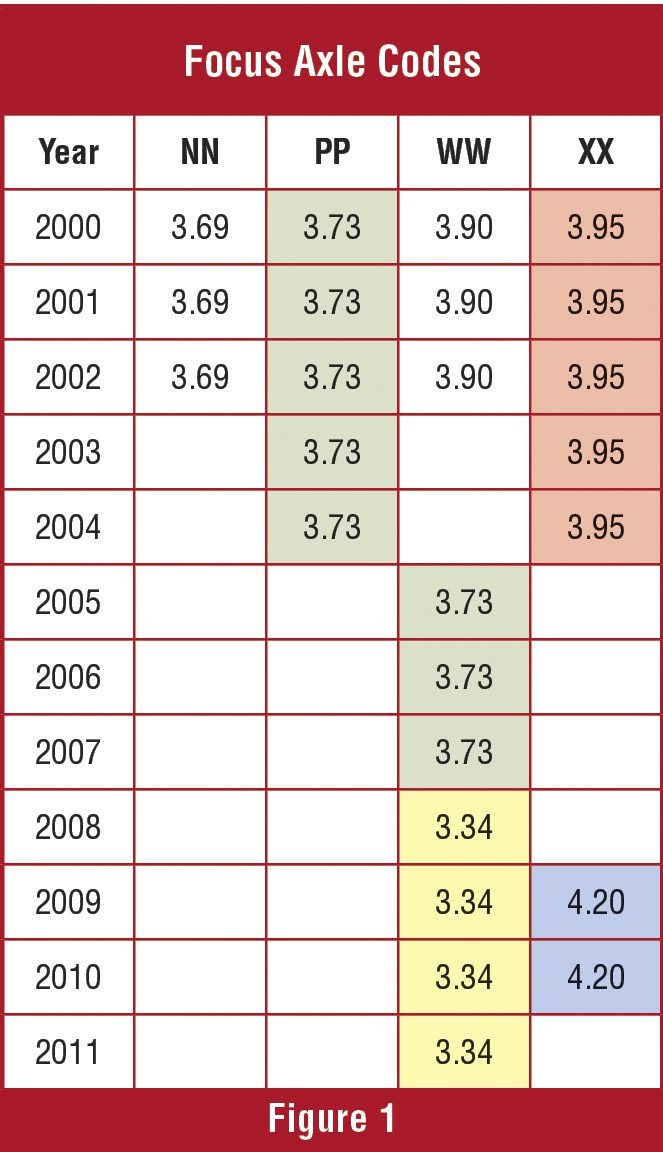
The problem is that the Focus was offered with many different final drive ratios, whereas the 2010 to 2013 Transit Connect had two possible ratios depending on the year. What makes matters worse is the Axle codes on the Vehicle Certification (VC) Label (Figure 1) may show codes for different ratios depending on the year. For instance, axle code XX can be a 3.95 ratio for the 2000 to 2004 model years but becomes a 4.20 ratio for the 2009 -2010 years.
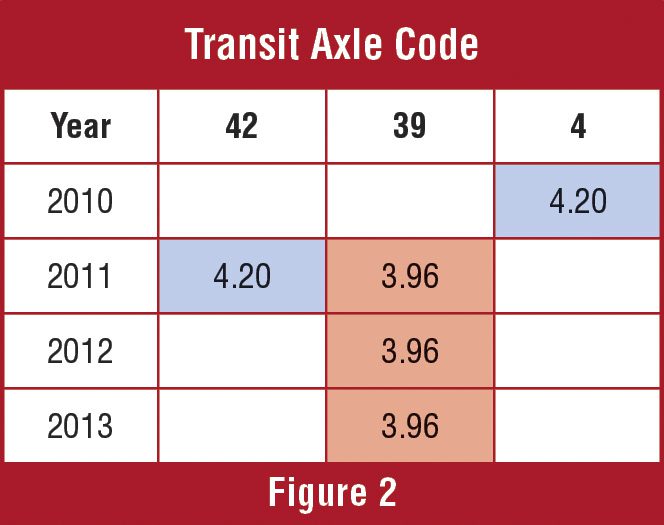 The table in figure two shows the 4.20 ratio offered in 2010 and 2011 models with VIL axle codes of 4 or 42. If a Focus transmission was installed with the VC code XX, it was possible to get the 4.20 ratio. It was also possible to get the 3.95 ratio.
Ratios are calculated by the PCM using the difference in RPM between the input speed sensor and the output sensor. In the case of the 4F27E, the output is the VSS. The PCM also looks at the engine RPM and expects to see the engine RPM change appropriately when a gear is commanded. With an incorrect ratio, the engine RPM is too high or too low and will likely set a ratio code.
IDENTIFYING WHAT YOU HAVE VS. WHAT YOU NEED
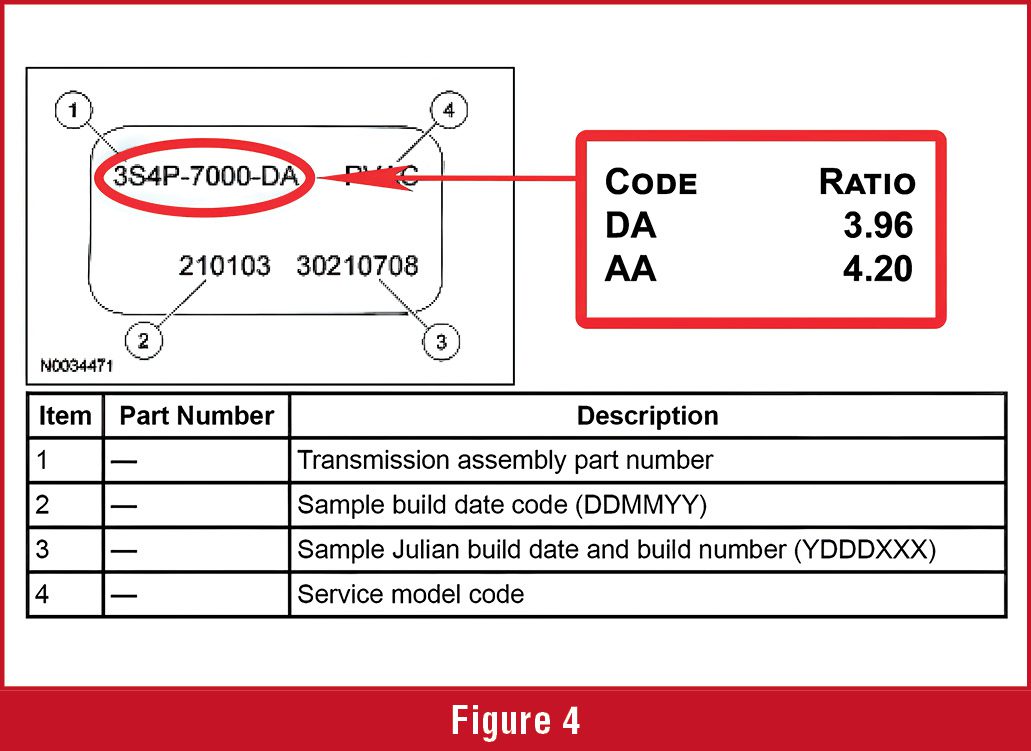
The identification tags on the vehicle and the transmission will save a lot of work and determine your repair path. First, locate the Vehicle Identification Label (VIL) on the vehicle’s B pillar (Figure 3). At the bottom, you’ll see “Axle.” The number below that is the code for the ratio. Match the axle code to the chart above in figure two. 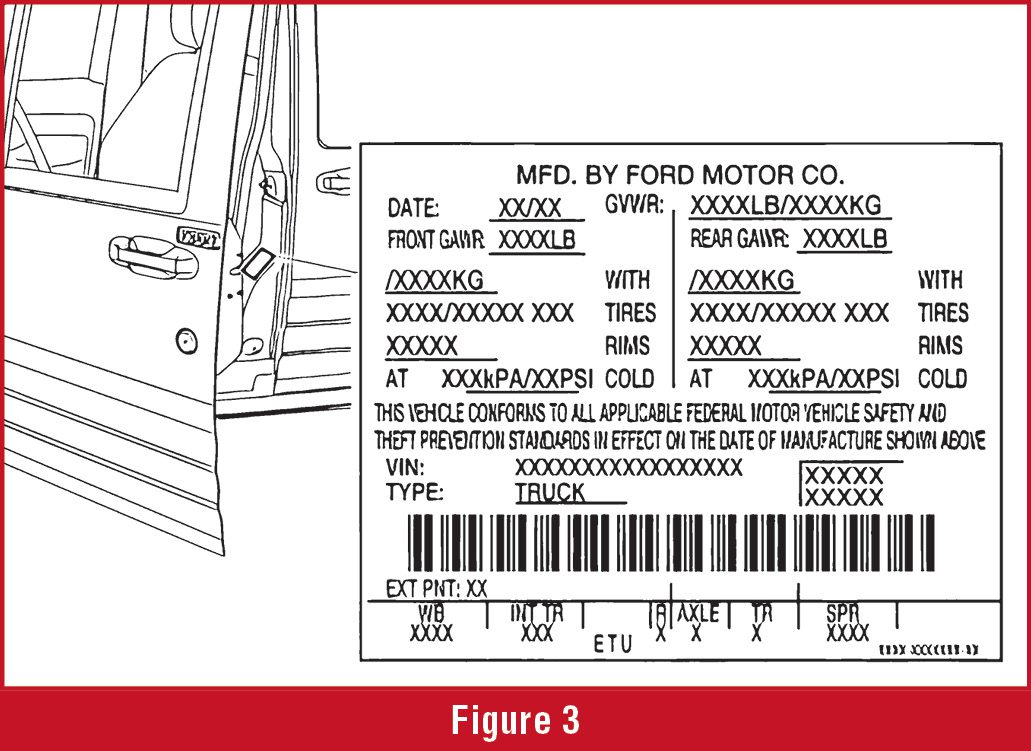 Next, look for the transmission identification tag on the transmission, located on the top right side of the case. If it’s present, look for the Transmission Assembly Part Number (Figure 4). The Transit Connect 4F27E was built with only two Transmission Assembly Part numbers, each with different final drive ratios: DA for the 3.96 ratio and AA for the 4.20 ratio. Looking at the Focus axle code table in figure one, only the 2009 and 2010 Focus with Axle code XX had a matching ratio for the Transit Connect with axle code 4 or 42. The Transmission Assembly Part number is the same for both applications, 8M5P-AA.
 Pay careful attention here. The same XX code on a Focus had two different ratios depending on the year. Only the later model 8M5P part number is the 4.20 ratio. The early model used from 2000 to 2004 is a 3.95 ratio. You’re probably wondering now; can you use the early Focus XX code transmission in place of a AA code Transit? And to be honest, I don’t know. They are so close in ratio that, logically, it seems like they would work. But when we factored in ABS wheel speed sensor data being used to validate VSS signals and expected engine RPM at a given commanded gear and road speed, it’s just unknown how the PCM will react. Use at your own risk.
What if the Transmission ID tag is missing? Well, it’s going to require disassembly of the transmission, counting all the teeth for the transfer gears and the ring and pinion, and a little math. You no doubt have counted ring and pinion gear teeth and found the ratio (ring divided by pinon). However, with this transfer gear setup, it becomes a little different. The output of the transfer gears is on the same shaft as the pinion for the differential. This is called a compound Gear.
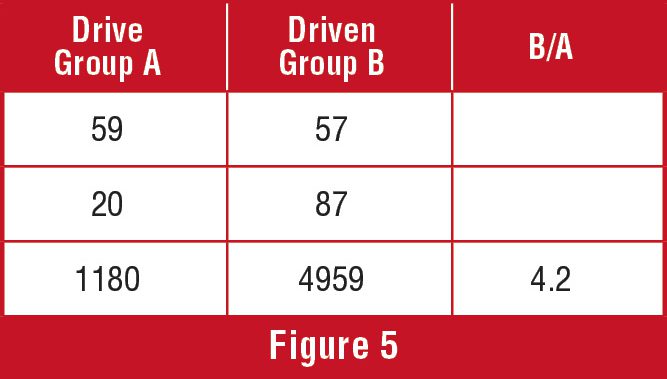 Here’s how you calculate this (follow along with figure five while we go through this): Consider the transfer gear drive gear of 57 teeth and the transfer driven gear of 59. The differential has a 20-tooth pinon and an 87-tooth ring gear. We have two sets of drive teeth and two sets of driven teeth. Multiply the two drive teeth. We’ll call that factor “A” (1180). Now multiply the two driven teeth. We’ll call that factor “B” (4959). Now divide A into B (4959÷1180=4.20). It’s that simple.
For the Transit Connect, any ratio other than 4.20 or 3.96 will result in setting gear ratio codes.
As with any job, listening to the complaint and examining the evidence will save a lot of time. Look to see if the transmission appears to have been replaced, has salvage yard writing on it, has dirt coloration on the transmission that doesn’t match the rest of the engine compartment, or it’s been cleaned, and the engine has not. In those incidences that you can’t be sure if it’s the original transmission or not and the fluid is clean and shifts are good, then use the information on the vehicle and transmission tag (if available) to determine if the transmission has been changed. If that can’t be determined externally, then the next step is to inform the vehicle owner you have to open the transmission and physically check the final drive ratio. It is a lot easier for everyone to identify the problem at the beginning of the job. It’ll save your builder’s hairline, your R&R tech will be happier, the service manager won’t cringe when the phone rings, and the customer will get their van back on time.