This is the third installment of ATRA+ articles. It’s a project that began a couple of years ago. It’s tied to the ATRA University Project and focused on the technician making the call whether a transmission problem is inside or outside the transmission. It’s a key role and one that ATRA can help teach students of technical schools. It’s an exciting project, and I’m happy to play a small role in launching it. And with this, Gears Magazine has an added feature to help diagnosticians search for articles relevant to their role.

 GEARS magazine currently organizes articles by groups: Technical, Management, and Other (Figure 1). Starting with the March issue, Gears has a new grouping, ATRA+. You can access any article relevant to the diagnostician by going to this heading. There are only three articles now, but the ATRA Tech team will get busy adding past articles that meet the diagnostic standard to this group. It’s a big leap in training shop techs that serve a key role.
In this edition of Shop Talk, we’ll look at a few overlooked check items that can cost you time, money, and customer satisfaction. Take a moment and consider that today’s computer knows if you’re going up a grade, down a grade, and even making a turn. It’s likely it knows the altitude and the weather conditions of where you’re driving. And depending on the manufacturer, there’s a list of other minor tweaks the computer makes on seemingly minor components. Initially, most of these related to engine performance and emmisions but it didn’t take long for engineers to realize that people drive differently going down a grade. If the driver takes their foot off the accelerator pedal and the car is still increasing in speed it might downshift to a lower gear. After all, that’s what the driver might do. And do you think a driver might delay a shift if they’re zooming around a corner? Sure. And what if it senses one tire rotating at a different rate than the others? That’s a tricky one, depending on which wheel it is but the computer might respond in a way you (or the customer) might not expect.

So, a customer comes in for a scheduled check on a shifting concern. We’ll call it “erratic shifting” because the customer can’t quite pinpoint what it does, just that it’s worse first thing in the morning.
You check the fluid level and condition, and they seem ok. You’re about to close the hood and go for a road test. But not so fast! An erratic shift problem (especially first thing in the morning) might be related to the battery (Figure 2).
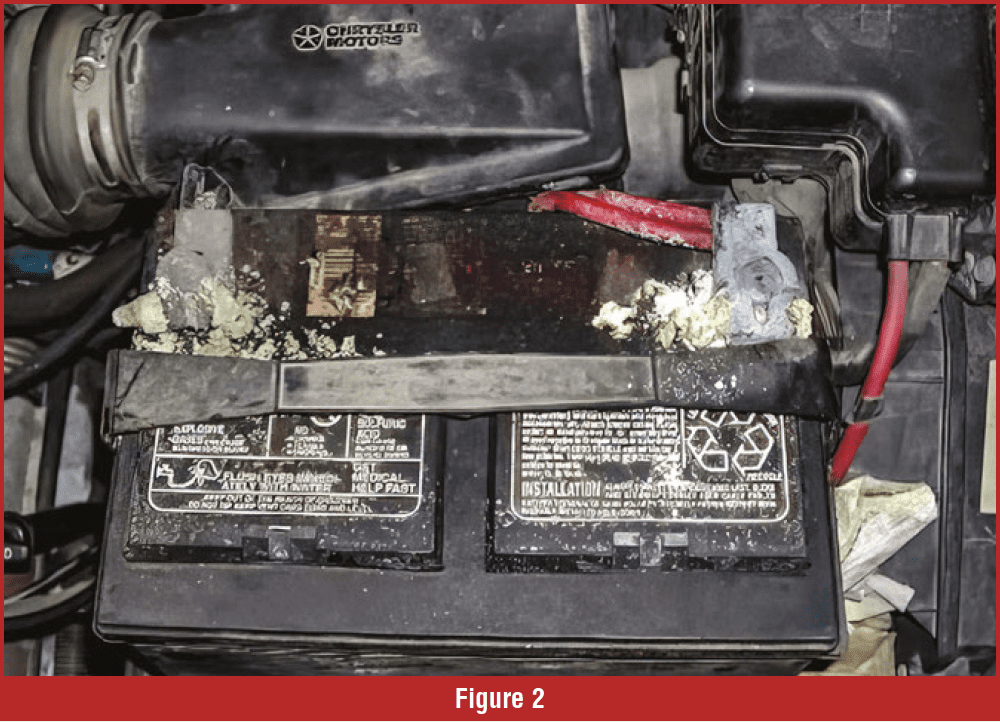 Shift problems related to batteries like this are common on the ATRA Hotline. I’ve even seen this in the field during a shop visit. The technician often doesn’t believe the battery is the problem. Why? Because the engine starts just fine. And then, after exhausting every other possibility (like replacing the computer), they reluctantly replace the battery. And what do you know? It works just fine now.
We’ve found that Chrysler and Dodge vehicles are particularly fussy, but any car or truck can act up with a low battery. Some shops have found this so problematic that they offer a battery service. This includes cleaning the posts and cable connectors, washing the battery to remove “junk” that might supply a small short between the terminals, adding post felts to help reduce future corrosion, and fully charging the battery.
With this knowledge, how about adding a battery check to your list of pre-check items? A fully-charged battery measures 12.67 volts. This is after it sits for some time (overnight is best). If you’re checking this after a recent car drop-off, you might turn on the headlights for a few minutes to eliminate the battery’s surface charge. Now test it again. If it measures 12.44 volts or more, then it’s in good shape. Once it gets down to 12.2 volts, you essentially have a dead battery — even if it cranks the engine. This is the region where cars start to trip codes and misbehave. If you want to know more about this visit www.veejer.com. The owner, Vince Fischelli is the battery guru and has a publication, “First Things First” that is a must read.
Another simple problem that might trip you up involves the tires. Under-inflated and mismatched tires can drive a computer system crazy. I recall a BMW with a range of shifting problems. In the end, after a bunch of testing and wasted time, it turned out that the customer had had a flat tire and put a spare on. It wasn’t the right tire, and the computer couldn’t determine if the driver was going around a corner or on a slippery surface. The question is, how many transmissions do you have to replace for shift problems created by a wrong tire? Even weirder is when a shifting problem is for nothing more than an under-inflated or mismatched tire where the front tires are brand “A” and the rear tires are brand “B.” All of this sounds silly until you’ve rebuilt the transmission, replaced the computer (and perhaps a few sensors), and still have the same problem.
The last thing (for now) is the spark plugs. This is a fairly recent phenomenon but an expensive lesson if you’re ever faced with it. We’ve seen this mostly with Jaguars and BMWs, but we’ve seen it with other cars and can reproduce it in the lab. It comes as a baffling and unpredictable shifting problem of delayed and harsh shifts that you can’t reproduce with a specific routine. You won’t find any DTCs, and nothing stands out in the scan tool data. If you’re not careful, you’ll go through the same routine as the tire issue mentioned above. Before you know it, you’ve quoted $3,600 for the transmission only to find that the replacement transmission suffers the same problem. Now comes the fun part… We’ll stop here because it’s not pretty.
In the lab, we used a Ford Explorer and opened the spark plug gap by A LOT. We overcompensated for extremely worn spark plugs. What we learned was the ignition system, trying to fire the plugs, created EMI (Electromagnetic Interference) that, in our case, made the computer think the vehicle was moving when it was sitting on the lift.
Sure, this is an extreme case, but let’s look back for a moment and consider the following. It had a shifting problem you can’t duplicate (it’s erratic). There aren’t any codes to follow. Today’s computers are pretty smart. They can sense a transmission problem that you can trace. Even if they’re wrong, they’ll at least give you a lead (a false transmission code). If you have nothing to go on, you may want to stop and consider EMI before condemning the transmission. Every manufacturer is different, and ways to check for these problems are different. The ATRA Tech department can help walk you through a calamity like this.
Today, it’s not just about diagnosis, it’s about checking the norms. What should be and what’s not right with a car you have coming into your shop? Who knows, this might launch a new shop position: the Valet. A person who checks that the fluid is right, the tires are right, the battery is right, and all the visual things we rush past are right. It makes me think, “Not so fast.”