Computer control systems can be simplified down to inputs providing information for a control module to command outputs — input, process, and output. Of course, the software side gets pretty deep and complicated, but when it comes down to it, everything that’s involved in engine and transmission computer control fits into one of those three categories. Common inputs include throttle position, temperature, pressure, and position sensors. Common outputs include mostly electromagnetic devices like actuators, solenoids, and coils. The control module makes calculations based on the information from the input devices. Then it controls output components to provide proper fuel mixture, ignition advance, transmission gears, TCC application and slip, line pressure, etc.

The control module relies on accurate data from the input sensors. When a sensor is out-of-range or failing, we hope that the control module can detect that failure and flag a diagnostic trouble code (DTC). Unfortunately, there are some situations where a sensor might fall out of calibration without the module detecting it. In most cases, the module can adapt to the skewed or misreporting sensor, and all is well. However, with some sensors, such as the Mass Air Flow (MAF) sensor, skewed data can be seriously detrimental to the engine and transmission operation.
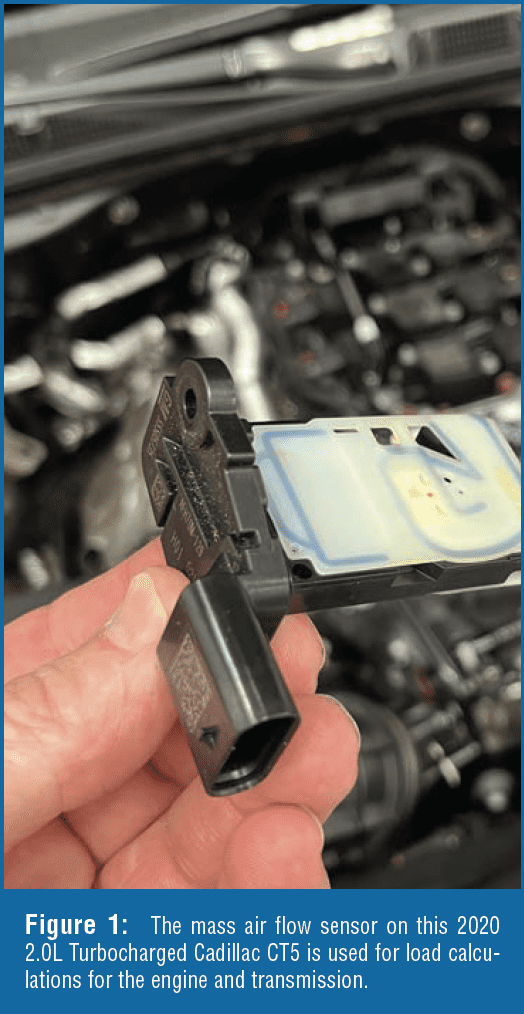 So how does this “fuel control” sensor have such an impact on transmission performance? As its name implies, the MAF sensor informs the PCM of the amount of air entering the engine. The MAF sensor (figure 1) is the primary load input to the powertrain control module (PCM). With MAF sensor information, along with other sensor data such as engine speed and intake air temp, the PCM can determine the engine’s torque output. This torque calculation is used by transmission programming to determine shift pressures and torque converter application pressures. Figure 2 shows an example of how the base pressure on a GM 6L80 is based on engine torque and transmission fluid temperature.
Here’s a process you can perform if you suspect a bad MAF sensor, which involves evaluating the fuel trim and load PID values in the PCM and potentially performing a volumetric efficiency (VE) test.

Take the vehicle on a test drive and read fuel trims at idle and under load. If you use a scan tool that records or logs, save the recording so you can view it after the test drive to get a more accurate interpretation and for safety’s sake. While recording, make sure you have the following PIDs included.
 WHAT TO MONITOR/RECORD

Engine RPM: This is needed to calculate the engine’s volumetric efficiency (VE) with a VE calculator.
Engine Load: Very often, the “calculated” load PID is the same as the engine’s volumetric efficiency, which means you can refer to the calculated load PID instead of entering the scan data into a VE calculator. On the Toyota products I tested, the “vehicle” load was closest to the results displayed in a VE calculator. So it would be worth it to log/record all PIDs that measure load. Absolute load is another common PID on super/ turbocharged vehicles and will indicate how much overall load is generated. At wide open throttle (WOT), this value will reach well over 100% because the super/turbocharger is cramming more air into the cylinder than the atmosphere can offer. Figure 3 shows a test drive recording of calculated and absolute load values on a turbocharged 2020 Cadillac CT5.
MAF Sensor g/s – Sometimes, you cannot find this PID displayed as grams of airflow per second (g/s). Depending on the vehicle, you might only find it displayed in Hz or voltage. If that’s the case, try scanning the vehicle in generic OBD2 mode. The scan tool’s update rate will likely be slower, but you should have the MAF sensor PID available in g/s (grams per second).

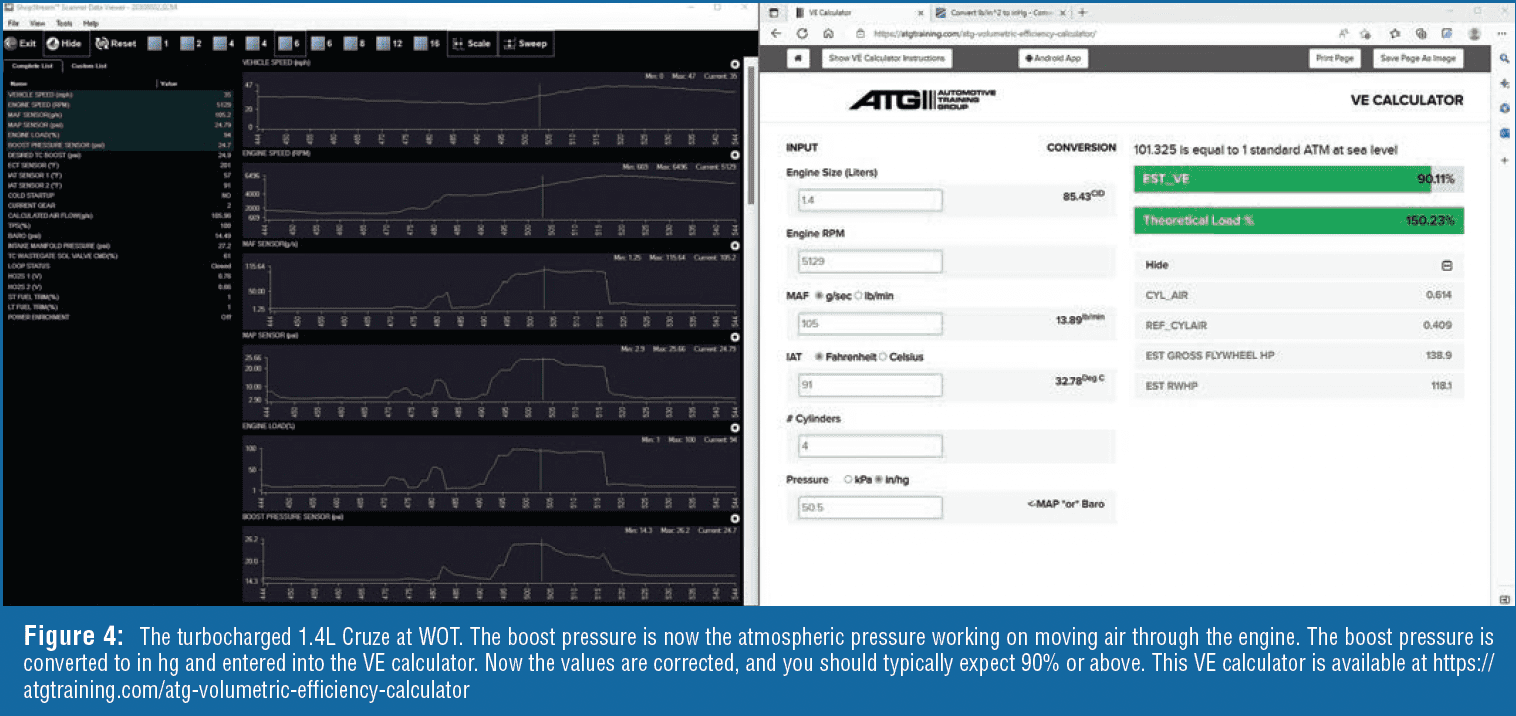
MAP Sensor kpa or in/hg: The Manifold Absolute Pressure (MAP) sensor provides input on the actual air pressure in the manifold. It’s useful to compare barometric pressure (key on, engine off) to wide-open throttle pressures to see if they are equal or at least close. If at WOT, the air pressure doesn’t climb to barometric pressure, then it has a restriction in the intake upstream from the MAP sensor, likely the air cleaner. The MAP sensor value will also be needed for performing a VE calculation on super/turbocharged engines. Under boost, the intake manifold is pressurized by the turbo or supercharger, so the boost pressure becomes the new atmosphere. Figure 4 shows the data from a turbocharged Chevrolet Cruze in the VE calculator (The barometric pressure was substituted with the manifold pressure while under boost).
Intake Air Temp – This PID will help you fine-tune the VE results by providing information for air density calculations.
 Fuel System Status – This PID will indicate if the fuel control system is in either Open Loop or Closed Loop. Often, but not always, under heavy load, the fuel system will go into open loop where it will disregard the oxygen sensor values and initiate “power enrichment,” which is where the fuel system runs a richer air/fuel mixture. The learned long-term fuel trim values will carry over into open loop, but it’s not uncommon for an engine to run at a 12.5:1 air/fuel ratio at wide-open throttle (WOT). The upstream and downstream oxygen sensors will peg rich at about .800 millivolts. If the voltage drops low, you know the fuel system is leaning out during the WOT test, indicating a fuel delivery problem. If the upstream sensors are AF sensors, you can only monitor the downstream sensors or watch the lambda PID. Since lambda represents a 14.7:1 AF ratio, an engine running rich will display a number less than “1” for the lambda PID.
HOW TO DRIVE
During the test drive, monitor the action of the long-term fuel trims (LTFT). If the LTFT stays within a normal range, it’s highly unlikely that there’s an issue with the MAF sensor. When performing the test drive and when conditions are safe, do a wide-open throttle run and record the PIDs mentioned above for post-test drive review.
EVALUATING THE DATA
As stated above, the MAF sensor is fine if the LTFT is in an acceptable range (+/- <10%) throughout various engine loads. This doesn’t mean that there isn’t a problem. Anything that can impede airflow through the engine will result in a drivability symptom (i.e., lack of power). But since the MAF sensor measures the correct airflow, the correct amount of fuel will be injected, resulting in a proper air/fuel ratio, and the engine’s fuel trim values will be normal. The same holds true for restricted exhaust or cam issues. Unless the engine runs so poorly that there’s incomplete combustion or a misfire, the air/fuel mixture will likely be correct because the correct amount of incoming air was measured and reported.
If the LTFT is not in an acceptable range (> +/-10%), the MAF sensor could be misreporting, or there could be another underlying issue causing a rich or lean condition. Many things can cause fuel trims to be out of range, such as improper fuel pressure, ignition misfires, EVAP purge issues, improper fuel alcohol content, vacuum leaks, and many other failures.
As the primary focus of this article is to evaluate the MAF sensor accuracy, start by reviewing the calculated load PID while at WOT. Preferably, the value would be close to 100%, although any value in the 90s, for most vehicles, would be sufficient. If you aren’t receiving the expected results, plug the recorded PIDs into a VE calculator. A quick search of VE calculators online will find numerous results, such as the calculator in figure four. If the load PID (or VE calculation) is off the mark AND your fuel trims are off, you likely have a MAF sensor that’s misreporting the amount of air entering the engine. That faulty MAF sensor is throwing off the PCM for fuel control and throwing off the calculation in the VE calculator. If the load PID and VE calculation is showing a well-breathing engine, then you have something else causing the fuel trim issues.
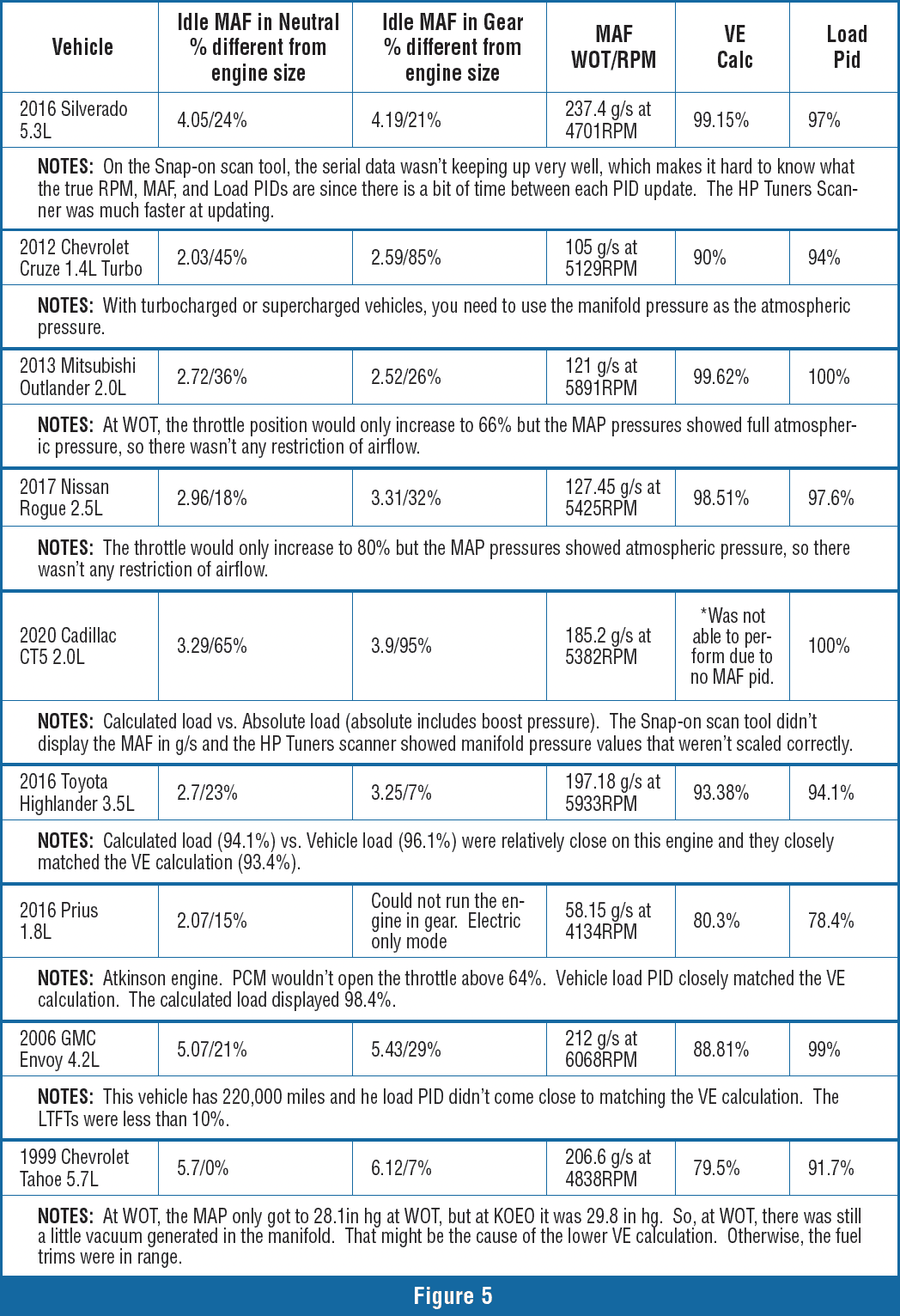
A common rule of thumb is that the MAF sensor’s grams of airflow per second (g/s) roughly equal the engine’s liter size. I’ve never really liked that rule of thumb (or most rules of thumb, for that matter). So, I set out to validate this test on a sample of SIU’s training vehicles with low miles and no issues. Plus, I added some of my personal worn-out but properly functioning vehicles to the test. The table in figure 5 shows the vehicle, MAF sensor g/s at idle and in gear, MAF sensor g/s at WOT along with the RPM, the VE calculation, the Load PID value at WOT, and some notes.
CONCLUSIONS
The rule of thumb isn’t very useful, except for the 24-year-old 360,000-mile Chevy Tahoe with the original MAF sensor. On average, the rule of thumb was about 27% off the engine liter size. With two of the nine vehicles, the MAF was less than the liter size, and on seven of the nine, the MAF was more than the liter size. It stands to reason that expecting the MAF to equal the liter size of the engine will lead to technicians unnecessarily replacing the MAF sensor. There are fans of this rule of thumb, so I often get caught up in debates about this topic. I usually give them this example of why I don’t like this rule of thumb. Imagine an engine running at idle with a mis re due to a bad injector. The engine will struggle to idle, so to keep the engine at its target idle speed, the PCM will command the throttle open more than typical. Because of this, the engine will move more air at idle. A MAF sensor that would normally read three g/s of airflow might now read nine g/s. So, is the MAF sensor bad because it isn’t following the rule of thumb? Of course not, and for that reason, I don’t believe that the rule of thumb works with MAF sensor diagnostics.
A better method is to review the PCM’s scan data. The MAF sensor is likely fine if LTFT is within an acceptable range. If the fuel trims are off, the MAF sensor could be misreporting, or there could be an issue with fuel and/or ignition. Performing a VE test will ensure the MAF sensor is reporting correctly. If the results of the VE test are good (90% or above), then the engine is breathing perfectly fine, and the fuel trims are a result of an ignition or fuel problem.