Over the years I’ve spent a lot of time talking with shop owners about two things that sit at the center of a successful business culture: being customer-centric and being team-centric. Both ideas make sense on their own. Customer-centric means we focus on the customer’s needs, service experience, and trust-building. Team-centric means we build a company where employees feel respected, empowered, and proud of their work.
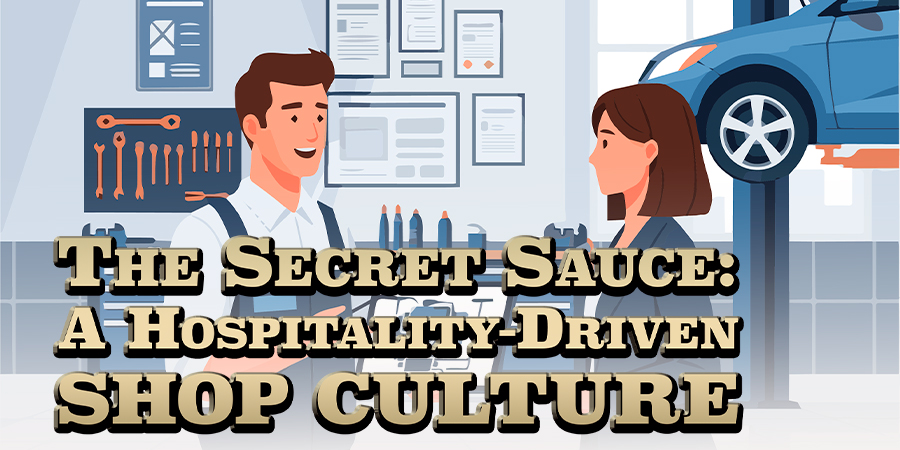
But recently I’ve been thinking about something deeper – something that might tie those two ideas together into what I’d like to call the secret sauce of a great shop culture. And it occurred to me that maybe the real answer is this: We’re in the hospitality business.
Now I know what some of you are thinking. “Hospitality? Thom, we rebuild transmissions. We don’t run a hotel or restaurant.” But stay with me for a moment. Because if you look closely at what customers actually experience when they walk through your door, you might realize that the most successful shops already operate this way – whether they realize it or not.
Let’s start with an uncomfortable truth. Nobody wakes up in the morning hoping they’ll need transmission work. Nobody circles it on their calendar and says, “Today’s the day! I finally get to spend several thousand dollars fixing my vehicle!” Most customers arrive at our shops carrying three heavy emotions: fear, frustration, and confusion.
They fear how much it’s going to cost. They’re frustrated about how long they’ll be without their vehicle. And they’re confused about what’s actually wrong with it and if they can trust you. Those three emotions are powerful and dangerous. Because confusion leads to distrust, and distrust leads to hesitation, suspicion, fear, and sometimes conflict. That’s why the best technical repair in the world won’t save a shop that delivers a poor customer experience. Customers don’t just evaluate what we fix. They evaluate how we make them feel while we fix it.
When you look at great hotels, restaurants, and resorts, something interesting becomes clear. Their real product isn’t food or lodging. Their real product is customer experience. Hospitality businesses focus on welcoming people, reducing anxiety, communicating clearly, and making guests feel cared for. And when you think about it, that’s exactly what our customers need when they bring us a broken vehicle.
To illustrate this point, let me share a hotel experience I had that failed to deliver. A couple of years ago, I went to Alaska, hoping to see the Aurora Borealis (Northern Lights). It was near the end of tourist season, and when we arrived, it was quite apparent that many of the hotel’s service staff had already headed south for the winter.
At check-in, the hotel clerk advised us that the hotel was no longer providing housekeeping services for stays of less than four nights, and they would refresh the rooms only every four days for longer stays. We were only staying three nights, and they said they’d bring fresh towels and other amenities if we contacted the front desk. Also, the restaurant was only serving breakfast, and the hours were limited to only 7:am to 10:am. They also emphasized that they cannot accommodate any requests for early check-ins or late check-outs.
When we arrived in our room, on the dresser was a written notice that reiterated the same information we had just been verbally given. The hotel’s slogan was prominently embossed on the notice: Enter as a Guest – Leave as a Friend. And right next to the notice was a “Tip Envelope.” Imagine how that landed on me, and I’m sure other guests too.
Bad gets even worse… the next morning at breakfast, we overheard several conversations at adjacent tables with guests raving about the Aurora Borealis they saw last night. When we asked how they knew when to get up to see them, they said that the hotel called the room to alert them to the fact that the lights were in full glory.
It turned out that the hotel offered a wake-up call for the Northern Lights if you requested it. Well, they were so focused on telling us what they don’t do that they forgot to tell us about that wake-up service, so we missed the lights. To make it even worse, that was the only night that the lights appeared for the rest of our 10 days in Alaska… what a disappointment! And years later, I’m still talking about it.
Now, with that story in mind, what if we think of our shops differently? If we start thinking of our shops as hospitality businesses that happen to repair cars, trucks, and transmissions, something powerful begins to happen. Our mindset changes. And when our mindset changes, our culture changes.
In previous articles and seminar presentations, I’ve talked about the customer journey as “from the curb to the bay, and back again.” Think about that journey for a moment. The experience begins before the customer even walks through the door. It starts when they visit your website, call you on the phone, and when they pull into the parking lot.
Was your website clear and easy to navigate? Was the phone person friendly and helpful? What do they see when they pull into the shop? Is the lot clean and organized? Is the signage clear? Is someone ready to greet them? Hospitality businesses obsess over first impressions, and so should we. Because customers begin forming their opinion of your shop before the first word is spoken.
In the hospitality world, the front desk is the command center of the entire experience. In our world, it’s the person at the service counter. Your service advisor isn’t just writing repair orders – they’re acting as the host of the customer. A great advisor does more than gather vehicle information. They listen carefully, acknowledge the customer’s concerns, and reassure the customer that they’re in good hands.
Think about the difference between these two greetings: “What seems to be the problem?” versus “Tell me what’s been happening with your vehicle, and we’ll help you figure it out.” One feels transactional. The other feels welcoming. That’s hospitality.
One of the biggest mistakes shops make is assuming customers understand what we understand. They don’t. To us, transmission diagnostics, pressure tests, scan data, and solenoid operation are everyday concepts. To the average customer, it’s a foreign language. Hospitality culture recognizes that clarity reduces anxiety, which is why communication is so important at every stage of the process – from the initial intake, through the diagnostic process, to repair recommendations, updates during the repair, and finally vehicle delivery.
Customers don’t just want answers; they want to understand the process. When we slow down long enough to explain things clearly, we replace fear with confidence. And confidence builds trust.
This is also where the team-centric part of the equation comes in. You can’t deliver a hospitality-driven customer experience if your employees are stressed, frustrated, or disconnected. Culture starts behind the counter and inside the shop. If technicians feel rushed, undervalued, or constantly blamed for problems, that tension will eventually spill into the customer experience.
But when your team feels respected, supported, and part of a shared mission, something remarkable happens. They begin caring about the customer experience as much as the owner does. They become proud of the shop. They take ownership. They look for ways to help. Hospitality culture more than how we treat customers – it’s also about how we treat each other.
One of the defining traits of hospitality businesses is flexibility. Things don’t always go according to plan. Flights get delayed, reservations get mixed up, and rooms aren’t ready. Great hospitality organizations solve these problems with grace and empathy.
Auto repair shops face the same reality. Parts get delayed. Hidden damage appears. Diagnostics take longer than expected. What separates great shops from average ones isn’t whether problems occur, it’s how those problems are communicated and handled. Customers can handle bad news. What they can’t handle is silence, confusion, or surprises.
One of the most overlooked parts of the customer experience happens at the very end – the delivery. Many shops rush through this step. But in terms of hospitality, this is the checkout experience – the moment where everything comes together. A great delivery process includes a clear explanation of what was repaired, a review of the invoice, maintenance or future recommendations, an opportunity for Q&A, and a sincere thank-you. This moment reinforces the customer’s decision to trust you and increases the chances they’ll return the next time they need service.
In today’s digital world, reputation travels fast. Online reviews, social media, and word-of-mouth can spread a customer experience – good or bad – across an entire community in hours. When customers feel respected, informed, and welcomed, they talk about it. They tell their friends. They leave positive reviews. They become loyal advocates for your shop.
The opposite is also true. A poor experience – even when the repair itself is technically correct – can damage trust quickly. Hospitality culture helps protect your reputation because it focuses on the entire experience, not just the repair.
So, what’s the secret sauce that blends customer-centric and team-centric culture together? In my book it’s a culture of hospitality.
When a shop adopts a hospitality mindset, everything begins to align. Customers feel welcomed, informed, and respected. Employees feel valued, supported, and part of something meaningful. Communication improves. Trust increases. Stress decreases. And the shop becomes more than just a place that fixes vehicles – it becomes a place where people feel comfortable doing business.
Here’s a question worth asking at your next team meeting: “If our shop were a hotel, what kind of experience would our guests say we provide?”
Would they say friendly and welcoming? Organized and professional? Clear and reassuring? Or would they say confusing, stressful, or impersonal?
That simple question can open the door to powerful conversations about culture and improvement.
Our industry has always been built on technical excellence, and that will never change. But technical excellence alone is no longer enough. Customers want more. They want transparency. They want reassurance. They want to feel that the people working on their vehicle actually care about them.
And when we remember that we’re really in the hospitality business, we begin to deliver exactly that – from the curb… to the bay… and back again.
“Come as Our Guest and Leave as Our Friend.”
If you’re interested in learning about establishing and nurturing a customer-first company culture, you’ll want to be at this year’s POWERTRAIN EXPO, this August 26th – 30th, in San Antonio. Why not sign up today and take advantage of early bird and group discounts?
About the author — Thom Tschetter has served our industry for over four decades. His article topics come from our readers and Thom’s years as a speaker, writer, certified arbitrator, business consultant, and his own in-the-trenches experiences. Thom owned a chain of award-winning transmission shops in Washington State, and ATRA presented him with a Lifetime Achievement Award for his years of training for the transmission industry.