Many of you are seeing a lot of radiator issues in a variety of car makes and models. They’re common on Nissans and Mercedes vehicles.
But are you missing others because you either don’t hear about them or don’t see any signs when you have the unit apart? Typically, water contamination causes flaked clutches, rusty metal parts, swollen seals, and wrinkled paper gaskets. But what if there’s just a tiny bit of water or glycol; not enough to cause a problem now, but will rear its ugly head after you rebuild the unit?
One way to check for water contamination is with test strips. Another test, one that Sonnax recommends, is the spoon test: You heat up a spoon and then put a drop or two of transmission fluid in the spoon: If you see bubbles or steam or hear a sizzle, there’s water present.
I like this test, but you’ll want to keep it away from your customers’ prying eyes, as it looks a lot like you’re using drug paraphernalia. And if you get the spoon too hot, the transmission fluid can ignite.
Here are a few other ways to check for water in the ATF:
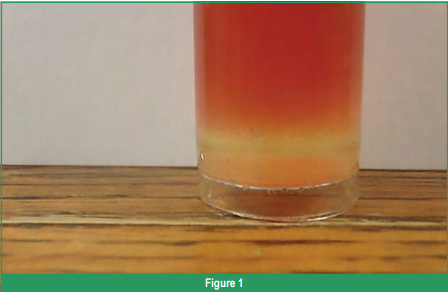
- Get a centrifuge — there are cheap units on Ebay or you can make your own using a drill. You’ll need some vials. The idea is to spin the vial; the heavy liquid will be forced to the outside of the spinning vial, separating the oil and water (figure 1).
- Apply a vacuum to the fluid — vacuum works because dropping the pressure also lowers the boiling point. Chances are you already have a vacuum test unit; all you need is a test tube.
If you can’ t find one, go to a cigar store and buy a cigar in a glass tube. Enjoy the cigar and then use the tube to test your fluid:- Put the fluid in the tube.
- Adjust the vacuum to the highest vacuum levels it’ll deliver; generally, around 28-29” Hg.
If there’s water in the fluid, within 10-20 seconds you’ll star t to see bubbles (figures 2 and 3). The amount of time will vary based on the percentage of oil to water; the more water the faster you’ll see bubbles.
Of course, if there’s a lot of water, you may be able to see it without performing a test; on the other hand, the test may be necessary to prove the condition to your customer.
Another worthwhile tool would be to have a microscope in  your shop. They can be cheap and are worth having around, and after the other tests, a microscope makes it easy to see the bubbles.
Keep in mind, it doesn’t take a lot of water in the ATF to cause a problem, and often those problems aren’t obvious. For example, we recently had a 2001 BMW with a 5HP2 4 that was slipping. We pulled the unit apart; there were no sign s of water or glycol contamination.
I checked anyway: The vacuum test revealed small amounts of water or glycol, so it’s either the star t of a radiator failure or water somehow entered the system. I’m going to let the customer know what we found and recommend replacing the radiator.
The important thing to remember about this situation is there wasn’t a single reason to think this unit had water contamination… but a simple test revealed it did, while I still had the transmission on the bench.
Oil and water don’ t mix, so finding even the smallest amount of water contamination isn’t all that difficult. But it does require that you make the effort to look for it.