
“Hey Dad, when I grow up, I want to be ordinary.” My dad was a WWII Marine Veteran, and I would have never said that to him. If I did, we would have had what he called an immediate sit-down. While he didn’t have any vicarious aspirations for what I’d do or be when I grew up, one thing that wasn’t on the table was being anything remotely close to ordinary. My dad would have said something like this, “Son, I don’t care what you decide to do with your life, but whatever it is, be great at it! Don’t settle for being average. Strive for excellence and always do your best.”
Fast-forward about half a century – I’m not sure how my dad would tolerate today’s world. Doesn’t it seem like the absence of excellence makes ordinary appear to be pretty darn good?
My high school and college teachers didn’t talk about striving for the Middle Class – whatever that means. I cringe whenever I hear a politician say, “Everyone should have a fair shot at the American Dream, to be in the Middle Class.” What the heck kind of a dream is that? Aren’t the terms Middle Class and Ordinary the same as Average? I can’t imagine bothering to make a goal to be average.
However, it appears that nowadays the Middle Class, Ordinary and Average are worthy pursuits. I guess that’s good news for our “everyone gets a trophy” generation. While I don’t agree that ordinary is a worthy goal or deserving of a trophy, it’s at least achievable, I think.
But, if average is the new standard, what about below average? More good news! Apparently, below average is also a worthy aspiration. Take our career politicians, for example. Regardless of their party affiliation, many graduated in the lower half of their classes, somehow passed the BAR exams, became lawyers, ran for public offices, and won. And decades later, they’ve risen to powerful, high-ranking, leadership positions, having never worked a day in the private sector.
You’re probably thinking, “Doesn’t there have to be a top, middle, and bottom ranking for every class or any profession?” Of course, but you might think about this the next time you’re on a flight. There’s a 50% chance that your pilot is “below average.”
All this causes me to question myself. Maybe I’ve had it all wrong. For the last 30-plus years, I’ve written and spoken about how to make your businesses extraordinary. After all, maybe ordinary is good enough! What if that’s all customers actually want or expect?
Apparently, many customers only want or expect ordinary. Many companies cater to these people, and the competition for their business is tremendous. Chances are you love at least one of these companies. In fact, one of the world’s largest, most profitable, and most famous companies has made “Being Ordinary” an art form. They’ve built their business model on always being ordinary. You could say, “They’re extraordinary at being ordinary!”
You’ve probably already guessed who I’m describing. When was the last time you went to Mickey D’s and had an extraordinary experience? If you can recall one, it’s most likely because it was a bad experience.
How does this relate to the auto repair industry, and more specifically, your business? When you opened your company, was your plan to be ordinary? Or was your dream to be different – better or maybe even the biggest or best in your area? How’s that dream playing out for you? How do you measure up against your competitors? Do you think your business is ordinary? And more importantly, how do your customers view your company? Do they see you being just like the rest? If so, you’re ordinary – whether you think so or not.
When you think about it, auto repair shops are ordinary businesses in an ordinary industry. Customers don’t have any measurable way to tell one auto repair from another in terms of quality. Oh yeah, they know when the quality is missing – the car doesn’t work right. However, they can’t objectively measure degrees of goodness. Their only measure is how the car repair experience felt to them. How were they greeted? How friendly was the staff? How clean was it? How did it smell? In short, how did they feel about the overall experience?
The Bucket of Ordinary repair shops is overflowing. There’s a lot of competition. The problem with being ordinary is that you have to compete vigorously and do a lot of advertising to attract a steady flow of new customers. I call this “Outside- In” marketing. You cast a vast net of advertising, trying to capture as many customers as possible from outside your shop and bring them into your shop. Whereas, with “Inside-Out” marketing, you focus your attention on the people who are already inside your business. You provide a customer experience that inspires them to tell people they know to come into your business. By the way, this also includes your team members. They’re your internal customers.
People don’t tend to talk about ordinary experiences. They talk about extraordinary experiences. Unfortunately, in our business, customers are better at seeing the bad than the good. As I said, “They have no way of measuring degrees of the goodness of the repair itself – it’s either fixed or not.”
So, auto repair experiences are less about the repairs and more about the customers’ experiences with the shop. Companies that have found ways to provide extraordinary repair shop experiences enjoy a less competitive environment. Their customers are loyal. They thrive primarily on word-of-mouth, referrals, and repeat business.
So, I ask myself, “Why don’t we invest more time, effort, and money on Inside-Out marketing instead of spending so much on Outside-In advertising.” The answer is in the question itself. Inside-Out marketing requires an investment of time and effort in addition to money. It’s much easier to just spend, spend, spend on Outside-In advertising.
A word of warning, customers are more likely to talk about bad experiences than good ones. Maybe a more descriptive term than extraordinary would be “remarkable.” Remarkable experiences are worthy of remarking or talking about. Obviously, you want to be remarkably good, but you’re better off being ordinary or “unremarkable” than being remarkably bad.
So, how do you consistently provide your customers with remarkably good auto repair experiences that they’ll eagerly share with their friends and family? How can you separate your company from ordinary and remarkably bad competitors?
Today’s competition isn’t that great. There’s never been an easier time for climbing out of the Ordinary Bucket of shops. The bar is lower than it’s ever been. You don’t have to be great – you just need an edge. It’s easy for a business to stand out. Sometimes it takes nothing more than a pleasant greeting, a smile, a please and thank you. I love it when I ask a restaurant server for something, and they reply, “Of Course,” or “You Bet.” It just has such a positive ring to it!
Whether your company is inside or outside the Ordinary Bucket of shops is ultimately in the beholders’ eyes. Three sets of eyes matter: your customers’, your employees’, and yours.
- Under-served customers will experience your service as ordinary or, even worse – bad.
- Under-appreciated employees are prone to provide ordinary service or worse.
- If you’re starting to feel a little queasy, your company is probably ordinary.
In other words, just because you believe your company is great doesn’t make it so.
Do you feel like you have some improving to do? Before you start trying to figure out how to fix things, here are three questions. Answer all three from the perspectives of your external customers, your internal customers (team members), and yourself. Be brutally honest with your answers. Consider doing a survey rather than guessing about what they think.
- What does your company do? What business are you in? If the answer is anything related to being an auto repair shop or fixing cars, you’re in the ordinary bucket. How does fixing cars make you different from any other auto repair shop? What do you really do? What problem(s) do you solve for customers? Aren’t you in the business of solving mobility problems for your customers – immediate, interim, short-term, and long-term? Once you and your team get this difference and fully understand the depth and breadth of what “mobility” means, your whole approach and company culture can turn on a dime.
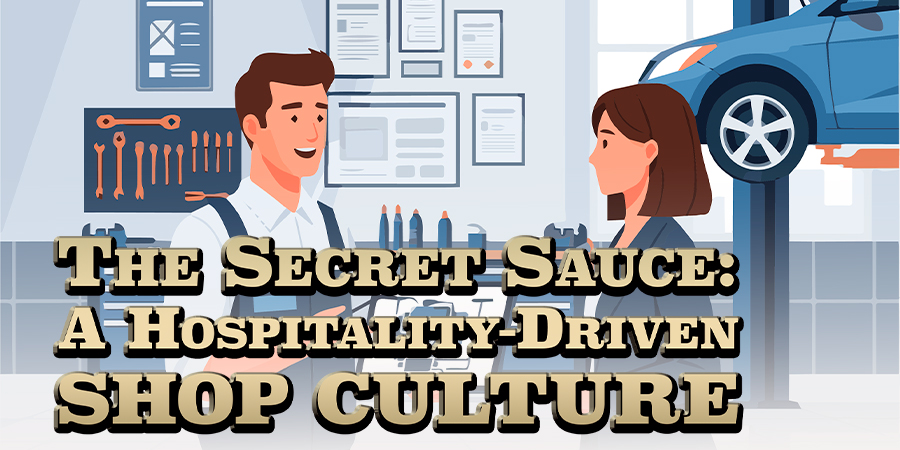
- What’s your secret sauce? What benefits do your customers get from you that they won’t or don’t get from your competitors? PLEASE, PLEASE, PLEASE – not fair or low prices, not quality, not honesty, or any of these me-too platitudes! All shops make these claims. The question you must answer is how does it make the customers feel? Do they feel important, valued, special, smarter, safer, cared for, or like family? That’s the kind of experience they’ll talk about! Once this is ingrained into your company culture, decision-making is a snap. You just ask, “How will this make the customer feel?” Maybe “hospitality” is your secret sauce.
- What’s your cherry on top, the surprise, the finishing touch? What’s something your customers get that’s related to your business, and they don’t expect or pay for? I’m not talking about the surprise in “Cracker Jack ®.” I’m talking about a bonafide, memorable surprise that will make a lasting impression. Here are some things I’ve seen used.
- Freebie fixes – remount rearview mirrors, replace worn pedal pads, reattach or tighten loose shifter knobs.
- Clean cars run better – wash cars or at least windows inside and out
- Give them reasons to come back often – lifetime air fresheners or free wiper blade inserts for life
- “Handwritten” thank you notes – one on the dashboard from the team members and one mailed by the service advisor, doubling as a 10-day recheck reminder
- Box of Candy left in the car
- Flowers delivered to the workplace – creates a buzz at the store or office.
I know this is a lot to take in. Just take the first step. Get your answers to these three critical questions off paper and into practice.
- What business are you in – really?
- What’s your secret sauce?
- What’s your cherry on top?
If you consistently deliver remarkable customer experiences, you’ll be the company that people can’t stop telling their friends about! Want some help? I’m accepting 10 new clients interested in developing a Fully Integrated TOMA Delivery System. This system integrates Inside-Out marketing principles with Outside-In advertising methods. If this interests you, call me at 480-773-3131 or contact me by email to coachthom@gmail.com.
If you’re attending the Powertrain Expo, don’t miss my presentation called “Only One Thing Matters in the Marketing War” on Saturday morning at 8. I have a valuable gift for every shop in attendance.