
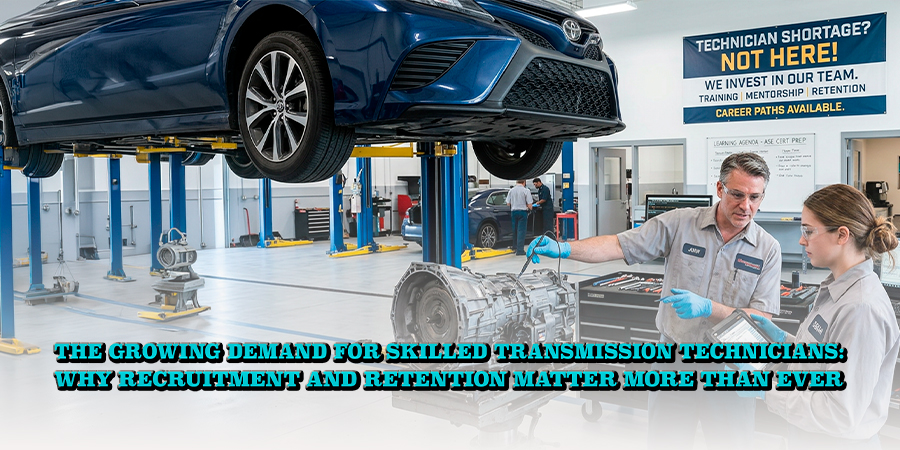
The automotive industry is facing a workforce challenge that directly impacts transmission repair shops, dealerships, and independent service centers across North America. While vehicle technology continues to advance rapidly, the pipeline of skilled technicians entering the industry has not kept pace with demand.
According to the National Automobile Dealers Association (NADA), the industry needs approximately 76,000 new technicians annually to replace retirees and meet growing service demand. However, only about 39,000 new technicians graduate from automotive training programs each year, creating an annual shortfall of roughly 37,000 skilled workers. This shortage has become one of the most significant operational challenges facing repair facilities today.
The demand is especially pronounced within transmission repair. Modern transmissions are no longer purely mechanical systems. Today’s technicians must understand advanced electronics, computer-controlled shifting strategies, hybrid drivetrains, continuously variable transmissions (CVTs), dual-clutch systems, and increasingly sophisticated diagnostic software. The growing complexity of these systems has elevated the technical expertise required to perform successful repairs.
Growth trends suggest this demand will continue for years to come. The U.S. Bureau of Labor Statistics projects approximately 70,000 automotive technician openings annually between 2024 and 2034, driven primarily by retirements and workforce turnover rather than new job creation alone.
For transmission shop owners, recruiting talent requires more than simply offering competitive wages. Today’s technicians are looking for long-term career opportunities, modern equipment, ongoing training, and a positive workplace culture. Shops that establish relationships with local technical schools, apprenticeship programs, and industry organizations often create a stronger pipeline of future talent.
Retention is equally important. Technicians are more likely to stay when employers invest in professional development, provide clear advancement opportunities, and create supportive work environments. Mentorship programs, manufacturer certifications, paid training, and transparent career paths can significantly improve employee satisfaction and long-term retention.
Workplace culture has emerged as a key differentiator among employers competing for skilled technicians. Successful shops foster environments built on teamwork, respect, communication, and continuous learning. Facilities that prioritize employee recognition, work-life balance, and leadership development are often more successful at retaining top performers.
Looking ahead, the transmission repair industry remains well-positioned for growth. Vehicle owners are keeping cars longer, transmission technology continues to evolve, and the shortage of qualified technicians shows little sign of disappearing. Shops that proactively invest in recruitment, training, and workplace culture will be best positioned to capitalize on this demand while building sustainable, profitable businesses.
This, along with many other critical topics related to building a Winning Shop Culture, will be discussed in several presentations at this year’s Powertrain Expo: August 26th – 30th in San Antonio. If you haven’t already signed up, don’t wait. Now is the time to take charge of your future – both financially and strategically.
References
– National Automobile Dealers Association (NADA): https://www.nada.org/nada/issues/workforce
– U.S. Bureau of Labor Statistics: https://www.bls.gov/ooh/installation-maintenance-and-repair/automotive-service-technicians-and-mechanics.htm
– AAPEX Technician Shortage Resources: https://www.aapexshow.com/blog/solve-auto-technician-shortage/
– TechForce Foundation Supply & Demand Report: techforce.org/techforce-releases-2023-technician-supply-demand-report/
About the Author
Edward Vela is an M&A Advisor and independent Financial Planner, also helping clients with raising capital. Edward has 15 years of wealth management experience but is not in the securities business. He writes this column for educational purposes.
Edward earned a Journalism Certification from the University of Massachusetts, a BA in Political Science, a Financial Planning Certification at UCLA, and an MBA from the UCLA Anderson School of Management specializing in entrepreneurship and finance. You can contact Edward at 925-300-8805 or the empiriKalpartners team at empiriKalpartners.com.