A customer has brought a vehicle to you with a shudder at speed. The customer describes it as “a feeling like driving on the rumble strip.” Most technicians see that description on the repair order, and the first thing we ask is: what vehicle speed, what gear, what engine speed, and what throttle input does the shudder occur? What are we looking for? Well, the root cause of the shudder may vary depending on the conditions when it occurs. It is strongly recommended, before you start diagnosing, to check for any TSBs that may be related to the symptom. A shudder between 35-45mph in 3rd or 4th gear is a strong possibility that it could be the engagement of the torque converter lock-up clutch, but there are several other possibilities.

You ask why engine speed and throttle input: well, secondary ignition failures cause cylinder misfires. A cylinder misfire feels like a shudder, and the condition worsens under heavy engine load and low engine rpm. So, knowing this is possible, we need to include cylinder misfire in our list of possible causes. Okay, great start on diagnosis if you are working on something older, but what if you’re working on something late model?
 Late model vehicles may apply lock-up as early as 10-15 mph in 2nd gear, use cylinder deactivation, and variable valve timing. Manufacturers use these operations to increase fuel mileage.
Why is that important to our diagnosis? If our shudder only happens between 35-45 mph and lock-up is happening at 10-15mph, don’t you think the TC shudder would also be present at those speeds? By knowing what normal operation is, we can systematically eliminate what is operating correctly and find what is not.
IDENTIFYING TC SHUDDER
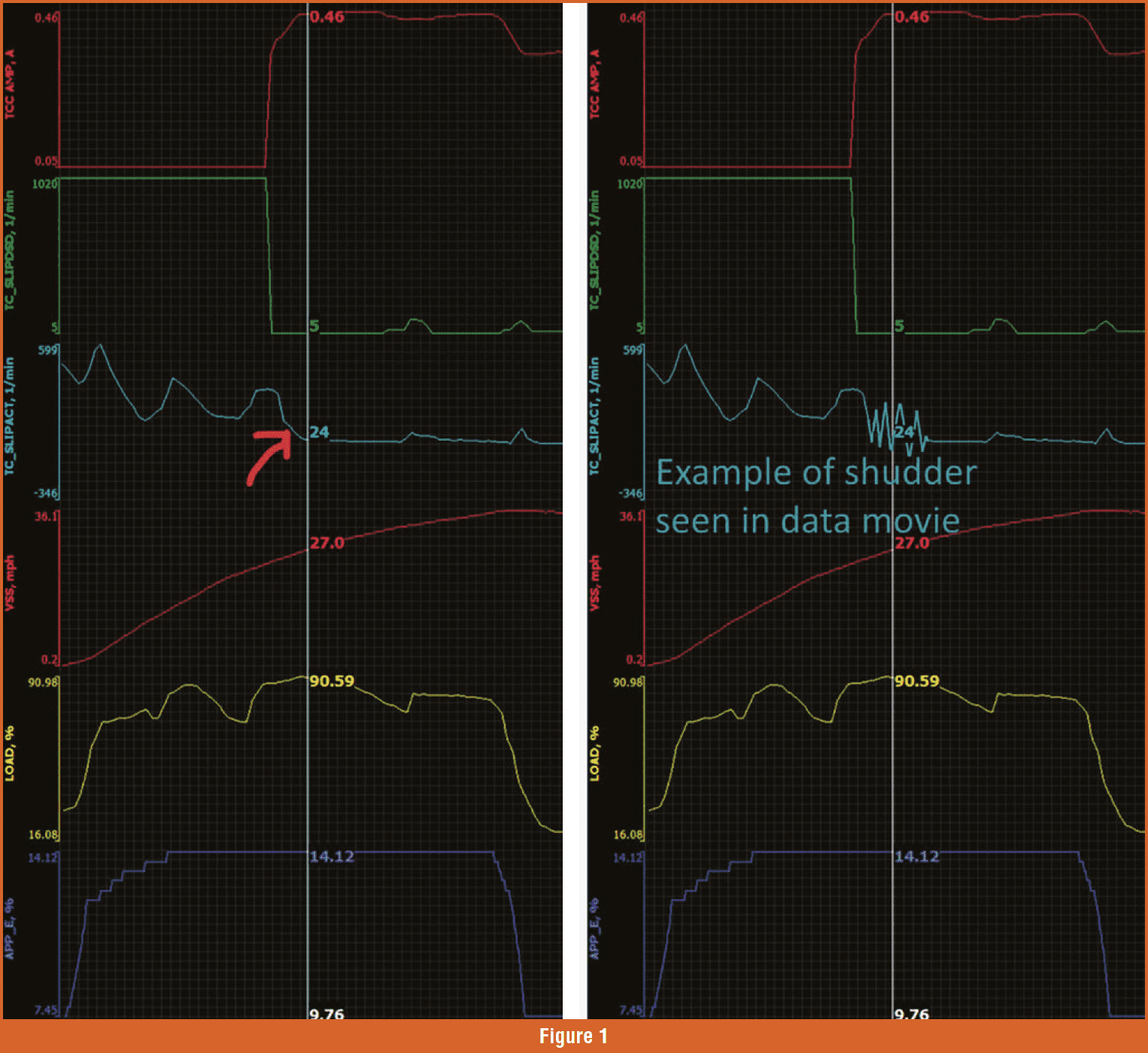
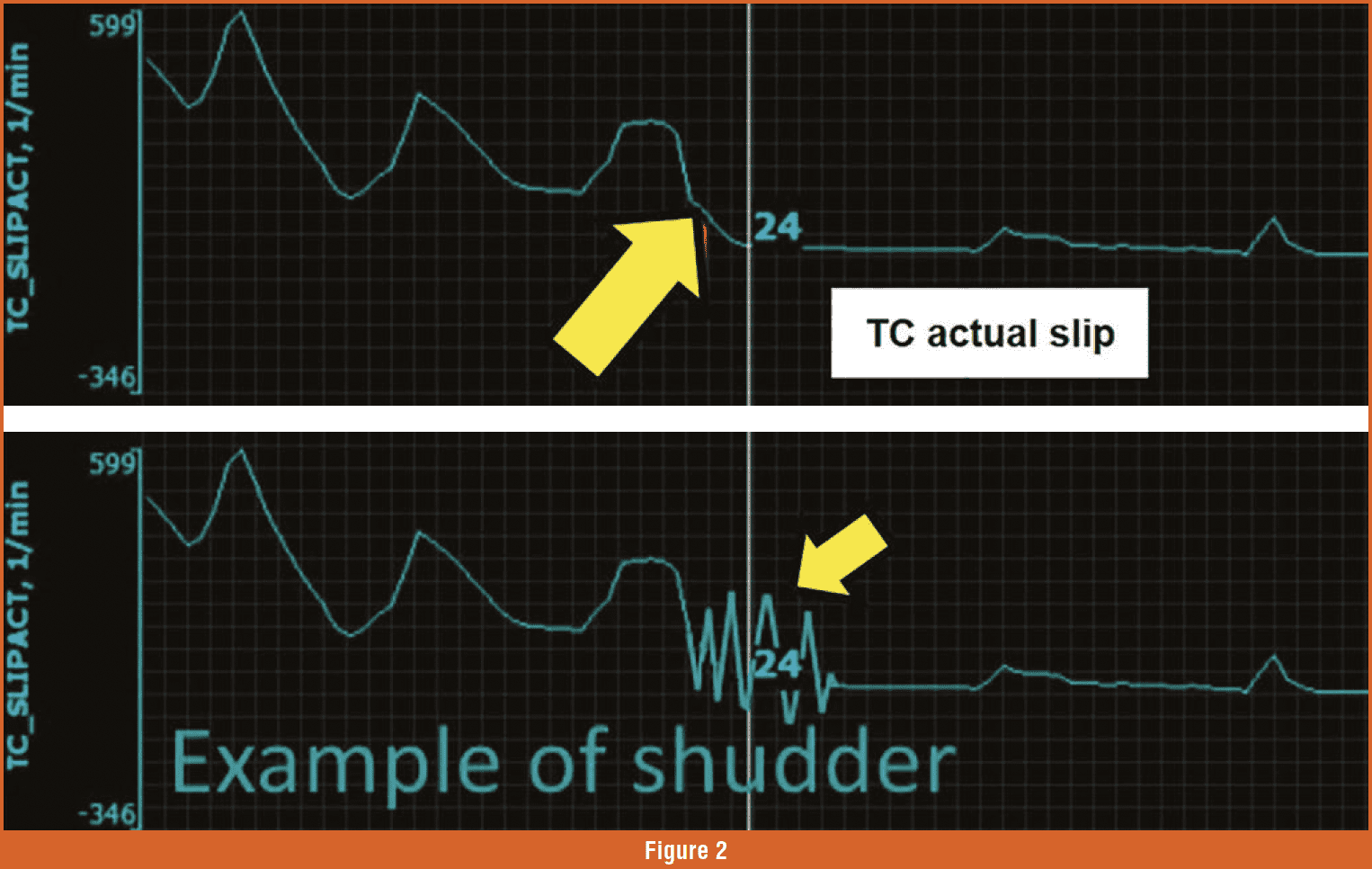
At this point, it would be best to hook up the scan tool and capture a movie of the transmission data stream at the speed the shudder happens (figures 1 and 2). Your focus should be on TCC commanded slip and TCC actual slip. To verify everything remained steady and did not influence the readings above, I would add TCC solenoid amps to verify the electrical signal and VSS, TPS%, and engine load% to verify those remained steady. If you abruptly changed the throttle input or the engine load changed dramatically in that section of the movie, I would look at a more stable, different section of the recorded movie.
NOTE: There are variations of these data parameters depending on the vehicle manufacturer and scan tool used, it is best to look up the manufacturer service procedure for testing your specific application, but we will stick to the ones listed above for this example.
TCC APPLY SHUDDER
Keep in mind that most lock-up clutches are designed to slip a small amount while engaged and that a small amount of slip is not an indicator of a malfunction. Check manufacturer specs to determine if yours is acceptable or not. (Most will be under 60 rpm slip).
WHAT CAUSES TC SHUDDER?
The contributors are bad fluid properties, uneven clutch surfaces, and poor module command.
I’m not one that believes in “lifetime fluid.” I believe that the claim is true that the fluid will go the life of the transmission, but what is that life expectancy? 75,000/100,000 miles? The manufacturer only needs the transmission to get through the warranty period. I would like to get as much life out of my transmission as possible, and fluid changes are needed to do that. Fluids, over time, break down and lose the additives that make them unique to your transmission’s needs. The only way to get that back is with fluid changes.
 While we are on the fluid topic, the claim of all makes and models is false advertising! NO ONE makes a fluid that is compatible with all applications. There is some cross-compatibility where a similar fluid could work, but you need to do your homework before making that decision. We will discuss fluid more in a later article. You need to know that your fluid could cause a TC shudder, so you may consider replacing it with new fluid of the correct type before condemning the transmission.
If the surfaces of the converter cover are uneven, like uneven surfaces in a manual transmission clutch or even brake rotor surfaces, you will have vibration/shudder when applied. If this happens in an automatic transmission, you have bigger issues that cannot be fixed without removing the transmission and assessing the damage, but you still want to identify what caused this.
If it is due to poor command of the transmission, that will cause a replacement transmission failure. Make sure the signal that you get on the scan tool matches the manufacturer’s specifications. Resources like Alldata, Identifix, and Mitchell have normal operation descriptions that can be used to help diagnose the vehicle for proper command. You may also find waveforms online that others have posted called “known goods” these can be extremely useful for diagnosing command issues because they are snapshots of what you should see if the vehicle is operating normally.
IDENTIFYING MISFIRE
What if the shudder is not in the TC? What else could it be? Well, for the longest time, if it was not the TC, it was usually a cylinder misfire. What if there are no misfire codes, and the engine runs great otherwise? The CEL will only set after a certain number of misfires in a given drive cycle, so if it is not a continuous misfire, it may not set a light. Are you aware of mode 6 in the scan tool? It is part of the Generic OBD tool function. It will display the misfire counts on each cylinder (figure 3). If you look at misfire counts and see the number go up every time you feel the shudder, it is very likely you have found your culprit.
DIAGNOSING MISFIRE Okay, great, you found misfires and identified what cylinder. What do you replace? Well, let’s break this down to the basics of what an engine needs to run, Air, Fuel, Compression and Ignition. With the exception of a valve issue, airflow won’t cause a misfire on one cylinder. The intake runners and exhaust share the same pathways between cylinders; the misfire would be on more than one cylinder. That leaves three other potential causes.
If this is a coil-on-plug type ignition system like most vehicles are now, and the misfire, for example, is in cylinder 3 – try moving the coil to cylinder one and the spark plug to cylinder 2 and retest it. If the misfire moves to cylinder one, then the coil is the root cause of the shudder. If it moves to cylinder 2, then it is the plug.
 You see how we are proving this out by trying to move the components in question and see if the misfire follows. This test can be applied to fuel injectors as well to prove the fuel system.
What if the misfire doesn’t move? Now we need to suspect a mechanical issue in cylinder three and should perform a compression test. Make sure to look up the specs of the compression test for that specific engine and get an accurate assessment. If the test is out of range, you have mechanical issues that need to be addressed.
MOUNTS / DRIVELINE
What if the ECM/TCM does not recognize a misfire, you don’t have misfire counts, and the TC slip looks okay? Well, check the obvious things first. We have all seen bad transmission and engine mounts and felt those vibrations. You checked your mounts, and they are good. No cracks in the rubber, and the drivetrain doesn’t have excessive movement when torque is applied. Great, how about the drive shaft? Working for Ford in my younger years, it was common to see trucks come in with this complaint. It was a simple fix, pull the drive shaft and lightly grease the splines.
Looking back to the fluid properties mentioned above, there is a bulletin that addresses TC shuddering in the 6-speed GM transmission. The bulletin states: Remove all the DEX VI fluid and use Mobile 1 “LV.” This makes sense because the Ford version of this 6-speed uses “LV” and has not had nearly as many shudder complaints as the GM, and it seems to be an effective fix for the shudder. Let’s look to see if there are any Easter eggs out there to help you narrow this down!
ACTIVE FUEL MANAGEMENT (AFM) & VARIABLE VALVE TIMING (VVT)
Both systems have had enough driveability & longevity issues that the aftermarket has come up with solutions to either fix or eliminate the system from the vehicle. Why is that important? Both systems, when malfunctioning, can cause what feels like a shudder. There have been several articles written by industry partners on these issues, tracing the shudder back to a source external to the transmission. So how do we prove they are working correctly and not the cause of the shudder? Let’s disable the system and see if the shudder still exists.
DISABLING ACTIVE FUEL MANAGEMENT / DISPLACEMENT ON DEMAND FOR TESTING:
If you feel the shudder and the AFM doesn’t switch to v4 mode, then AFM is not the issue. Here are a few ways to disable the system for testing purposes.
There are several aftermarket components and programmers designed to disable the AFM system. For some models, you can simply select the “L” or “M” range on the shifter and drive the vehicle. However, you must manually select your upshifts with the button on the shifter. Note – confirm by watching the indicator on the dash that the engine doesn’t go into V4 mode.
With the engine running, unplug the MAF sensor for 20-30 seconds and plug it back in. This will force a DTC in the PCM and keep the vehicle in “fail-safe,” preventing AFM/DOD.
VARIABLE VALVE TIMING (VVT)
Variable valve timing is what the name suggests. It varies the timing of the opening and closing of the valves. This system is used to improve efficiency and emissions control. It allows the cam to be advanced when prompted by the PCM, which changes how the engine performs. This should be monitored on the scan tool as we did for the TC lock-up earlier. Look at commanded advance and actual advance to see if it coincides with the shuddering feeling. We hope this information helps you narrow down your diagnosis more accurately and in a timely manner. While it is meant to help you in your diagnosis, it is not vehicle specific, and you should also consult the manufacturer’s service guide for more specific testing procedures.