Diagnosing Nissan vehicles equipped with a CVT transmission can be a nightmare. Especially when the vehicle enters limp mode or the transmission completely fails. Trouble codes stored in control modules may or may not help you find the root cause of an issue unless you are aware of code definitions and conditions for setting the codes. In the case of Nissan’s infamous ‘judder codes,’ knowing what the vehicle is looking at to set the DTC is just as important, if not more, than the code itself. In this article, we are going to look at diagnosing the root of DTC P17Fx code complaints and related repair.
THE CVT CONTROL STRATEGY
First of all, it is important to understand what is behind the strategy of controlling the CVT. Engineering papers give little indication of what is really happening. However, when you acquaint yourself with the scan data and observe how the vehicle’s powertrain strategy responds to driver inputs, everything looks pretty clear.
The drive-by-wire throttle control is key in managing the engine and transmission as a unit. The driver can have a steady foot or be a two-foot driver; with a cable-less throttle, engine torque remains predictable at all times because the TCM and PCM work to maintain a smooth balance.

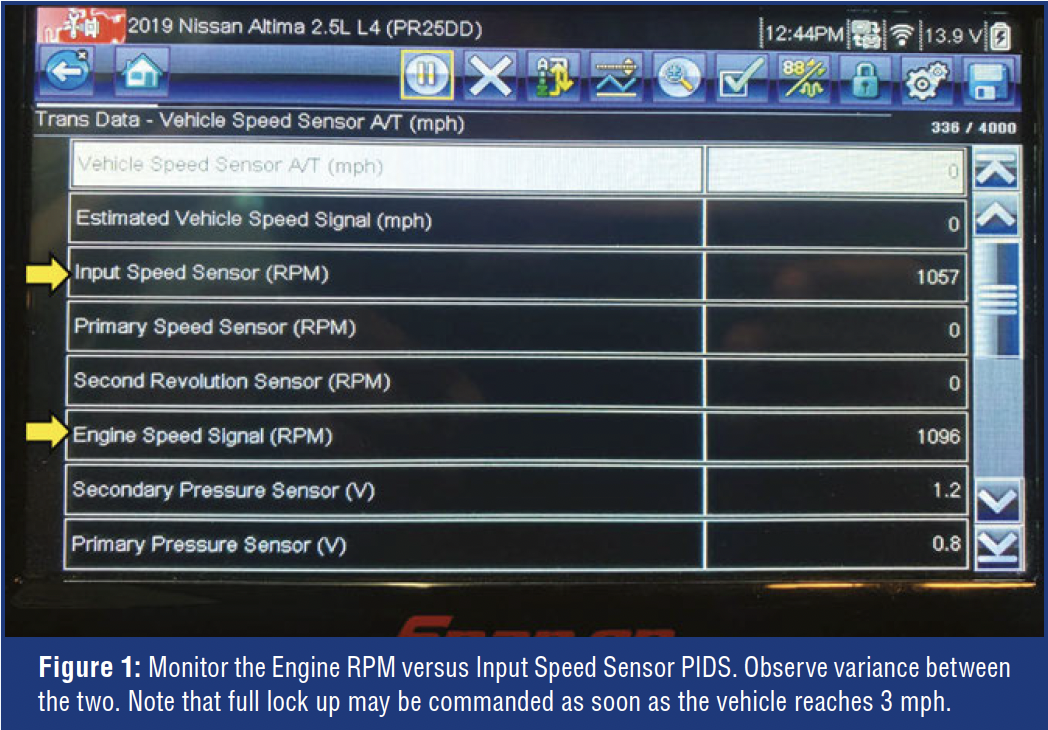 As a matter of fact, if you have a scan tool attached to one of these vehicles, you can pull up the engine RPM and Input Speed Sensor PIDs and monitor the variance (figure 1). You will observe an engine RPM fluctuation of 5 to 15 RPM while the transmission Input Speed Sensor remains smooth and relatively constant. This can be observed on the vehicle tachometer too.
So, the question is, what’s happening? Basically, the engine management programming is attempting to keep a predictable torque going into the transmission. Wide swings in torque input for a CVT mean death to the unit. The endgame is to keep a push-belt-equipped transmission in ‘push’ mode and a chain-drive unit in ‘pull’ mode. The moment torque is input from the road through the output ring gear or the chain/belt slips, the powertrain management counteracts it by changing pulley ratio and/or pressure, engine torque input, and/or TCC lock-up command. Any of these conditions can trigger a P17Fx series DTC.
Given this overview, let’s look at items ‘outside the box’ that can falsely generate a judder code.
OVERALL VEHICLE CONDITION
Vehicle drivability, electrical system health (including ground), and sensor health are important items to take into consideration when finding the root cause of failure in CVT-equipped vehicles.
There are numerous concerns outside of the unit that cause transmission-related drivability issues and failures. Known items ‘outside the box’ that affect the transmission operation and durability are as follows:
- Engine misfires
- Faulty mass airflow sensor
- Torn or cracked air inlet hose to the throttle body
- Faulty crankshaft sensor
- Faulty camshaft sensor
- ABS faults
- Brake light issues
- Brake switch issues
- Brake light assembly (corroded or damaged)
- Faulty wiring and connectors
- Wrong TCM
- Defective TCM
- G-sensor (faulty or out-of-calibration)
These and other issues will destroy your CVT if not repaired prior to replacing the transmission. If you had multiple CVT failures, you probably have something in the vehicle causing the transmission to fail. Note that DTCs may or may not direct you to faulty components or systems at the root of your failures. A thorough inspection must be performed before condemning the CVT.
P17FX AND OTHER CODES
DTCs P17F0 and P17F1 were present on early CVT applications. However, starting with 2018-2019 Nissan Sentra, Versa Sedan, and Versa Note, additional programming was added to enhance the diagnostic process. The programming includes new diagnostic trouble codes and transaxle management related to these codes. Always check with the Nissan service department before working on any of these vehicles. Many of them may still be under an extended factory warranty.
DTC P0868 (Transmission Fluid Pressure Low) was added to the CVT- 7 platform and will turn on the check engine light. Low pressure indicates that inadequate pressure was present long enough to possibly cause the belt to slip and become damaged. To diagnose P0868, remove the valve body and inspect the push belt with a borescope. If the push belt is good, replace the valve body. If the push belt is damaged, replace or rebuild the transmission.
Codes P17F0, P17F1, P17F2, P17F3, and P17F4 were added and will not turn on the Check Engine light. The CONSULT 3 Plus or equivalent scan tool is necessary to clear these codes. The new logic monitors the CVT more closely during daily operation. These DTCs were added to enhance the diagnosis of CVT-related failures. Below are Nissan-specific code definitions for the P17Fx codes:
P17F0: Indicates a problem with the Continuously Variable Transmission. It may mean that the CVT belt is slipping, or the transmission control module (TCM) is faulty. The code may require a replacement of the valve body, the TCM, or the transmission, depending on the severity of the damage. The code can be diagnosed by clearing it with a capable scan tool and checking if it returns with the ignition on.
P17F1: Appears when the CVT does not comply with the factory requirements. It is usually caused by a failed valve body. If the code changes to P17F0, it means there is major belt slippage, and a new transmission is required. In some cases, P17F0 and P17F1 codes may indicate a defective TCM. To confirm this, all codes should be documented and cleared with a capable scan tool, and the ignition should be kept on for a bit without the engine running. If the code returns, a defective TCM has been confirmed, requiring a new module.
P17F2: Indicates a problem with the clutch ratio. The clutch ratio is monitored by the TCM (Transmission Control Module) or the Engine Control Module (ECM), depending on the vehicle. The code is set when the clutch ratio does not meet factory specifications, which means the clutch is slipping or not engaging properly. This affects the vehicle’s performance and fuel efficiency.
P17F3: (Ratio Monitoring Clutch A and E) Indicates mechanical transmission problems or a faulty transmission assembly. The TCM monitors the clutch ratio. When the calculated ratio varies from the requested ratio, the code is set, and the Service Engine Soon light is illuminated. Note that this may be caused by an incorrect unit installed in an application.
P17F4: The code is related to the auxiliary gearbox (clutch judder). The TCM monitors the clutch ratio. This code may also indicate push belt slippage. The vehicle may also hesitate and/or have reduced power.
When diagnosing issues that conclude in module and/or unit replacement, always verify that CVT and engine speed sensors are functioning correctly before attempting a repair.
ALL-WHEEL DRIVE WITH DTC P17F0
CVT-8 units equipped with All-Wheel Drive can produce a P17F0 trouble code, indicating the chain is slipping inside the unit. This code can falsely point to the transmission as the source of the problem in the All-Wheel Drive portion of the drivetrain. You must diagnose the AWD system prior to condemning the unit. Let’s take a closer look at what is happening here.
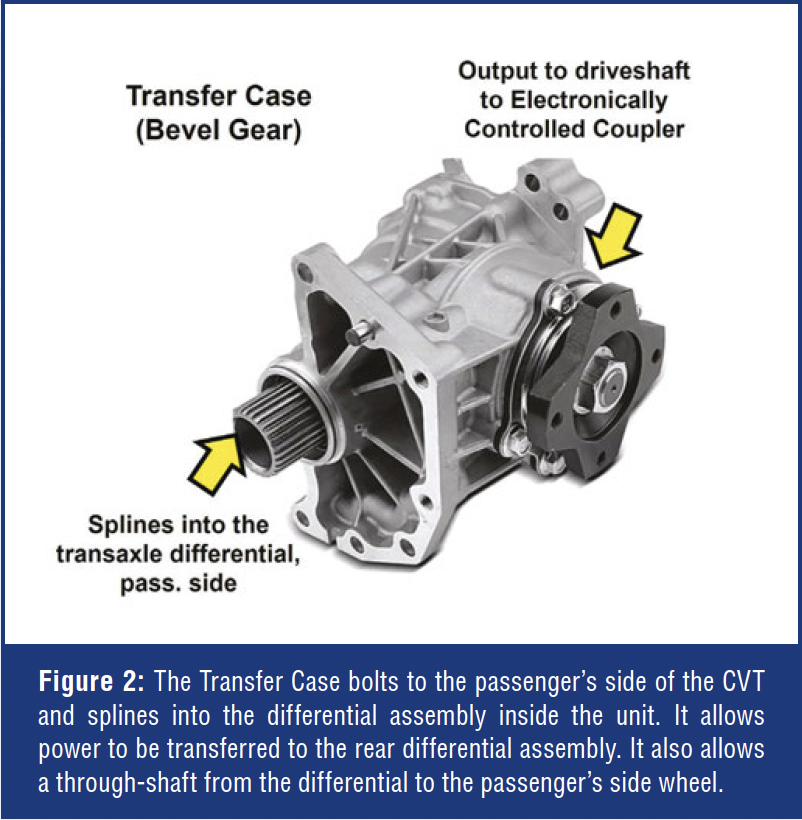 Vehicles like the 2013-2020 Nissan Pathfinder equipped with the RE0F10E/J have a light-duty AWD system set up. Since the unit is Front Wheel Drive, power reaches the rear axle through a transfer case (bevel gear box) and a drive shaft. The drive shaft inputs to an Electronically Controlled Coupler that modulates torque to the rear differential assembly (figures 2 and 3).
On the Pathfinder version, there is provision for the driver to control rear differential torque by using a 4WD Mode switch in the driver’s console area (figure 4). The LOCK selection fully engages the clutch and prevents slip (full-time 4WD mode). The 2WD selection places the vehicle in FWD mode only with no torque allowed to the rear wheels. AUTO mode allows for the powertrain management system to modulate the clutch on and off based on torque demand. Under heavy acceleration, the clutch locks on to transfer maximum torque to the rear axle. 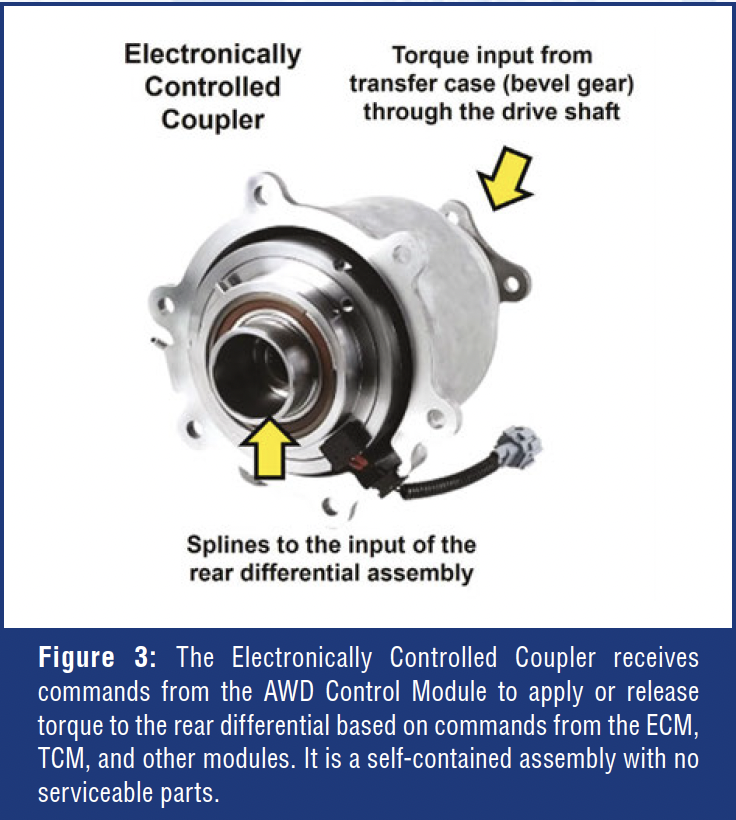 As torque demand decreases, the clutch allows for slip, thereby transferring less torque to the rear wheels. In cruise mode, the vehicle will operate in FWD mode. Note that the Electronically Controlled Coupler may be used for vehicle stability, ADAS, and ABS events.
Now for the problem: as the coupler clutch wears, torque transfer deteriorates. The commands from released to full apply do not transfer torque as requested by the powertrain controls. This results in a shudder sensation noticed during acceleration in AUTO mode. The shudder is most severe during heavy acceleration and diminishes under light throttle. 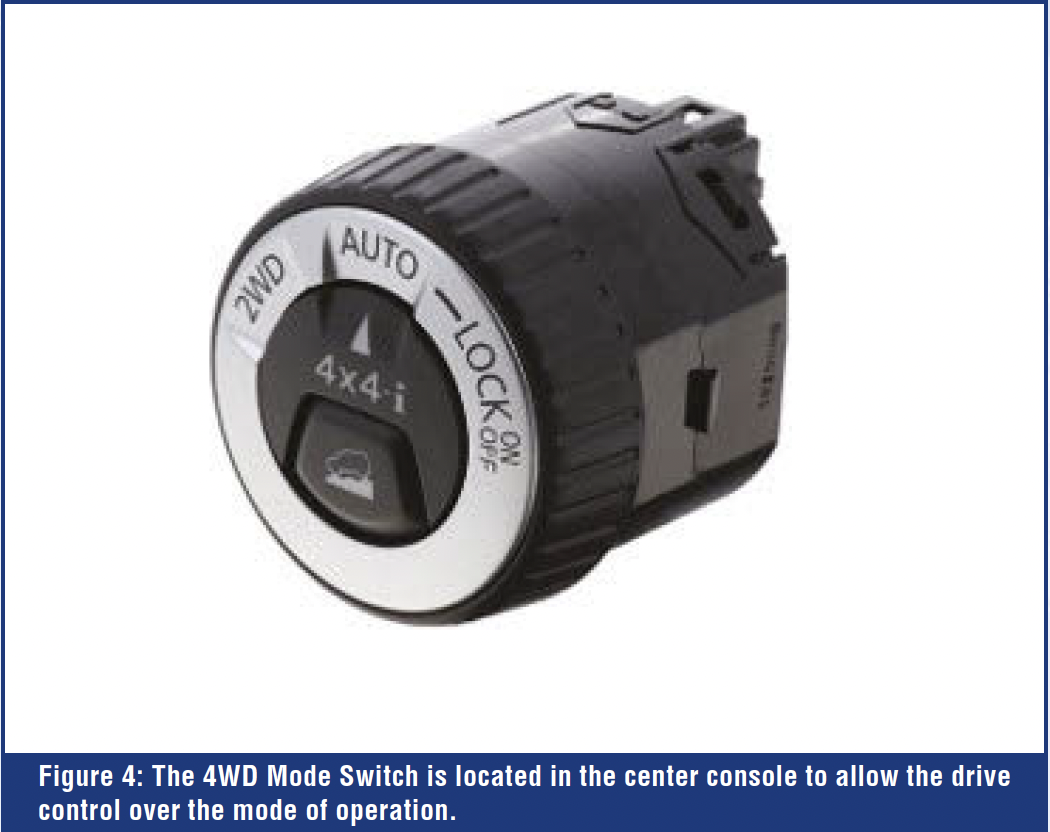 The unfortunate part of this is that the shudder condition is often severe enough to trigger a P17F0 DTC in the TCM. Note that the code can be cleared using a Consult 3+ scan tool or an equivalent for diagnostic purposes.
To isolate a fault with the Electronically Controlled Coupler, place the unit in 2WD mode and drive under heavy acceleration. If the shudder complaint is not present in AUTO mode, then the Electronically Controlled Coupler is at fault. The fluid is not serviceable, nor are there serviceable parts inside. The unit must be replaced as an assembly.
Nissan CVT units will remain with us for the foreseeable future. Engineers love this design because of its simplicity and efficiency. However, as these vehicles age, we will need to keep this discussion in mind to ensure we address the root cause issues behind vehicles that come into our shop. Knowing what can cause a good transmission to fail will help you avoid pitfalls and deliver the goods to your customers with confidence.