The ZF9HP48 unit entered the transmission market in 2014. This transaxle is used in a wide variety of OEM applications worldwide (Figure 1). While each manufacturer may use different names for it, the unit is primarily identical in operation and control, inside and out, with minor variations in parts. 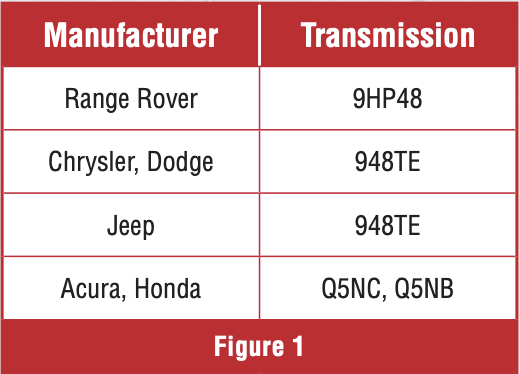 With it came hydraulically controlled dog clutches, something the automatic transmission industry has not seen used. Fast-acting computers, coupled with speed-sensor feedback and pulse-width-modulated solenoids, made a seemingly difficult shift into a reliable transition. With state-of-the-art technology at the heart of this transmission comes a question of durability. Hydraulic and mechanical components eventually wear and cause problems. In this article, we will look at a common customer complaint stemming from internal component failure.
THE TECHNOLOGY
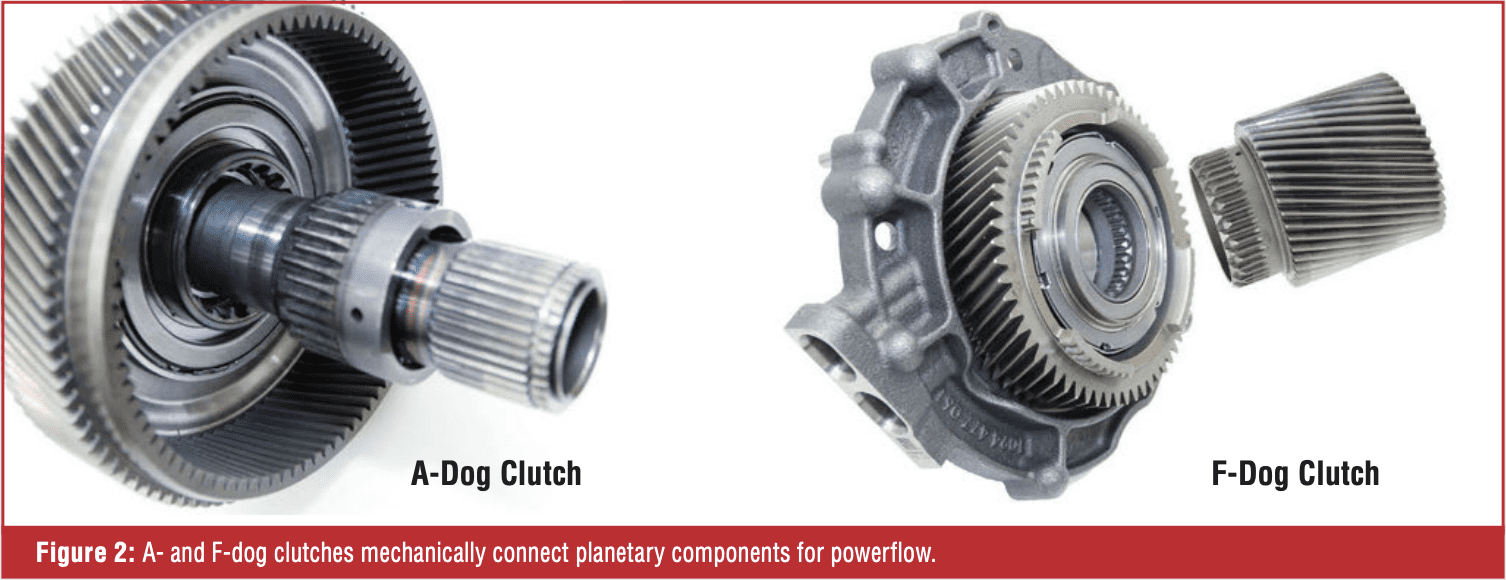
The ZF9HP48 and all its variants share the same clutch technology. While most of the unit contains hydraulic piston-applied clutch packs, there are two hydraulically actuated dog clutches. Both dog clutches resemble non-synchronized manual transmission sleeves designed to engage and disengage planetary components (Figure 2).
 The A- and F-dog clutches share a hydraulic pressure transducer circuit. The pressure transducer sends an electrical signal in response to either dog clutch changing state (applying or releasing). An internal valve allows pressure to pass through the shaft during the apply and release process of the dog. This pressure flows to the pressure sensor on the valve body. When the dog is fully engaged or disengaged, the valve bottoms out and the pressure drops. The computer uses this drop in pressure to verify the dog is in the proper position. If the valve hangs up, pressure does not drop, and the transmission sets a code.
THE CUSTOMER COMPLAINT
A vehicle equipped with a park-by-wire version of the ZF9HP48 transmission, or any variant, may experience a condition in which the vehicle is stuck in park. Models equipped with the rotary-style gear selector may have a customer complaint about selecting Drive or Reverse, and shortly thereafter, the selector automatically returns to Park. A DTC P0810 (Clutch Position Control Error) may also be present.
THEORY OF OPERATION
First, let’s look at how code P0810 is set. The purpose of the diagnostic is to detect an incorrect dog clutch position due to either hydraulic, electrical, or mechanical failure. The actual position of either dog clutch A or F is calculated based upon pressure variation resulting from the dog clutch actuation. The pressure is measured by a pressure sensor. A symptom of an incorrect dog clutch position is detected if the actual position does not correspond to the commanded position for greater than a calibrated amount of time. A fault is set when the number of symptoms exceeds a calibrated threshold. Failsafe operation may be commanded.
The TCM performs an additional diagnostic immediately after engine restart. It monitors the time between the solenoid command and either engagement or disengagement states. If the time between the command and the engagement or disengagement state exceeds a calibrated threshold, a fault is stored, and failsafe operation is initialized.
WHAT THIS DIAGNOSTIC DOES
The TCM is constantly checking whether dog clutches A and F are moving the way they’re supposed to. The diagnostic runs whenever the engine is running above a certain speed, and the oil pressure sensor is working correctly (no electrical faults or bad readings). It specifically watches during two situations:
- Normal operation (state monitoring) – when the vehicle is running normally.
- Startup/initialization (initialization monitoring) – when the clutches are first being set to their starting positions.
The code will trigger under the following conditions:
- During normal driving: The clutch position doesn’t match what the system is commanding for too long.
- During startup: The clutch fails to move into either the engaged or disengaged position within the expected time.
If this problem is detected, the check engine light (MIL) may or may not illuminate. However, a fault code may be stored, and the following action will result:
- The transmission goes into limp mode (limited range selection or stuck in Park).
- The system stops requesting certain torque adjustments from the engine.
- Remote start may be disabled.
There are several possible causes for a DTC P0810. The most common causes include:
- Low transmission fluid
- Dirty or contaminated fluid
- A faulty valve body
- Internal transmission damage
Keep in mind that proper diagnosis will take you from the fluid level check and correction to the removal, repair, or replacement of the unit. Let’s follow a diagnostic path to help us isolate our issue.
DIAGNOSING THE ISSUE
If a DTC P0810 is set, use freeze-frame failure records to determine the conditions under which the fault occurred. If the vehicle is stuck in Park with a P0810, there is a high probability that it is due to a faulty A-dog clutch. However, note that a fault detected in either the A- or F-dog clutch can trigger this DTC.
First, check for any codes in all modules. Body control codes that indicate the door, hood, or back hatch is ajar, the driver’s seat is unoccupied, will trigger the safety programming, keeping the vehicle in Park. To isolate a possible A-dog clutch failure, use the following procedure:
- Check transmission fluid level and condition.
- Fix the fluid level if it’s low.
- Use a scan tool to read and record fault codes and freeze frame data.
- Clear the codes.
- Drive the vehicle under the same conditions that caused the issue:
- Select Reverse.
- If the vehicle goes into Reverse, check for movement.
- If it moves, return to Park or Neutral.
- Select Reverse again.
- If the vehicle moves, select Drive. If the selector automatically returns to Park, check for codes. The A-dog clutch is most likely faulty.
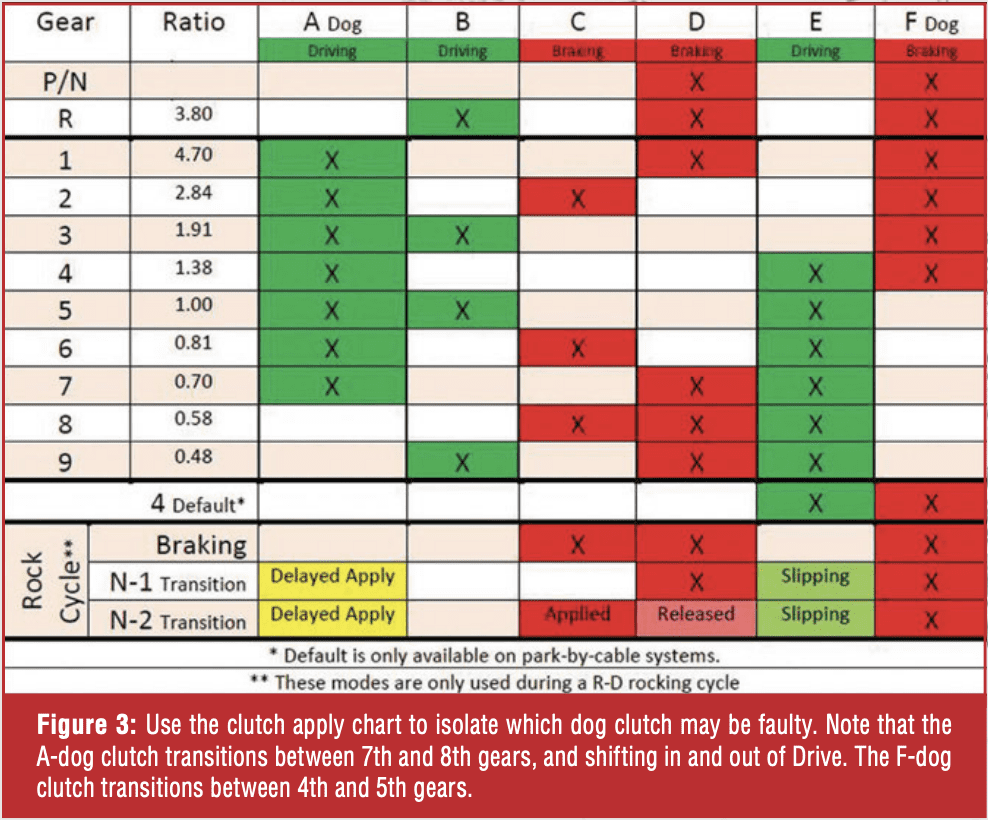 If no fault occurs, it may be necessary to repeat the last five steps. Note that freeze-frame failure records may indicate that the fault occurred while the vehicle was moving. Attempt to duplicate the recorded conditions. Also note the gear at the time the fault occurred (Figure 3).
If the DTC returns, repair or replace the transmission as necessary. If not, continue testing for an intermittent condition. Attempt several forced downshifts to lower ranges while monitoring transmission data for faults.
ISSUES INSIDE THE UNIT
 Inspect the valve body for sticking A-Dog Clutch control valve or malfunctioning A-Dog Clutch solenoid. No issues with valve bore wear have been reported yet.
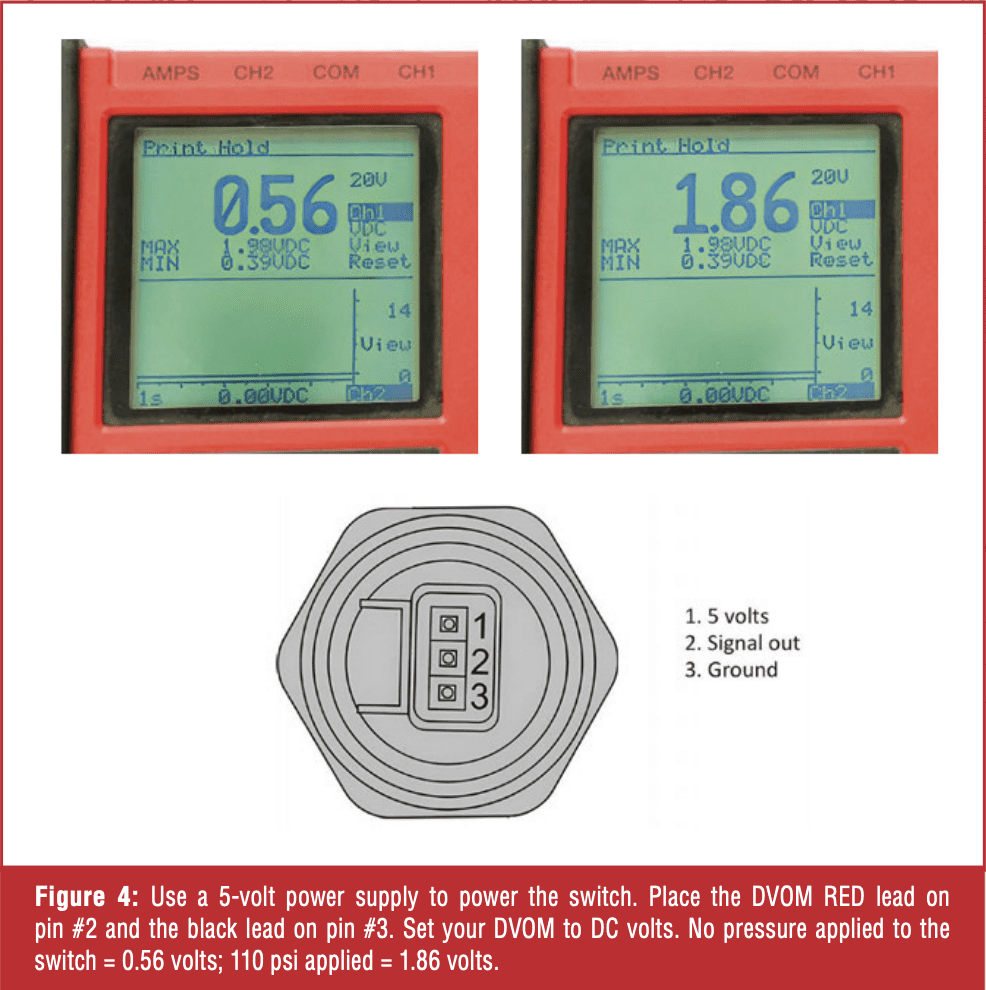
Bench test the Dog Clutch pressure switch. It is a Hall-effect switch (Figure 4). You will need to use a power supply and compressed air. If the pressure switch tests good, we need to move on to the A-Dog clutch.
INSPECTING THE CLUTCH
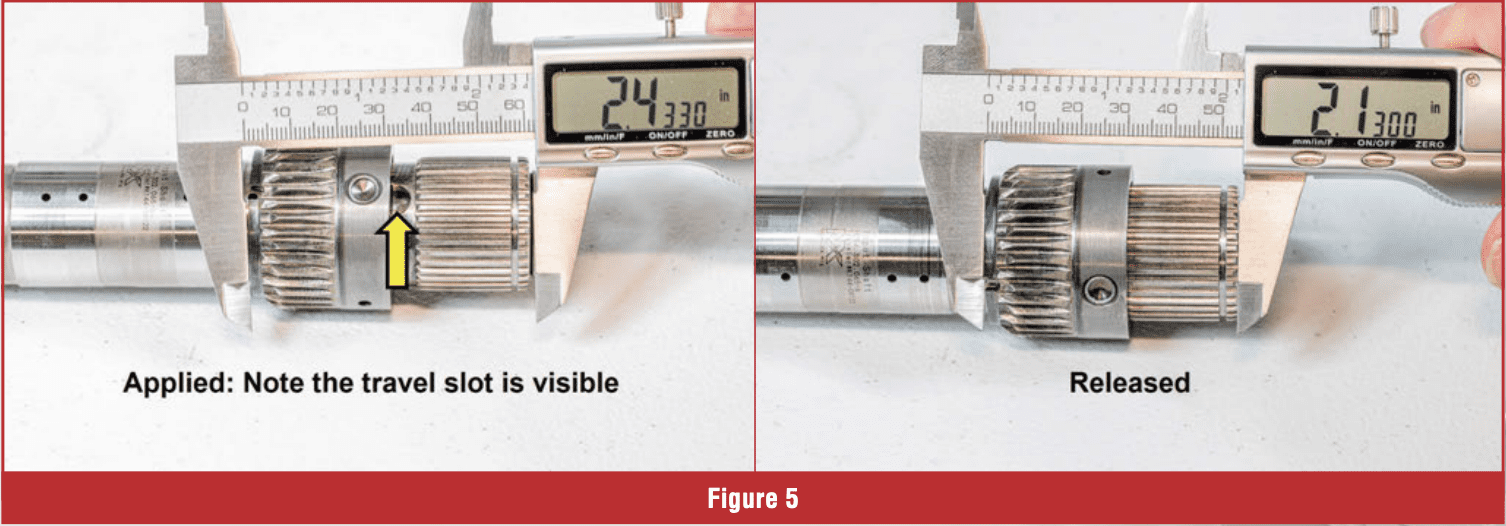
During the disassembly inspection, isolate the input shaft with the A-Dog clutch. Check for full-range freedom of movement of the dog clutch on the shaft. Note that it should travel from applied to release without resistance. Use a dial caliper to measure and verify (Figure 5). Check for damaged A-Dog clutch spline. Note that the sleeve tends to suffer damage before the P1/P2 sun gear/ring gear does.
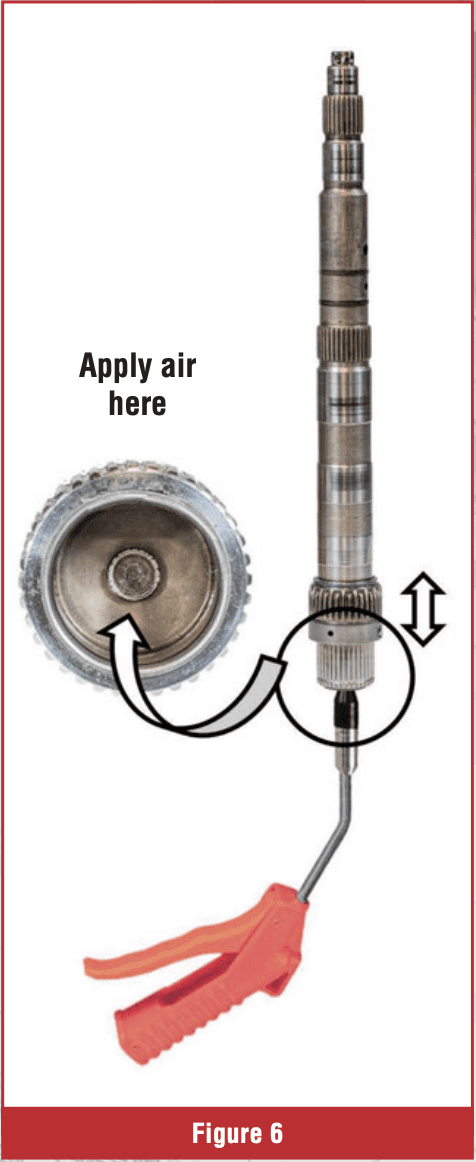
 If the A-Dog clutch moves freely, perform an air check by blowing compressed air into the applied side (bottom of the shaft). While holding the shaft vertically, observe the dog clutch movement (Figure 6). It should travel to the fully applied position when air is applied with minimal leakage. Release the pressure and observe the dog clutch return to its fully released position.
 The A Dog clutch valves inside the input shaft are retained by a hardened end plug with a 0.207” feed orifice. The larger internal valve seals and responds to the application and release of oil fed to actuate the sleeve. A hardened pin passes through the center of the valve, is loosely held, and fastens securely to the A Dog sleeve. The sleeve moves freely with minimal lateral freeplay on splines on the input shaft. If the tests performed show that the A-dog clutch assembly is not functioning correctly, replace the entire shaft and dog clutch assembly.
The A Dog clutch sleeve can be purchased through aftermarket hard parts suppliers. A new input shaft includes the A Dog clutch assembly. There are two different input shafts: Chrysler (without an orificed tip) and other models (with the orificed tip).
When new technology is compromised, symptoms and DTCs may not lead us directly to the root of the problem. Always research how a system you are not familiar with operates so you can better understand how failures can occur. Here at ATRA, we are constantly researching new technology so we can help you deliver the goods to your customers with confidence!
Special thanks to Nat Wentworth of Eriksson, Jim Mobely of Sonnax, and Pat Schulte for supporting research and information!