In this issue of Keep Those Trannys Rolling, we are going to take a look at a 2004 Mini Cooper that was experiencing erratic or pulsing ratio changes while driving. This 2004 Mini Cooper was equipped with a 1.6L engine and a GACVT-16Z CVT transmission.
I first learned about this 2004 Mini Cooper when a local used-car dealer’s sales manager contacted us about a Mini Cooper with erratic operation while driving. According to the sales manager, a local automotive repair shop installed a used CVT transmission, and the transmission adapts needed to be reset. I informed the sales manager that we would be willing to take a look at the Mini Cooper, and we scheduled an appointment for it to come in the next morning.
Morning Always Arrives Early
The next morning, I arrived early with a call from the local tow company. They were on the way with the Mini Cooper. The Mini Cooper arrived on the back of a flatbed tow truck. According to the tow truck driver, he was familiar with this Mini; he had been towing it from shop to shop for the last few months. He said, “Nobody has been able to fix it, good luck”. Well, this was top secret information that the sales manager did not share with us. With the vehicle pushed into a bay, it was time to perform our initial inspection.

Initial Inspection
With the Mini pushed into the bay, we began our initial inspection. We conducted a walk-around inspection for scratches, dents, and other visual concerns. This Mini was in exceptionally good condition. We inspected under the hood. We found numerous wiring harnesses misrouted and several connectors broken. It was obvious that someone had worked on the vehicle previously. We checked the fluid levels and replenished them as needed. We lifted the vehicle up on the rack to perform an under-vehicle inspection. During the inspection, we checked the underside of the engine and transmission. The transmission was identified as a used assembly with yellow writing identifying the vehicle type. We completed our under-vehicle inspection, including a visual inspection of the exhaust and fuel systems. Everything seemed to be okay on the underside of the vehicle. With the vehicle inspection completed, it was time to take a closer look at this little Mini Cooper.
First Look
With the vehicle inspection completed, it was time to take a closer look at this little Mini. We connected our scan tool to the vehicle Data Link Connector (DLC) to check the on-board computer systems for codes. 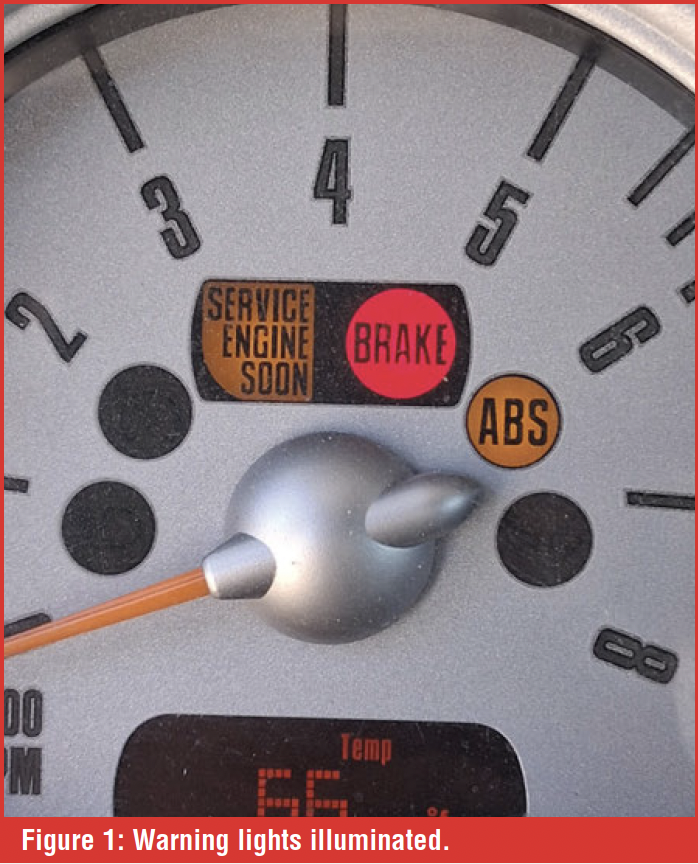 There were numerous codes in the Digital Motor Electronics Module (DME), Anti-lock brake (ABS) control module, Transmission Control Module (TCM), and Steering Angle Module (SAM). Every warning light in both dash panels was illuminated (Figure 1). We documented all the codes and then cleared them from each computer system. We rechecked the system for codes and found that the codes had reset in the DME, ABS, and TCM. It was obvious that resetting the transmission adapts was not going to fix this little Mini. We contacted the dealership sales manager to discuss what we had found and to see if we could get the real story.
The Real Story
According to the sales manager, this Mini was taken in as a trade-in. The sales manager indicated that the previous owner had the transmission replaced due to pulsing, erratic operation, and illuminated warning lights. The previous owner indicated that the Mini had been to several repair shops to address transmission shifting concerns, but they could not fix it, so he traded it in. After a brief conversation with the sales manager, we agreed to take a closer look at the little Mini.

Taking a Closer Look
After rechecking the system for codes and finding that the codes had reset in the DME, ABS, and TCM, we needed to take a closer look at the computer systems. The DME, which controls the engine/emissions operations, had reset code P0122 (Throttle/Pedal Position Sensor/Switch ‘A’ Circuit low) and P0123 (Throttle/Pedal Position Sensor/Switch ‘A’ Circuit high). The ABS system had reset codes C5D91 and C5D92 (left front wheel speed sensor performance), and the TCM had a reset code P1776 (CAN/comm left-front wheel sensor). Knowing that problems with the DME and ABS will interfere with the transmission operation, it was time to take a look at each of these systems.
Digital Motor Electronics Module (DME)
The purpose of the Digital Motor Electronics Module (DME) is to control the engine and emission systems’ operation. The DME shares its data information with the ABS and TCM. During the initial inspection, we found broken or loose connections and misrouted engine wiring harnesses. We rerouted the engine wiring harnesses and secured them to their proper locations. 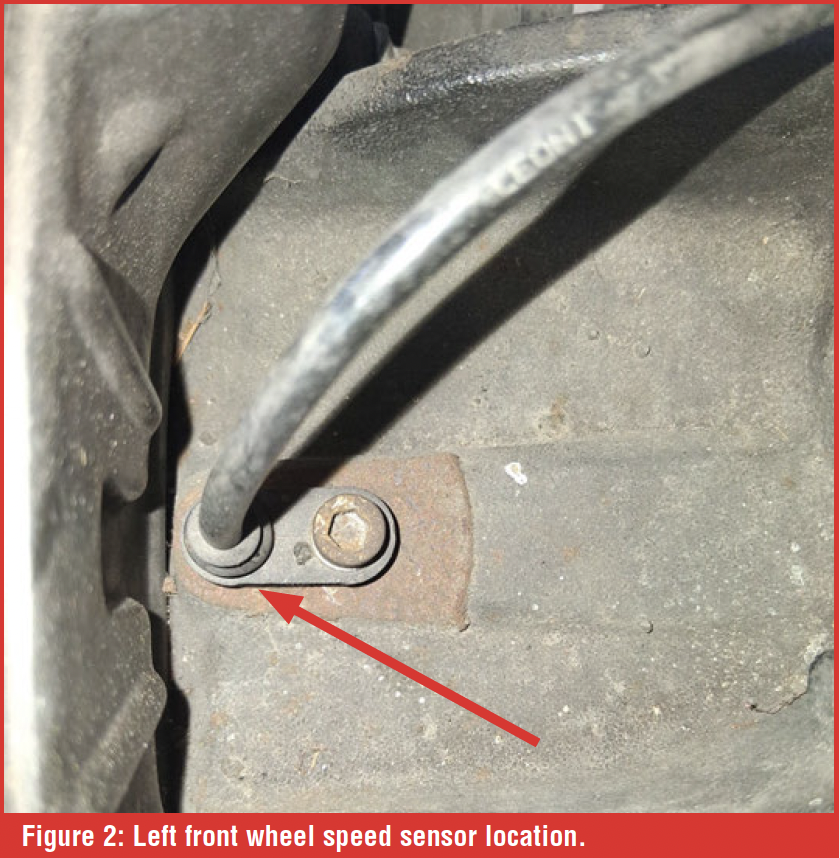 We repaired several connectors, including the broken throttle pedal position sensor (TPPS) connector, which resolved the P0122 and P0123 (TPPS) codes. With the engine performance codes cleared, it was time to take a look at the ABS system.
Anti-Lock Brake (ABS) Control Module
The purpose of the Anti-lock brake (ABS) system is to control the brake system and prevent brake lock-up during brake application. The ABS system shares its data with the DME and TCM. While checking the ABS system for codes, we found codes C5D91 and C5D92 (left-front wheel sensor performance) resetting in the ABS system. We checked the left front wheel speed sensor operation (located in the left front wheel housing) (Figure 2) and found that the wheel speed sensor signal was erratic. We checked the wiring and connections for the left front wheel speed sensor (Figure 3) and found a corroded connection at the speed sensor connector. 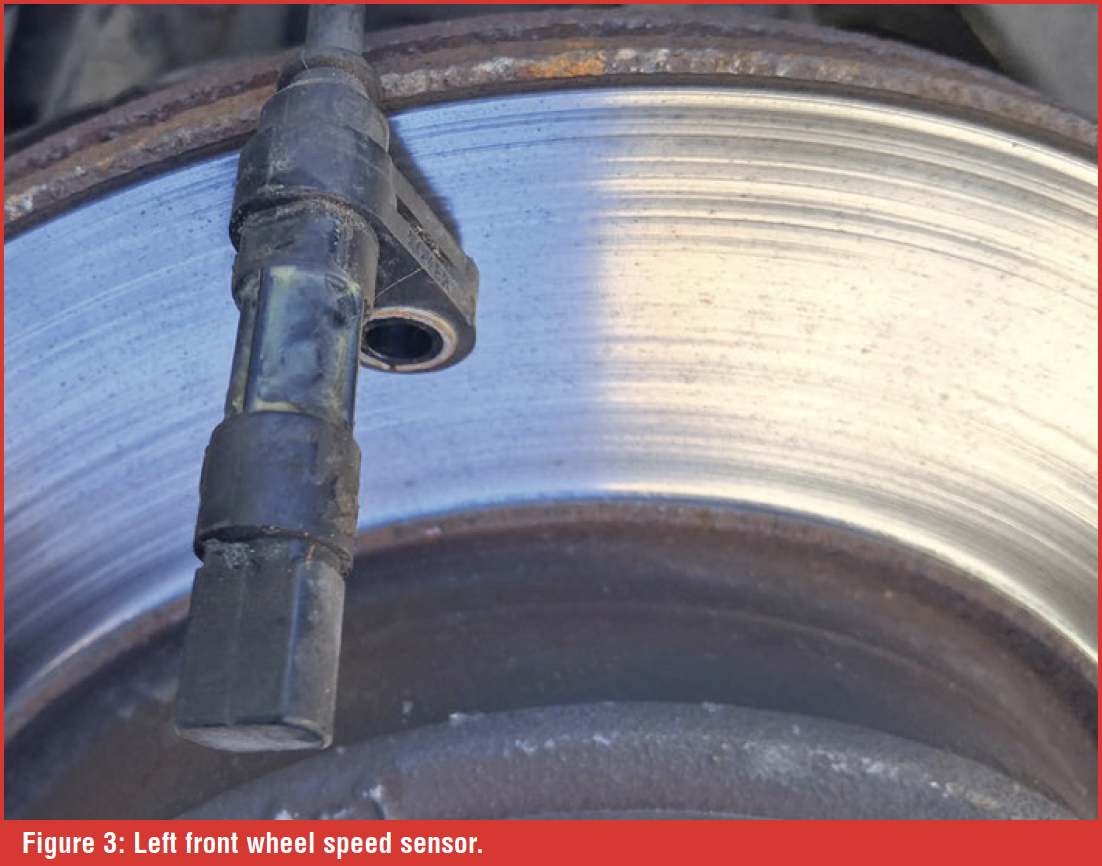 We repaired the speed sensor connector and rechecked the ABS system for codes. Codes C5D91 and C5D92 had cleared and did not reset. With the DME and ABS system repairs completed, it was time to take a look at the TCM.
Transmission Control Module (TCM)
The purpose of the TCM is to control the operation of the CVT transmission. The TCM uses inputs from he DME and ABS systems to control the CVT transmission operation. After repairing the DME and TCM codes, it was time to recheck the CVT transmission operation. We cleared the P1776 (CAN/comm-left front wheel speed sensor) code from the TCM and rechecked for the code resetting in the TCM. The P1776 (CAN/commleft front wheel speed sensor) code did not reset. With all the codes cleared from the computer system, we reset the engine and transmission adapts and headed out for a test drive.
Test Drive
During the test drive, we drove through parking lots and city streets. We drove on the freeway at speeds below 60 mph to allow time for the emission monitors to reset. It took close to 50 miles of freeway driving before the emission monitors reset. During the test drive, the transmission worked perfectly. Ratio changes were smooth and on time. After the emission monitors had reset, we headed back to the shop.
Back at the Shop
With the transmission working perfectly, we checked the computer systems for codes; none were found. We contacted the dealership’s sales manager and made arrangements to have the vehicle picked up.
With a little bit of patience and a better understanding of how the CVT system interacts with the DME and ABS systems, you should have no problem Keeping Those CVT Trannys Rolling down the road.