What we’ve known as the Neutral Safety Switch has changed over the years and has had various names such as the Park Neutral Position Switch, Internal Mode Switch, Range Sensor, and a host of others. Some are on the outside of the unit, some are on the inside, either by itself, or it may be part of a MechTronic unit. For the most part it prevents an engine start unless the shifter is in Park or neutral, it turns on the reverse lights and might interfere with upshifts, or prevent any upshifts at all. These concerns are simple to spot and we all know what to do if we see them. But a neutral condition? If you’re faced with this condition you might easily take off in the wrong direction.
 One such case id GM’s NSBU (Neutral-Start-Back-Up) switch used on the Allison LCT 1000 series. It’s been around for a long time and for those who haven’t seen too many of them you’ll want to pay close attention.
Besides keeping the engine from starting, the NSBU can keep the truck from moving after it’s started. Or it can allow only one forward gear. That TCM that’s on the fan shroud is very protective of its transmission. Any minor discrepancy in the electronic flow of this switch can and will throw the unit into limp mode. It has redundant circuitry to let the TCM know if a wire or contact has failed.
The switch is costly if purchased from a GM dealer. If you have access to an Allison dealer, it may be a bit cheaper. If you work on these units, you should be in the habit of having one of these components on the shelf. Some have tried using a park-neutral switch from a 4L60E. While it may work, it isn’t as heavy duty as the Allison part, nor is it sealed from the weather as good. As previously stated, any change in resistance or continuity in these circuits will upset the TCM, which means that the Allison is more sensitive to water intrusion in the switch than the 4L60E and that’s where we get into trouble.
The NSBU has two connectors (figure one). One connector has four pins, and the other has seven. All four pins of the first connector go directly to the TCM and tell it which range the transmission is in. The seven-pin connector does all the other work like the power feed for the starter relay and backup lights, which can also control a backup warning klaxon. (You know, the “beep, beep, beep” that wakes you on an early Saturday morning). One exception is pin “D” which is a ground wire to the TCM.
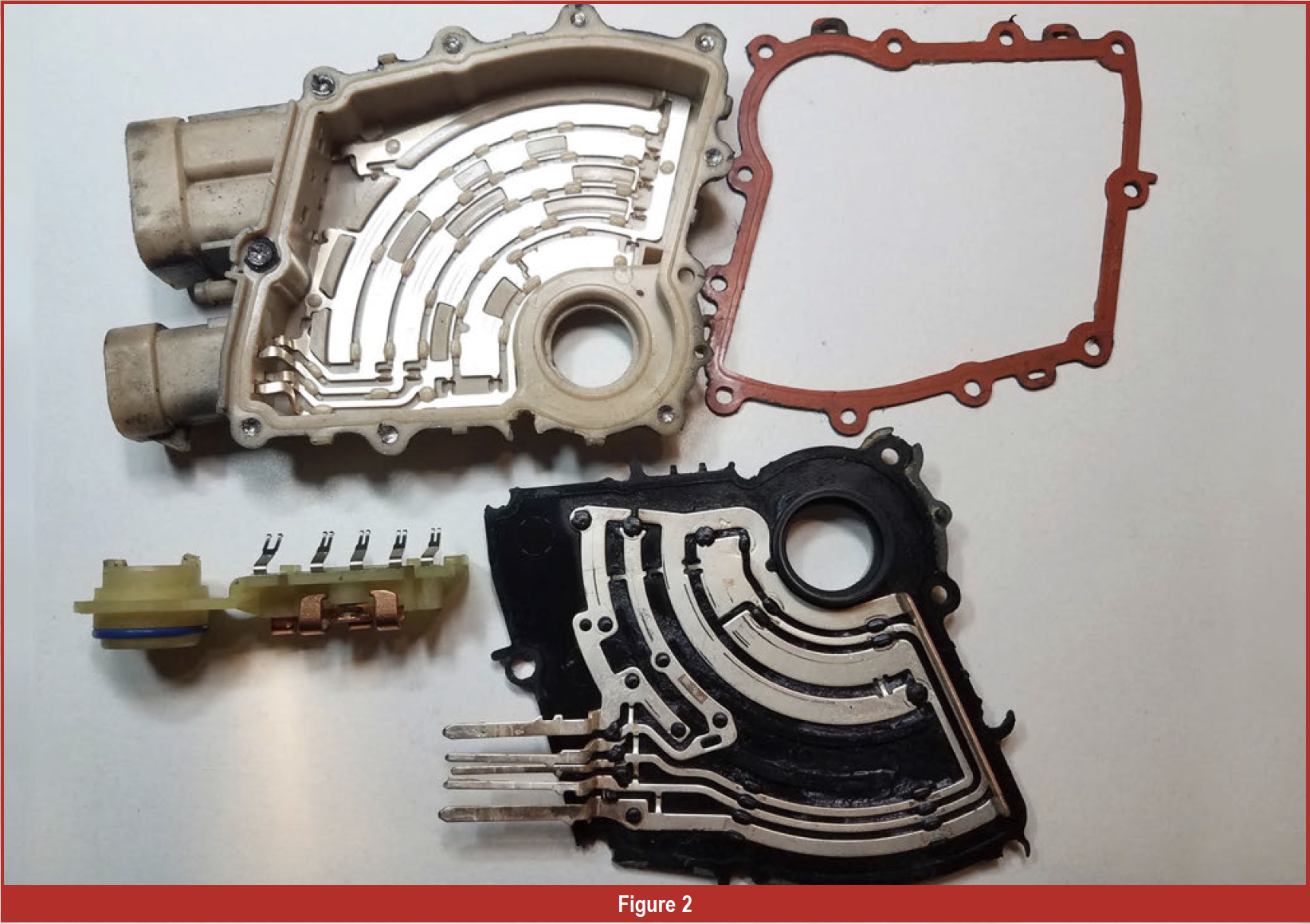
There’s no mystery to the workings of the NSBU; inside is straight forward with just a series of wiper contacts (figure two). The five silver contacts are connected together and travel on the paths on the tan body. The two copper sets have two contacts each and travel on the black cover. Incidentally, a sharp eye will notice a total of nine pins, two more are hidden in the tan body in the large connector.
The problems with this component arise when it has lost its seal from the elements, and also from being worn out. It’s not uncommon for these trucks to go 300,000 miles or more which translates to a lot of shifter movement. With that much wear, and the risk of water intrusion you can have resistance between the wipers and the blades; something the TCM isn’t programmed to understand. That is, it understands on/off, open and closed; it doesn’t understand just barely on or slightly closed!
What’s more a NSBU with poor contacts might not show up on your scan tool and there aren’t any “resistance” specifications to test for a worn out switch. Some conditions will set a P0708 (Transmission Range Sensor High) code but that’s just if you’re lucky. The worst condition is a partially-failed switch that causes a problem but doesn’t set a code.
 If you get one of these in with a no-shift or no-move condition check the switch activity with your scan tool and compare it with the switch range chart in you reference material. The pressure manifold switch and the NSBU work together and verify each other so codes P840-P876 and P1709-P1714 which are pressure manifold codes, can also point to a faulty NSBU.
If all looks well and you’ve checked the simple things like power and grounds, the battery etc. then STOP, and try this next. Keep a new NSBU handy as a testing tool. You can use one for a 4L60E but never actually replace an Allison switch for the common 4L60E switch; the Allison version is sealed much better and less likely to fail if exposed to the elements and driven great distances like a working truck.
If the transmission begins working correctly then you’ve found the problem without spending too much time. If not, you’re back to square one but at least you won’t get bit after a long testing session only to find it was a simple switch.
It’s often the simple things that get us but you can stay one step ahead with your new-found tool.
Good luck!