I’m sure it’ll come as no surprise to anyone that today’s cars are more complex and more difficult to repair than they were just a few years ago. And there’s no sign of things getting any easier.
In fact, just the opposite: We’re already facing 8- and 9-speed transmissions, with full computer controls and integration across the transmission, engine, and brake systems. And, according to all reports, there are all sorts of new gadgets and systems on the way!
There’s no doubt about it: Today’s technology is keeping us hopping on the ATRA Technical HotLine. But what you might find surprising is just how often the problems that get our phones ringing turn out to be caused by something that’s decidedly nontechnical. Something so simple that, in the end, we all end up giving ourselves a Homer Simpson-like smack on the head and its accompanying “Duh!”
After a lot of consideration, we’ve come to realize that there are six basic points that could eliminate the vast majority of problems in the shop. 6 easy steps that, if you follow them religiously on every diagnosis that comes your way, you’ll reduce your diagnostic times, improve your customer satisfaction, and increase your bottom line.
Here are the 6 easy steps we came up with:
1. KNOW THE COMPLAINT
Sounds simple doesn’t it? But how many times have we heard the customer complain about one thing, only to find out it’s something completely different? All too often, the actual customer complaint gets lost in the confusion of the language barrier between the customer and you.
And here’s the thing: The customer is there for a reason. He’s noticed something that seems, well, not right with his car. He’s been driving it for the last that many years, and suddenly something seems… different. He may not know how to explain the problem, but he knows something’s wrong.
Now you get the car in your bay, along with a cryptic note about a noise or a roughness or a shift problem, and you’re left to guess what he thinks is wrong. So you go for a ride, find and fix a dozen issues that you were able to isolate. But none of them is the one the customer was complaining about.
The answer? Get the customer to show you the problem. He knows when it occurs and what it sounds like. He knows what driving or road conditions that are necessary for it to show up. Get him to show you what he’s complaining about so you’re on the same page.
And who’s going to go with the customer? A service writer or the technician who’ll be working on the car? If it’s a service writer, you may simply be adding one more link into a chain of confusion. The better bet? Have the technician go with the customer, so there won’t be anything lost in translation.
That’s the easiest way to be sure you know what you’re supposed to fix.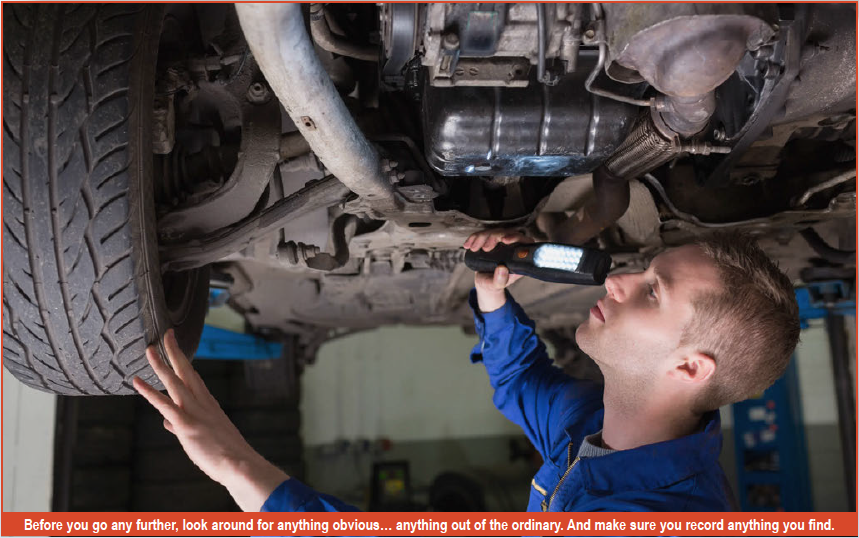
2. STAND BACK AND LOOK
I know it’s tempting to dive right in and handle a repair as soon as you know what the customer’s complaint is. But that’s a great way to put yourself in an unfortunate situation.
Before you start to address any problem, take a step back and look the car over. Look for any damage or other problems that might be worth noting. For example, has someone been under the hood recently? What did they do to the car? Were they trying to fix the same problem, or did they actually cause it?
Remember, it’s a lot easier to fix something that broke on its own than it is to figure out someone else’s mistake. Sometimes a look at what came before you can clear up a whole lot of diagnostic questions.
When you find something wrong — anything from a scratch on the fender to a completely burned wiring harness — make a note of it and, if possible, get a picture of it. Even if it has nothing to do with the customer’s complaint. If nothing else, it’ll prove later that you weren’t the one responsible for it.
3. CHECK FOR BULLETINS
Okay, now you know what the customer is complaining about and you’ve taken the time to look for anything obvious or out of the ordinary. Now take advantage of the technology at your fingertips and run a search for any bulletins or common complaints on line.
Some of bulletins you discover may cover the obvious, but others might be a complete surprise to you. Very often, those bulletins are the product of dozens — or even hundreds — of hours of diagnosis and analysis, just to find something that you might never have guessed on your own.
Not to mention that the problem you’re trying to fix might simply require a programming update. All the adjustments or parts replacements in the world won’t fix a problem that a simple change to a line of code corrects instantly. That’s something you need to know… before you dive into the diagnosis.
What’s more, you may find something about a recall, hidden warranty, or class action lawsuit that will address the problem you’re looking for. Sure, that may mean you’ll have to send the customer to the dealer to get his car fixed. But how much will that enhance your reputation when he learns that the factory is footing the bill?
4. IDENTIFY THE CAUSE
I know: The last three of these cars that came in with the exact same problem had a bad line pressure solenoid in the transmission. But, even though you’re already sure what’s wrong, take the time to diagnose it… again.
Sure, it’s tempting to make quick work out of a simple repair. But what if it isn’t that simple? What if it’s something entirely different? Jumping the gun and replacing parts without being sure of the source is a terrific way to turn the customer’s problem into your problem. That isn’t going to help anyone.
Think you know what’s causing the problem? Great — then you’ll know where to start your diagnosis. Check that component and make sure you’re right before you call the customer with a recommendation.
And, for heaven’s sake, never try to sell a maintenance service before you actually have the initial complaint repaired. To the customer, that’ll just mean he got a bigger bill without actually getting his car fixed.
5. PROVIDE A CLEAR DIAGNOSIS
You’ve analyzed the problem and you’re pretty clear about what’s wrong. Now it’s time to deliver the diagnosis to the customer.
Remember to explain things in his language. Yes, he thinks he knows all about cars. He doesn’t. So speak clearly. Avoid tech-speak. Use metaphors that he’ll understand.
Trying to explain a plugged solenoid? Relate it to a kinked garden hose. “No matter how much you press the lever on the spray nozzle, nothing comes out because the hose is kinked.” That he’ll understand.
And make sure he knows whether you’re sure this will fix his problem, or if there could be other problems later. These days, one problem could easily be masking others that you won’t be able to diagnose until you fix the first one. Make sure the customer understands that there could be more work necessary.
Finally, make sure you get an approval for the work. Just because you explained it doesn’t mean the customer said it’s okay to do the repairs. Get the approval before you perform the actual repairs.
6. MAKE SURE IT’S FIXED
You understood the complaint, you diagnosed and found the problem, and you made the repairs. Think you’re done? Not quite yet.
There’s one last step you need to take after every repair, before you deliver the car. Make sure the problem is really fixed.
Generally that means a thorough road test, to try to duplicate that problem again. That may involve driving on side roads or the highway, and it may mean a relatively long drive. This is the shakedown cruise, where you get to make sure your repairs really took care of the customer’s problem.
This is no time to drive gently, to avoid rattles or wear. This is where you want to make every effort to force that problem to show up again. If it’s going to come back, you want it to rear it’s ugly head now, while you’re behind the wheel; not later, after the customer has the car back.
Once you’ve completed your test drive, make one last check for codes, just to be sure they’re gone for good. If anything else shows up, your work isn’t done.
But if the car drives well, the problem’s gone, and there are no codes, you’ve done your job well. Make sure everything’s clean and ready to be delivered, and you can get started on the next car on your list.
Seems pretty simple doesn’t it? And it is. Did you want it to be complicated? Well, there’ll be plenty of that while you’re doing the specific diagnosis and repair.
But what we’ve found through the calls to the ATRA HotLine is that the actual repairs don’t usually cause the real problems in the shop. The real problems are because of these 6 basic issues. And they can be eliminated by following these 6 easy steps.
Make them part of your regular diagnostic procedure and follow them carefully every time a car comes into your shop. You do that, and you’ll probably face fewer problem cars and enjoy greater customer satisfaction every day.