
In this issue of Fishing for the Facts, we examine a UA80E with a transmission overheating concern in a 2018 Toyota Camry (3.5L). As it turns out, the vehicle belongs to the wife of a longtime friend.
While at his shop for work on my own car, the owner—Dwayne, a friend of many years—asked me to take a look at his wife’s Camry, which was already there. It was the perfect opportunity to inspect the vehicle, take it for a road test, and see what we could uncover.
DUPLICATE THE PROBLEM
Before heading out for our test drive, we performed an initial inspection on the vehicle. We checked engine coolant and transmission fluid levels. We also performed a comprehensive diagnostic check of all modules using our scan tool to identify any codes present in the system. No codes were present at this time. With our diagnostic scan tool attached and ready for the test drive, we focused on transmission temperature condition and torque converter slip. While driving the vehicle through the city and on the highway, we noticed the transmission temperature rising to 220 degrees F. The torque converter slip was normal with no codes present at this time. It was time to return to the shop for further diagnostics.
RETURN TO THE SHOP AND DIAGNOSE
After duplicating the running hot condition, we returned to the shop to diagnose this concern. Given the fact that we did not observe issues with the TCC operation, we were convinced that we were looking at a cooling system concern. With all fluids checked good, no codes present, and torque converter slip within specifications, it was time to check the cooler flow temperatures at the transmission inlet and outlet cooler lines. There should be a 20-degree difference between the cooler lines. We checked the lines with a thermal gun, which indicated the cooler system was working properly.
Next, we installed the Sonnaflow in our transmission cooling system to check our flow rate. Normal cooler flow for this application is 1.6 gallons per minute (GPM). We were only getting 0.8 gallons per minute (GPM), which was low, leading to our transmission overheating. After verifying that the external transmission cooling system was operating properly, it was time to inspect the valve body for any related valve or damper wear.
After carefully removing the valve body assembly, it was time to perform a vacuum test to check for any worn valves or dampers that could be causing the transmission to overheat. We performed a vacuum test on all valves and dampers.
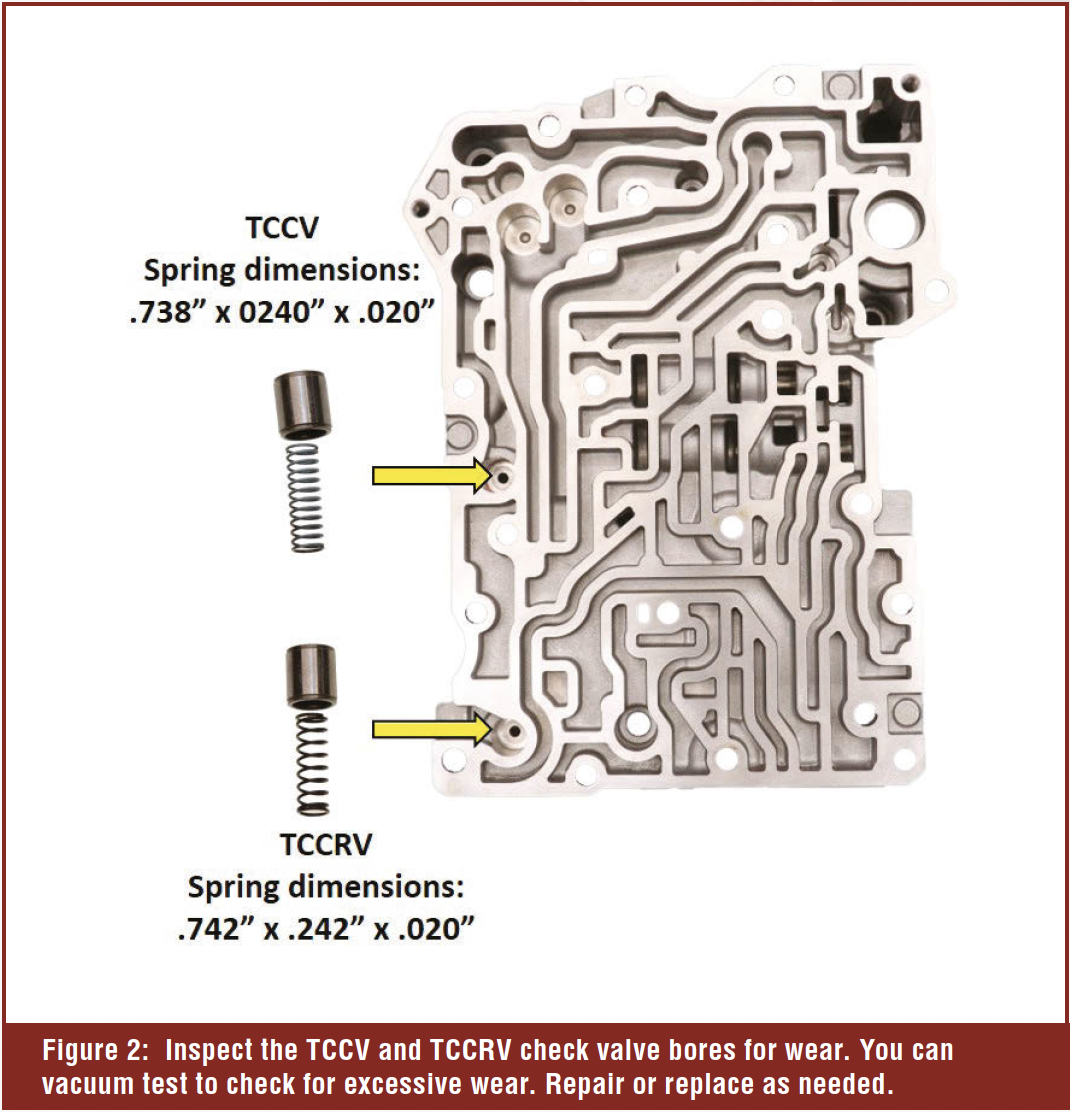
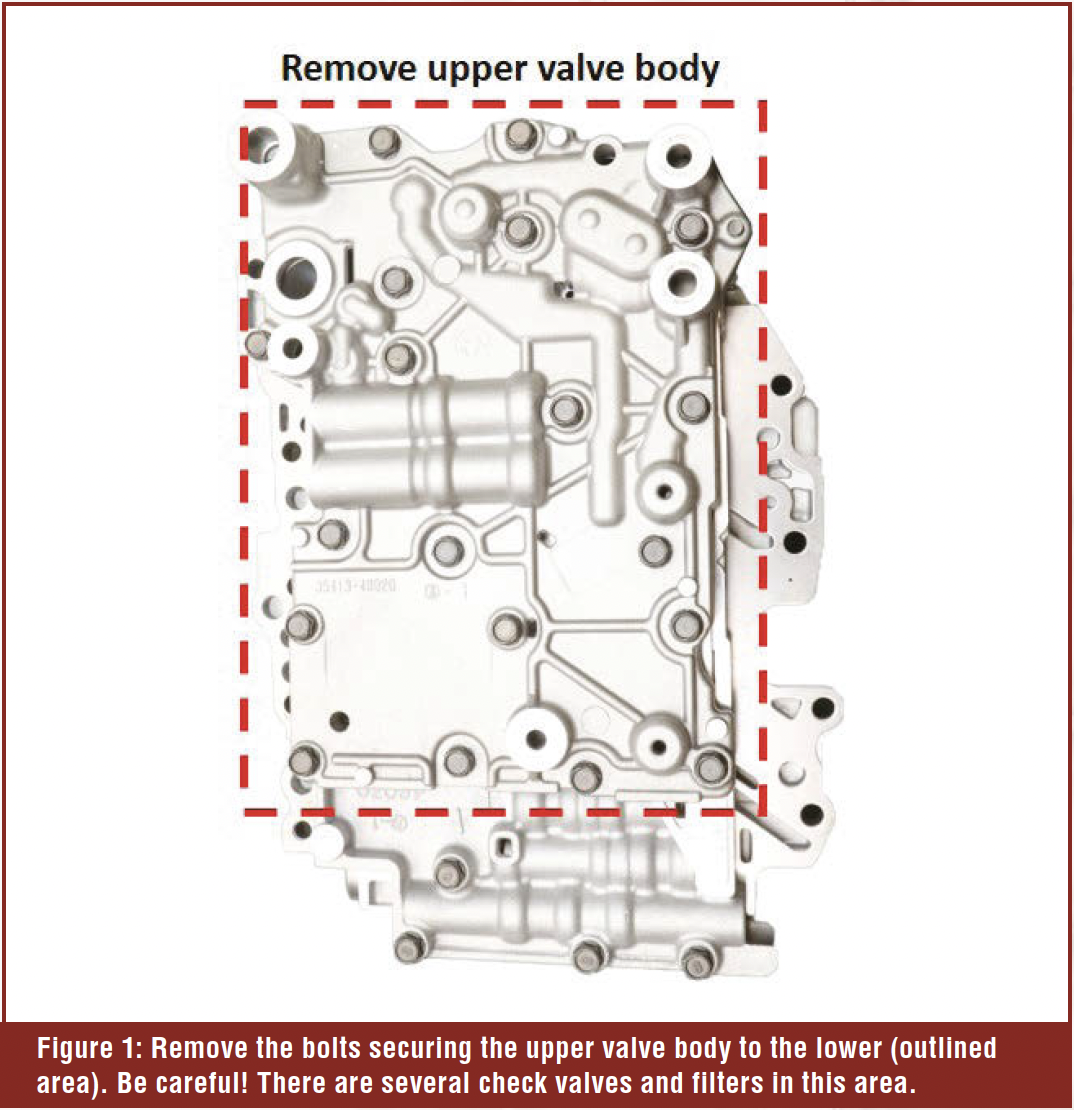 While performing a vacuum test on the dampers, the vacuum was low, around 8 inches. The Torque Converter Clutch Relief Valve (TCCRV) and the Transmission Cooler Check Valve (TCCV) dampers were the issue (Figures 1 & 2). These dampers are used in the Toyota and Lexus UA80E, UA80F, UB80E, and UB80F transmissions to prevent cooler and torque converter relief return pressure from getting too high. The Transmission Cooler Check Valve (TCCV) damper routes fluid from the TCC relay valve to the cooler to prevent overheating and supply the lube circuits. This damper closes the connection when the engine is off to prevent torque converter drainback. When the bores and/or pistons wear out, the pistons can get stuck in place and either block fluid flow or remain open, causing improper fluid flow. This can cause low cooler flow, lubrication failures, torque converter failures, fluid overheating, and related trouble codes, as well as torque converter drainback and delayed engagements. Replacing these worn dampers may require replacing the rear valve body casting assembly or the entire control valve body.
 REPAIRING THE ISSUE
After diagnosing the Torque Converter Clutch Relief Valve (TCCRV) and the Transmission Cooler Check Valve (TCCV) for wear, we purchased an OEM valve body from the local dealership to replace the worn original. As a note, aftermarket repair kits are available to repair as needed. With the OEM valve body replacement and correct fluid level verified, it was time to get back on another test drive.
TEST DRIVE TO VERIFY REPAIR
After valve body replacement, fluid level checks, and the vehicle reaching operating temperature, we performed a scan of all modules for codes. We cleared all adapts, reset all adapts, and completed all functional tests that needed to be done. It was time for the test drive. With the scan tool connected to the ALDL connector, we checked the transmission operating temperature, and everything looked good at that time. We then set our data to the TCC slip and transmission temperature operation for our final test drive. We proceeded through the city, driving onto the highway, with the transmission operating temperature and TCC slip at normal levels. On the highway, we decided to take a 30- mile round-trip test drive. After about 15 miles, we then headed back to the shop for the final recheck. Back at the shop, the transmission was back to normal operating temperature with no codes present.
With the information we’ve discussed, you should have no problem fixing the UA80Es running hot and overheating concern, and not waste time “Fishing for the Facts”.