
Automobile manufacturers are exploring every way possible to make vehicles more fuel-efficient. Powertrain management strategies are tailored with this in mind, while simultaneously maintaining a seamless and responsive driving experience. The result is a combustion engine coupled to a transmission with systems added to control and maximize the efficiency of every drop of fuel that goes through the engine.

 Through testing, manufacturers found that controlling the vehicle idle strategy improves fuel mileage too. This is why we have vehicles that turn off or go to neutral when we stop at traffic lights. While it seems like overkill, drop by drop, they are making a difference in how much total fuel we consume operating our vehicles.
While the engine-side enhancements are touted and well-advertised, the transmission side changes are less noticeable and subtle. As transmission technicians, we must be aware when these systems are in play that there are additional concerns that we need to address from diagnosis to unit repair that directly affects us. Let’s look at some of these strategies and how they directly affect the transmission side of the powertrain.
FUNCTIONAL STRATEGIES
First, all start/stop and neutral idle control systems share common functional strategies. While different manufacturers have their twist on how they get things done, the basics remain the same. Overall powertrain management, vehicle driveability, and safety are the main items that drive these commonalities. Start/stop and neutral idle control strategies are initialized when the following conditions are met:
- The engine and transmission are within operating temperature.
- Vehicle speed is zero.
- DRIVE range is selected. (The range that allows full automatic selection of all forward ranges).
- The brake pedal is depressed and the accelerator pedal is fully released.
- The vehicle electrical system is adequately charged, and electrical demand is safely maintained by the vehicle battery alone.
Note that any time the brake pedal is released, the engine is commanded to restart. Other driving conditions and sensors may be used by different manufacturers to determine when the start/stop or neutral idle control function is initialized. We will mention them further in this article.
Some conditions may exist to cause the start/stop or neutral idle control function to be disabled. The following common situations are:
- DTCs stored or pending in the PCM.
- Engine or transmission over/under temperature operating conditions.
- Faulty sensors and/or sensor signals.
- Manual gear select operation.
- Weak battery and/or faulty charging system.
Most manufacturers have a disable switch that can be selected by the driver. It must be selected each time the vehicle is started if the driver wants to disable this function. Some manufacturers have additional items that disable these functions based on programming. We will also mention these further in this article. Also, note if the battery or charging system was serviced or disconnected, it may be necessary to initialize the PCM to reset the start/ stop or neutral idle function on some vehicles. If the start/stop or neutral idle control system is not working after a recent battery disconnect, refer to manufacturer-specific information for an initialization procedure.
 Now, let’s look at specific examples of start/stop and neutral idle control technology and how it affects transmission operation and repair.
FORD 10R80 START/STOP SYSTEM
Ford vehicles equipped with the 10R80 transmission with start/stop technology have an auxiliary pump inside the unit. The pump maintains hydraulic pressure while the engine is commanded off. Not all 10R80 units are equipped with this pump and you cannot tell from the outside the transmission. You can check for resistance on pins at the connector (figure 1).
The electric auxiliary oil pump inside the transmission is controlled as needed to provide line pressure. The PCM commands the pump on until the vehicle is restarted. This ensures the clutch components remain engaged and ready to launch the vehicle on demand.
The auxiliary pump consists of an electric motor, pump assembly, and a filter. A one-way check valve is also incorporated in this assembly. It prevents transmission pump pressure from bleeding through when the pump is not operating. The pump is located under the transmission pan mounted over the parking pawl assembly at the rear of the case (figure 2). Fluid is picked up directly from the sump. Pressure is discharged through a feed pipe directly into the mainline pressure passages.
Since the auxiliary pump is in the mainline hydraulic circuit, seals that are in this area are critical and must be serviced or replaced. In the event of heavy metal contamination, it is important to fully disassemble the auxiliary pump, clean out the debris and replace the filter. Failure of this system can cause complaints of a ‘bump’ sensation after engine restarts, slipping on takeoff, or slipping in all ranges.
ZF 8HP APPLICATIONS
ZF8-speed applications and FCA (now Stellantis) variants can have either Neutral Idle Control or start/stop technology incorporated with transmission operation. For vehicles with Neutral Idle Control, the transmission will have no modifications. Vehicles utilizing start/stop technology will have electrical and hydraulic modifications.
 Vehicles using start/stop technology are equipped internally with a solenoid- controlled accumulator called a Hydraulic Impulse Storage (HIS) Assembly. It is a reservoir that is used to keep the hydraulic system primed when the engine is turned off by the Powertrain Management computer (figure 3). This device allows the driving clutches to remain applied so there is no ‘bump’ from the clutches reapplying when the engine restarts and the vehicle moves.
The storage device is charged during the normal operation of the vehicle. A solenoid is positioned at the end of the fully charged position and ‘captures’ the piston and holds until required. The check valve at the inlet retains the fluid in the cylinder. The solenoid releases the piston when the powertrain management determines a need for transmission fluid pressure. Fluid pressure is delivered to the mainline hydraulic circuit until the engine restarts.
Like the Ford system, bumps on a restart and slipping complaints can be attributed to issues with the HIS system operation or components. Burnt A, B, or C clutches may indicate a weak accumulator spring or other HIS control issues.
ZF8-speed units using Neutral Idle Control can have similar symptoms and issues. Neutral Idle Control involves the TCM partially disengaging clutches when the vehicle is stopped in a forward range. This is done by controlling the slip rate of the B clutch.
Powertrain management control parameters calculate the difference between engine speed and transmission turbine speed. Enough residual pressure is maintained to keep the B clutch at a ‘touching point’ while maintaining a neutral-like condition. This ensures that there will be no delay or bump sensation on take-off from a stop. Also, the C clutch is applied to ensure power flow on demand. This is done to minimize the possibility of rollback when taking off uphill.
Neutral Idle Control deactivates if output shaft rotation is detected or when the driver applies the throttle or releases the brake pedal.
Vehicles with Neutral Idle Control that spend considerable time idling in traffic will often have B clutch failure or issues.
TOYOTA U880E/F START/ STOP SYSTEM
The Toyota/Lexus U880E/F transmission is designed specifically to operate with the engine start/stop technology. This transmission is generically known as the AWF8F35 with different versions used by 7 different manufacturers. While the basic footprint for the unit remains uniform, the internal control systems on these transmissions differ from one manufacturer to the next. The valve body, hydraulic controls, and internal wiring harness are unique to the U880E/F and cannot be interchanged with other AWF8F35 models.
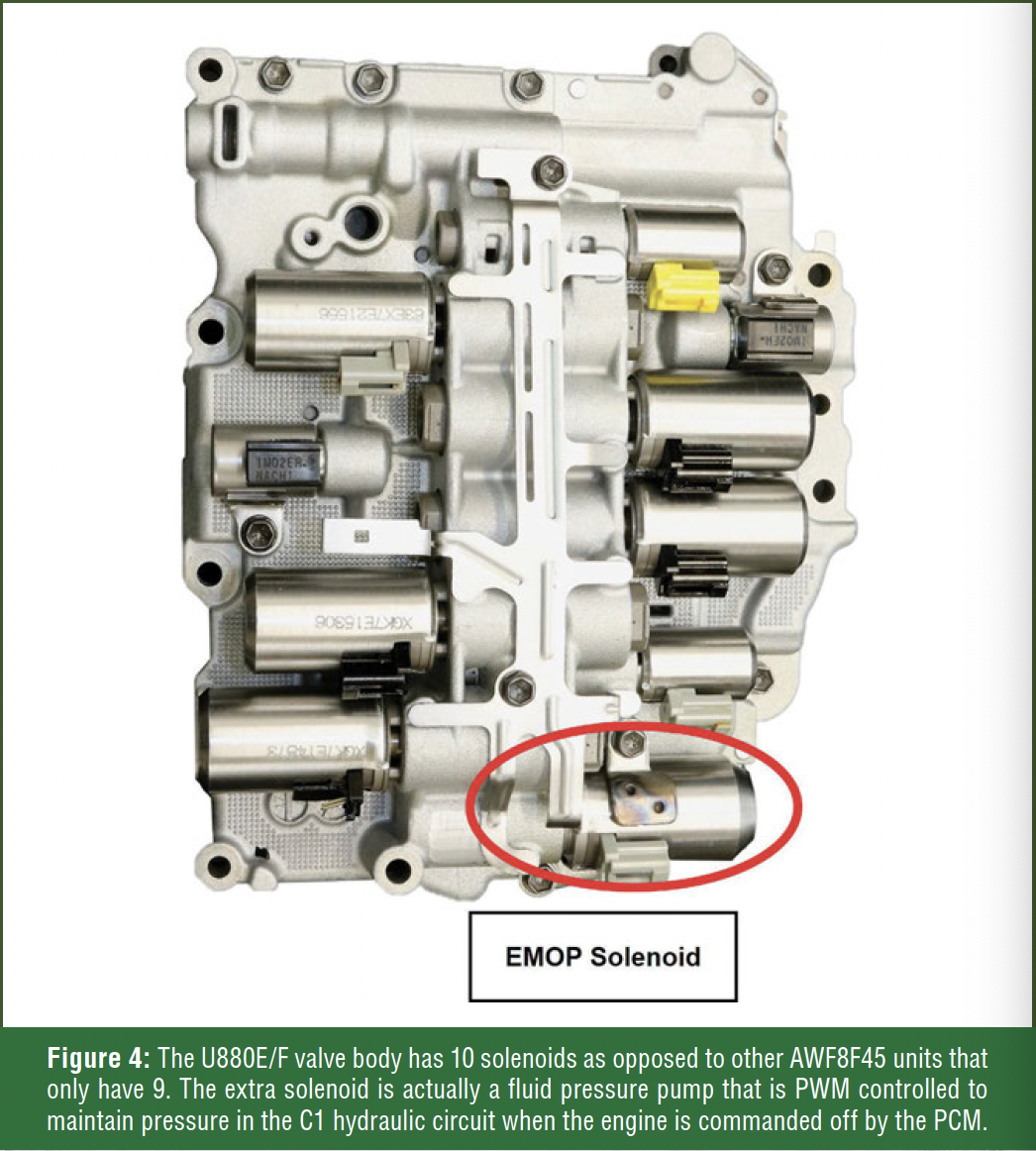 Like Ford and ZF 8-speed units, Toyota maintains pressure in the hydraulic circuits while the engine is commanded off. They use a solenoid on the valve body call an EMOP (Electronic Magnetic Oil Pump) (figure 4). The piston in the EMOP operates in response to ON/OFF signals from the TCM, creating pressure. The hydraulic pressure generated by the EMOP is solely used to engage the C1 clutch during an idling stop state, smoothing the transition from a stopped engine to a driving state.
The pressure generated by the EMOP is less than the pressure produced by the main oil pump while the vehicle is running. A special procedure is necessary to properly check line pressure.
NISSAN NEUTRAL IDLE
Nissan uses a Neutral Idle strategy with vehicles equipped with a CVT transmission. This is done by modulating the Forward Clutch pressure down to a touching point; similar to ZF 8-speed applications. The strategy they use requires all of the following conditions to be met:
- Driving environment: Flat road or road with mild gradient.
- Selector lever position: “D” position.
- Vehicle speed: 0 km/h (0 MPH).
- Accelerator pedal position: 0.0/8.
- Brake pedal: Depressed.
- Engine speed: Idle speed.
- Turn signal lamp/hazard signal lamp: Not activated.
The programming strategy stops or prohibits the neutral idle control when the TCM and ECM detected that the vehicle is in one of the following states:
- Engine coolant temperature and CVT fluid temperature are too high or too low.
- When a transaxle malfunction occurs.
- When the vehicle detects DTC and is in failsafe mode.
Neutral Idle control stops when the vehicle speed reaches a predetermined threshold or the brake pedal is released or the accelerator pedal depressed.
Similar malfunctions and issues as mentioned with other systems will occur with the Nissan applications as well.
As manufacturers search for more ways to increase fuel mileage, more systems and powertrain management strategies will be introduced. Knowing how these systems interact with the transmission helps us understand failures that we witness inside the units we work on. As these systems come into the aftermarket, it becomes more important for us to keep up-to-date on these changes.