

Building late model transmissions seems to be easier than building some of the earlier model 4 speed units, at least mechanically. Once you learn the do’s and don’ts for a particular unit, it is as easy as walking in the park on a Sunday afternoon! That is how most of us are with the 6T70 transmissions by now. However, some items come into play on the bench level that can cause issues when trying to deliver the final product.
Shift quality concerns after a rebuild are among the most common issues with the 6T70 transmission. Providing all external items were addressed, several internal components could cause shift quality concerns that cannot be corrected by relearning the adaptive shift strategy. So let’s dive into this unit and look at what could go wrong.

 “EVERYTHING WAS GOOD UNTIL IT WARMED UP.”

The 6T70 transmission is the unit that will trick you into feeling everything is okay after a short test drive after rebuilding. Shift quality issues usually don’t show up until the vehicle reaches full operating temperature. After clearing the transmission adaptive tables, the TCM doesn’t take long to learn the shift timing. Once the transmission reaches operating temperature, the shift learning process corrects most shift concerns in 3 to 5 complete shift cycles.
The most common shift complaints fall into three major categories:
- Flares
- Bumps
- Tie-ups
Since this is a clutch-to-clutch shifting unit, these issues represent a performance concern between the timing of the releasing clutch relative to the applying clutch. All of these concerns cause burnt clutches. Let’s examine problems internal to the transmission that can cause these concerns.
THE TECHM
The ‘magical box’ that contains the TCM, solenoids, and integral wiring harness and connectors are the most expensive and challenging components to qualify. While most shops have determined a standard for replacing, it still is not a precise science. As a result, several shops that I frequent leave the call to the builder. Others adopt the rule of running the TECHM to see if it will work or not.
 Providing the vehicle is functional (if you plan to reuse the TECHM), drive the vehicle from hot to cold under heavy to light throttle to observe as many shift sequences as possible. Bench testing does not provide enough feedback regarding the performance capabilities of the module. Static resistance tests (figure 1) are the only things you can perform unless you happen to have an original GM OEM bench tester!
An excellent rule of thumb is to call for a replacement when there are electrical TCM or solenoid DTCs and whenever there is excessive metal contamination in the transmission. These conditions indicate compromised solenoids and/or circuits, ultimately affecting the clutch timing control. TECHM failure is imminent in these situations even if the vehicle works correctly and is delivered.
CHECK THOSE BUSHINGS!
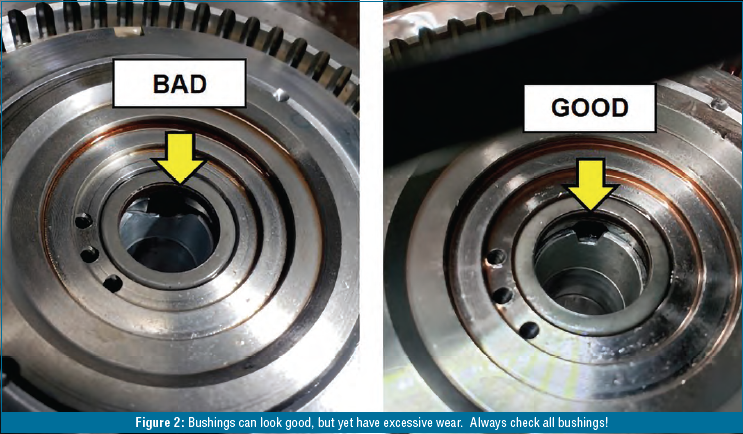
As these units age, bushing wear is a more significant problem. Specific bushings wear more than others. The stator and sun gear bushings are the most noteworthy (figure 2). Excessive bushing wear affects the delicate ‘pressure-vs-lube’ balance inside this unit. Worn bushings allow oil assigned to lubrication to flow too freely. When pressure demand is low, this usually isn’t an issue. Problems arise transitioning from low to high-pressure demand.
Lube oil pressure is directly related to compensator feed oil pressure. Compensator feed oil, otherwise known as balance oil, is used to control the dynamic response of the clutch apply pistons. The pressure to lube oil balance creates a natural balance for maintaining clutch piston apply and release times relative to pressure demand.
High throttle input equals high-pressure demand and low compensator feed oil pressure, allowing pistons to apply faster. Conversely, low throttle input equals low-pressure demand and high compensator feed oil pressure, creating more accumulation and a slower, smoother piston apply rate.
Worn bushings create a time lag that the TCM cannot correct. Shift concerns vary from tie-ups to flares and bumps. These issues are inconsistent and unpredictable but can be duplicated under transitional throttle demand.
VALVE BODY WEAR
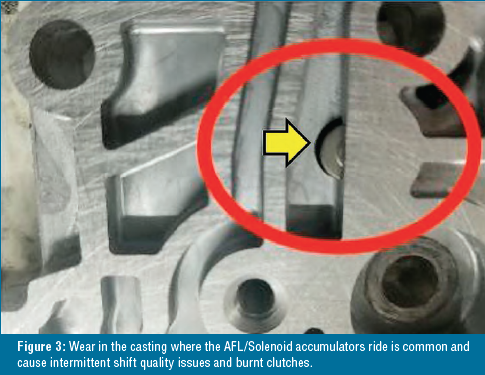
While there are other wear areas in the valve body, the 6T70 transmission is developing issues with the AFL/Solenoid accumulators. The bores are wearing, causing the shift complaints as mentioned earlier (figure 3). The accumulators dampen pressure fluctuations in the AFL/Solenoid circuit. The result is leaking in the clutch apply circuit, causing durability issues.
On Gen 1 units, Actuator Feed Limit (AFL) pressure is used to feed the shift and line pressure control solenoids. There are three accumulators used. They smooth out the pulses generated by the PWM solenoid operation. On Gen 2 applications, there are six accumulators, one for each solenoid. If the accumulator bores or pistons are worn out, the casting and pistons will need to be replaced or repaired.
Shift quality complaints will always be a significant customer complaint for us to address. However, with more electromechanical involvement, issues are more challenging to isolate. With this in mind, the builder’s job is critical to ensure that internal concerns are addressed while the unit is on the bench the first time. Knowing what to look for helps to deliver the goods on time!