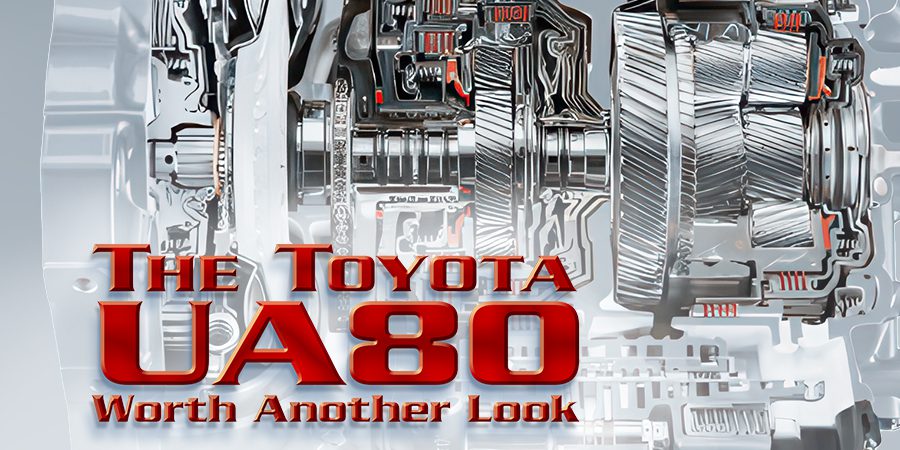
The UA80 series transmissions have been on the market since 2017. Now, they are beginning to come into transmission shops worldwide, needing diagnosis and repair. Many of them are outside the factory warranty on mileage, so chances are that they could end up on your doorstep sooner rather than later. In previous GEARS articles, we introduced this unit and various operational characteristics. Now, we will present faults and diagnostic strategies that could help resolve customer complaints more efficiently.
 UNIT IDENTIFICATION

Identifying the unit you are working on is essential. The UA80 has a few variants that are easy to pick out. First, there are four-cylinder versions (UB80) and six-cylinder versions (UA80). The case has an identification embossed on the converter housing side of the unit (Figure 1). Next, the suffix determines whether the unit is two-wheel or four-wheel drive. For example, UA80E = two-wheel drive, and UA80F = four-wheel drive.
Finally, these units can be fitted with Stop/Start capability. Looking at the dashboard gives you a quick read on the unit coming out of the car. However, if the unit comes from a recycling yard or a remanufacturer, you can pull the side cover and observe the solenoid layout. A unit that has a Stop/Start pump will have an extra connector (white with red and black wires) coming from underneath the valve body (Figure 2). The harness goes to the Electro-Mechanical Oil Pump (EMOP), which is mounted on the transmission pump housing and can only be serviced by disassembling the unit (Figure 3).

DRIVABILITY COMPLAINTS
The most common complaints about the UA80 series transmissions are related to drivability. The earliest units suffered the harshest reviews from customers complaining about a lack of power on acceleration, shift hunting at cruising speeds, and lock-up cycling on and off. Programming updates for 2017 and 2018 model-year vehicles are available to fix most of these complaints. However, issues remain about a lack of power or excessive throttle pedal movement required to get the vehicle moving even with the latest software installed.
Before advising the customer that programming will solve their issues, you MUST realize this might not be true! Keep in mind that Toyota is trying to maximize fuel economy. So, the transmission shift programming tends towards quicker upshifts into higher ranges and lower RPM shifts. As a result, the vehicle can feel sluggish even after the latest software has been installed.

It is best to drive the vehicle with the customer in POWER mode and NORMAL to verify a low power complaint. In most cases, no repairs should be made to the vehicle if the customer is satisfied with the vehicle’s performance in POWER mode. Note that operating the vehicle in POWER mode does not compromise the life of the transmission.
INSIDE THE BOX
These units are coming into shops out of warranty and needing internal repairs. Always check your soft parts supplier to ensure you can get the overhaul kit as needed. Since this unit is not that popular yet, it may take a few business days in some areas. Also, most hard parts are going to be available from the OEM only, and they may be pricey, but don’t be scared to price the unit realistically.

One area of concern is the counter drive gear sub-assembly support bearing area (Figure 4). The nut that retains the races may come loose and allow the transfer gear to move. The condition is caused by a locking tab that keeps the nut from backing off its set position, which was not bent enough during assembly. Symptoms associated with this issue include the following:
- Bumps and clunks while transitioning on and off the accelerator.
- Whining noises inside the transmission
- Harsh shifting
- Reduced power mode
Toyota services the counter drive gear support as an assembly; however, the bearings, races, and related components are available only in the aftermarket as used parts. The bearing is an angular ball bearing design that requires the lock nut to keep the races in position. There is no preload, so in the absence of a spanner wrench, you can use a punch to tighten the bolt. If the unit comes in with the lock nut properly secured, make a punch mark on the support and nut (Figure 5). This will allow you to disassemble, inspect, clean, and return the nut to its original position. Note that Toyota does not give torque specifications for the spanner nut. The locking plate is designed to line up one of the tabs with a slot on the bolt. Take time to bend the locking tab completely into the groove.

Another critical item to be aware of while inside this unit is the C3/C4 drum. The C3 piston and return spring are assembled and riveted in place (Figure 6). Thirty-two rivets are holding this drum assembly together, making it difficult for the aftermarket to come up with a solution to service the C3 piston. A new replacement drum from Toyota costs just shy of $2,300 US (part number 34610-48030). Used drums are available online in the neighborhood of $450US dollars, but beware of the source and condition of the assembly.
FLUID CONTAMINATION
Another common concern with these units is fluid contamination. The vehicle can drive well with no drivability concerns. However, when you inspect the fluid, it is extremely dark, almost black! The fluid may not have a distinctive burnt odor. This condition results from clutch debris from the torque converter clutch.

The torque converter clutch is often cycled on as part of fuel-saving strategies. Operation modes for TCC applications range from partial to full lock-up based on torque demand. The TCC control strategy extends to coast-down applications, too. So, the torque converter clutch has quite a difficult life and emits a considerable amount of clutch dirt.
Perform a careful test drive to verify that the TCC controls are working correctly with no shudders or performance issues. After a sump inspection, you may determine that a fluid service is recommended. However, note that TCC failure is probable in most cases.
Drivability and durability issues arise when engineers push the boundaries of physics. The UA80 series transmissions and other units are enduring growing pains related to this concept. Fortunately, electronic controls working in concert with fast-acting hydraulic circuits allow programming updates to cancel most negative effects. As technicians, we must rely on technology as a first line of offense for solving drivability issues. After that, ATRA will do everything to give you the latest need-to-know information so you can confidently deliver the goods to your customers!