While working on the ATRA technical Hotline, we get to encounter some pretty interesting problems. Recently, we received a call from a member shop encountering a 2017 Chevrolet K2500 truck that would not exceed 84 mph. According to the shop foremen, the vehicle had come into the shop with a major transmission failure. Due to the level of internal damage, the transmission assembly was replaced with a new GM assembly, and the vehicle computer system was updated to the latest calibration. During the final test drive, the technician noticed that the vehicle would not exceed 84 mph, and the Drivers Information Center (DIC) displayed a warning indicating “ACCELERATION IS LIMITED,” accompanied by an audible chime sound. According to the technician, the DIC warning and chime sound would cease once the vehicle dropped below 84mph. Other than that, the transmission seemed to work perfectly.

After a lengthy conversation with the shop foremen and accessing the Vehicle Infotainment System (VIS), it was determined that the vehicle was programmed to operate in “TEEN DRIVER MODE.” Once it was determined that the vehicle was using “Teen Driver Technology” and was operating in “TEEN DRIVER MODE,” we realized that it was operating as programmed. Now, you may ask yourself, “What is Teen Driver Technology”?
THE WHAT, WHY, AND HOW OF TEEN DRIVER TECHNOLOGY
In this issue of “Keep Those Trannys Rolling,” we are going to take a look at “Teen Driver Technology” to explain what “Teen Driver Technology” is, why it’s needed and how the systems work to keep teen drivers safe.
What is Teen Driver Technology?
Teen Driver Technology is a term used by automotive manufacturers to identify specific programs capable of controlling vehicle operations during teen driver operation. Teen Driver Technology uses built-in systems to monitor and control the vehicle during teen driver operation. Depending upon the manufacturer, the teen driver technology system can limit the vehicle’s maximum speed, provide excess speed and seat belt warnings, limit audio volume, and even include Geo-fencing restrictions. Some systems allow the parent or guardian to monitor the vehicle’s operation in real-time. Some systems will even allow adjustments to the system during teen driver operations. You may ask yourself, “Why do we need Teen Driver Technology.”
 Why Do We Need Teen Driver Technology?
Nothing is more important than the safety of our teen drivers. Studies have shown that teen drivers are likelier to exceed posted speed limits, not buckle their seat belts, or be distracted while driving. Studies indicate that ninety percent (90%) of teen drivers are distracted while driving. Forty percent (40%) of teen drivers do not wear seat belts while driving. It is estimated that ninety percent (90%) of all parents or guardians have no idea where their teen driver is, hence Geo-fencing (geographic boundaries). Now, let’s take a look at how Teen Driver Technology works.
How does Teen Driver Technology Work?
Teen driver technology uses built-in systems to monitor and control vehicle operations during teen driver operation. Depending upon the manufacturer, the teen driver system may use information from the following systems to monitor the vehicle during teen driver operation.
- The Engine Control System
- Transmission Control System
- Stability Control System
- Anti-lock Brake System
- Park Assist System
- Blind Spot Alert System
- Collision Alert and Collision Avoidance System
- Traction Control System
- Pedestrian Avoidance System
- Lane Assist System
- Supplemental Restraint System
- Global Positioning System (GPS)
During teen driver operation, vehicle acceleration, braking, collision, and pedestrian avoidance systems are enhanced. Collision and Pedestrian Avoidance Systems distances are increased. Teen Driver system restrictions may include:
- Will not allow the teen driver to disengage the park position unless the driver’s seat belt is buckled (to prevent driving unbuckled).
- Limit the audio system volume output (to prevent distractions).
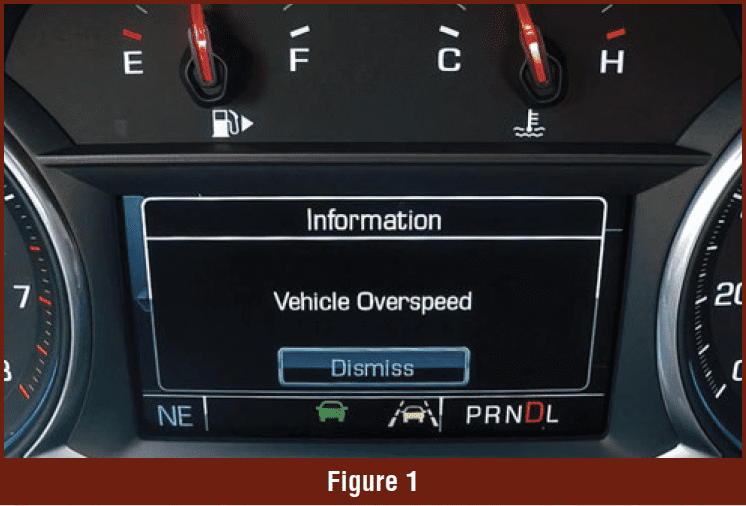
- Audible warnings for excessive vehicle speed (Figure 1).
- Limiting the vehicle speed (Figure 2).
- Allow for Geo-fencing. Geo-fencing is a virtual perimeter of a geographic area, which means the parent or guardian can set up specific areas in which a teen can or cannot operate the vehicle.
- An assigned key fob to identify a teen driver is operating the vehicle.
 Each of these functions are designed to address ninety percent (90%) of teen accidents and collisions. Using GPS, teen driver systems can track a teen’s movements in real-time, so you always know the location of your teen driver. Now that we have a better idea of how teen driver technology works let’s take a look at a few of the manufacturers using Teen Driver Technology.
MANUFACTURERS USING TEEN DRIVER TECHNOLOGY
The following manufacturers are using Teen Driver Technology to keep our teens safe.
- 2017 & newer GM vehicles: Identified as “TEEN DRIVER MODE.”
- 2018 & newer Ford vehicles: Identified as “MyKey” technology.
- 2018 & newer Toyota/Lexus vehicles: Identified as “Entune 3.0” technology.
- 2018 & newer Hyundai vehicles: Identified as “Blue Link” technology (geo-fencing included).
- 2018 & newer Mercedes vehicles: Identified as “Mbrace Connect” technology.
- 2019 & newer Volkswagon vehicles: Identified as “Security & Service Family Guardian.”
 Each of these manufacturers has unique teen driver systems. It would be recommended to become familiar with your specific vehicle’s Teen Driver system before attempting any repairs.
GM’s TEEN DRIVER MODE REPORT CARD
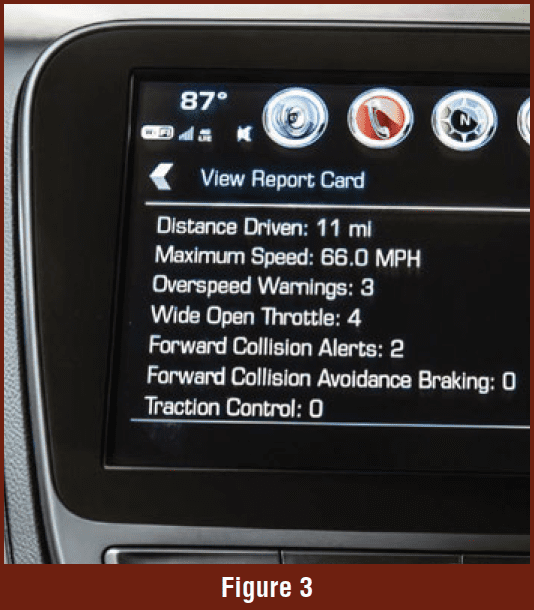
G.M.’s Teen Driver Mode system makes it possible to view a report card of the teen driver’s driving habits. Depending upon the vehicle, you may be able to view: distance driven, maximum speed obtained, overspeed warnings, acceleration history, ABS activation history, traction control activation history, and more. With this information, a parent or guardian can make sure their teen driver is operating the vehicle in a safe manner (Figure 3).
Well, there you have it. We diagnosed an “unable to exceed 84 MPH” concern and learned quite a bit about “Teen Driver Technology.” With Teen Driver Technology, you should have no problem keeping your teen drivers safe.