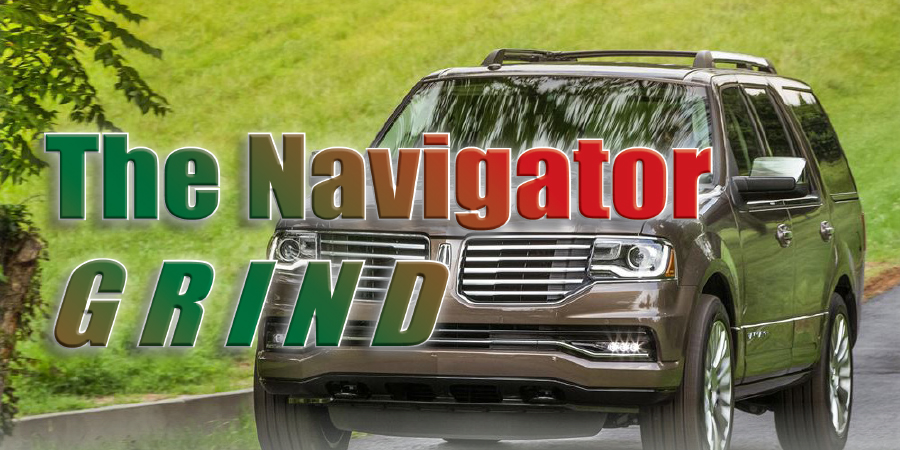
In this issue of Keep Those Trannys Rolling, we’re going to take a look at a 2016 Lincoln Navigator Sport. It’s equipped with a 3.5L engine, a 6R80 transmission, and an AWD system. The complaint was an intermittent grinding noise while driving.
Initial Inspection and Test Drive:
 Perform your initial inspection by checking under the hood for anything obvious that could be causing an intermittent grinding type of noise. Inspect the underside of the vehicle, check driveshafts, U-joints, and suspension components. Also inspect the engine, transmission, and differential for any loose or damaged components. Use your scan tool to check all modules for codes and address any codes first.
Your initial test drive should be at various speeds through city streets and on freeways or highways. Also, drive the vehicle through city parking lots and rough roads. During the road test, make sure you are turning the vehicle in both directions on hard turns.
We discovered the grinding noise coming from the front of the vehicle. One tool that is a must when dealing with noise/vibration/harshness issues is the “chassis ears.” Refer to “I have a tool for that” -Gears-Sept 2020.
Connect your chassis ears to the front suspension and front differential area or wherever you feel the noise is coming from. This testing led us to the right front hub area.

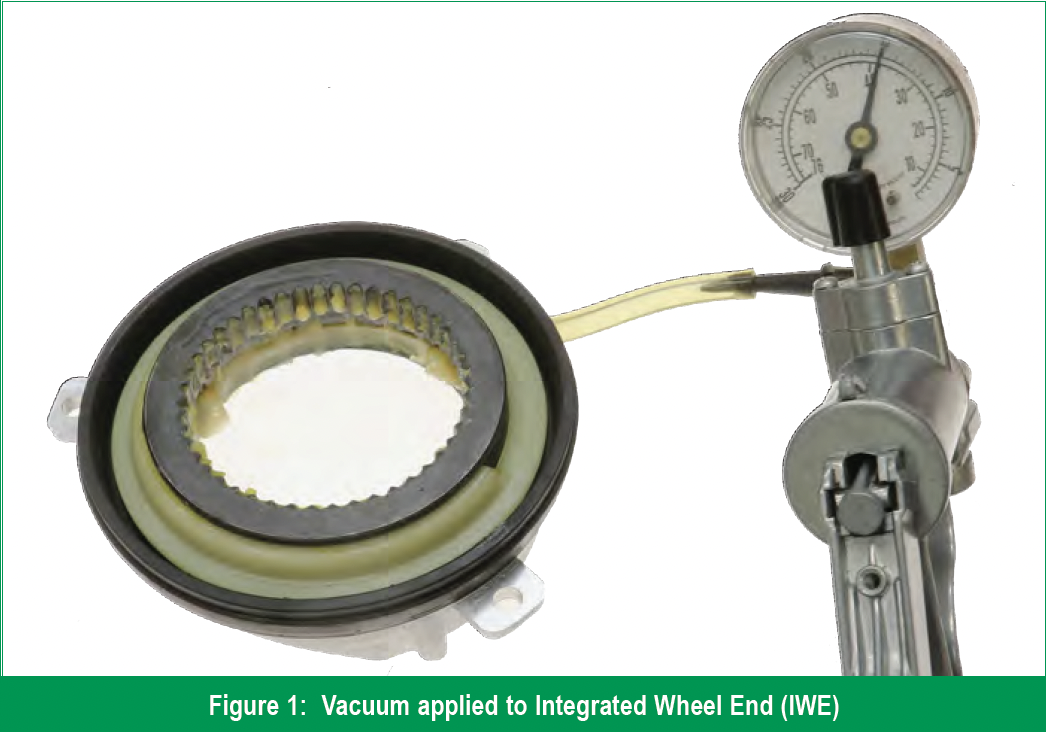
Ford uses an IWE (Integrated Wheel End) system. It’s a computer-controlled vacuum system that engages and disengages the front wheel hubs during 4WD or AWD operation. When vacuum is applied to the IWE (Figure 1), it’s unlocked, allowing the front wheels to freewheel. When vacuum is removed from the IWE (Figure 2), it’s locked, allowing the front wheels to lock into 4WD or AWD operation.
 With the vehicle on the rack, inspect the front differential and front hubs. Spin the front wheels to locate the failed hub. Check the AWD vacuum system going to the front differential. With the engine running, there should be close to 17” of vacuum at the right front hub. With the engine off, the vacuum should bleed down after a few minutes. To test the system internally, use a vacuum pump directly to the IWE fitting. While spinning the wheel and apply and release the vacuum going to the IWE. If there is a noise that occurs on either hub during the vacuum test, it fails the leak down test. This is an indication that the IWE has an internal problem.
Inspecting the Integrated Wheel End:
The right wheel hub internal seals in the IWE were leaking, causing the IWE to partially disengage while driving, thus causing the grinding noise. To repair the problem, replace both the right and left IWE (always replace them as a pair) and reassemble the front end of the vehicle. After refilling the front differential with fluid, verify the repair with a test drive.
With a little bit of knowledge about Ford’s IWE system, you should have no problem fixing the “Navigator Grind” and “Keep Those Trannys Rolling” down the road.