In this issue, we’re going to look at what the future holds for the automatic transmission industry.
Fuel Economy Drive the Industry
Since the introduction of the Corporate Average Fuel Economy (CAFE) standards in 1975, automakers have been at odds with the U.S. Department of Transportation (DOT) and the Environmental Protection Agency (EPA) to improve the gas mileage in cars and light trucks (trucks, vans and sport utility vehicles) produced for sale in the United States.
Mandatory fuel economy regulations were first introduced in 1978 for passenger vehicles and in 1979 for light duty trucks. The average CAFE standard for 1978 passenger cars was 18.0 MPG; for light trucks in 1979 was 17.0 MPG. CAFE standards increased over the years to a point where the average passenger vehicle had to deliver 27.5 MPG and an across the board average of 23.5 MPG (including the average light duty trucks) by the year 2010.
On July 29, 2011, the federal government announced an agreement with thirteen large automakers to increase fuel economy to 54.5 MPG (depending on the vehicle footprint) for cars and light-duty trucks by model year 2025. These CAFE fuel economy standards are driving the automakers to produce more fuel efficient vehicles.
Producing Fuel Efficient Vehicles
With the tightening of the CAFE standards in 2011, automakers had to break new ground while designing today’s vehicles.
They installed computer systems to control engine operation, fuel injection systems to control the fuel delivery, and computer controlled transmissions to control shifting, all to meet the stricter CAFE standards of 2011.
By controlling the engine and fuel injection systems, automakers have been able to get the most out of their engines, but that wasn’t enough to keep up with CAFE standards. Automakers had to come up with something else to meet the new, stricter standards. That’s when they decided to look at increasing transmission gear ratios.
Increasing Gear Ratios
In the early ’70s, it was fairly common for a vehicle to have a threespeed automatic transmission. In the ’80s, the four-speed automatic transmission was common in most vehicles. As the ’90s rolled through, we saw a few five-speed automatics, but the four-speed automatic transmission was still in most vehicles.
By the early 2000s, most automotive manufacturers started installing six-speed automatic transmissions into their vehicles in an attempt to meet the 2011 CAFE standards. As time moved on and the CAFE standards have become even stricter, automakers continue to make advances in automatic transmission design. The four-, five-, and six-speed automatic transmissions of the past won’t cut the mustard for today’s CAFE standards.
Today’s automakers had to scramble to design new automatic transmissions to meet and exceed the 2016 CAFE standards… and beyond. Most automakers are looking into adding even more gears. Seven-, eight-, nine-, and ten-speed automatic transmissions are on the road or in the works.
Let’s take a moment to look at some of the new design automatic transmissions that are on the road today or will be in the near future.
New Design Automatic Transmissions
Seven Speeds — The first new design automatic transmission we’re going to discuss is from Mercedes Benz. In 2003, Mercedes Benz introduced the 7G-TRONIC seven-speed automatic transmission (figure 1).
The 7G-TRONIC has seven forward gears and a reverse gear, and an efficiency rating of 85%. As impressive as that is, the 7G-TRONIC automatic transmission is already being replaced by the  nine-speed 9G-TRONIC automatic transmission which we’ll discuss a little later.
Eight Speeds — Next we’ll look at the eight-speed automatic
transmission. These aren’t new to the automotive world: Toyota has been using eight-speed automatic transmissions in their Lexus lines for a couple years now, and ZF is producing eight-speed automatic transmissions to take the place of the ZF6HP automatic transmission.
The ZF8HP eight-speed automatic transmission (figure 2) is 11% more efficient than the ZF6HP series transmission. It’s available in the BMW 760Li and 5 series GT models, the Audi A8, the Bentley, and the Rolls Royce Ghost.
Meanwhile, General Motors has its own eight speed automatic  transmission (figure 3), known as an 8L80 or 8L90, depending on application. The 8L90 eight-speed transmission made its debut in the 2015 Chevrolet Corvette Z06 and the 2015 Cadillac Escalade. The 8L90 replaced its predecessor, the 6L90, in the 2015-up Chevrolet Silverado and GMC Sierra and Yukon.
Nine Speeds — Daimler broke the mold and designed the first nine-speed automatic transmission for Mercedes Benz. The 9G-TRONIC (figure 4) debuted in the 2016 Mercedes Benz E350 Bluetec. It was designed to replace its predecessor, the 7G-TRONIC, and has an efficiency rating of almost 92%, which makes it 7% more efficient that the 7G-TRONIC.
 Ten Speeds — In an effort to meet 2016 CAFE standards, Ford Motor Company and General Motors co-developed a ten-speed automatic transmission for their next generation rear wheel drive trucks and passenger car lines. This is the third time in the last decade that Ford and GM teamed up to build a transmission.
Each company manufactures their own transmissions in their own plants, but the transmissions have similar components. Ford released the ten-speed automatic transmission (figure 5) in the 2016 F150 Raptor. General Motors released its ten-speed automatic transmission for production in the 2016 Silverado and Sierra truck lines.

What’s Next?
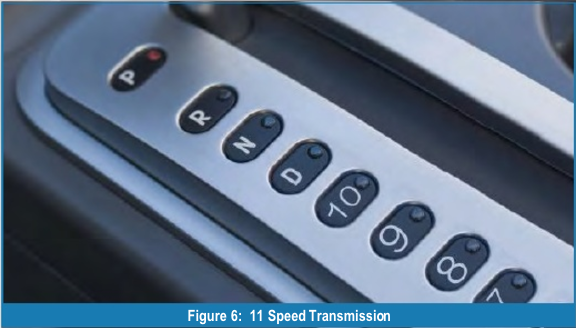
With Ford and GM producing ten-speed automatic transmissions, you might be wondering, what’s next? Well, just to give you a little insight, Ford has requested a design patent on a new, rear-wheel drive, eleven-speed automatic transmission (figure 6). Just think: eleven forward speeds!
Well, there you have it: a quick look at what the future of automatic transmissions may hold for you. With the development of new design nine-, ten- and eleven-speed automatic transmissions, the automakers are on their way to meeting and even exceeding the latest CAFE standards.
With a better understanding of what’s coming down the road, you should have no problem keeping those trannys rolling.