
The automotive engineering world took notice when ZF came out with the first rear-wheel drive 8-speed transmission in 2008. Soon afterward, other manufacturers followed suit. Then, in 2012, Powertech, Hyundai’s powertrain division, produced the A8TR1 transmission. It debuted behind the Hyundai Genesis V8, followed by the Equus and Genesis coupe.

 They also introduced a lower input torque variant called the A8LR1. By 2015, Kia placed these units behind their V6 engines in the Stinger. The gear ratio spread varies considerably compared to other rear-wheel-drive 8-speed units (Figure 1). Note that the 1:1 ratio is 5th instead of 6th gear, which is typical for other manufacturers.
These units are reliable but are aging and beginning to show up in aftermarket shops. With little information published in the aftermarket on these units, it is time for us to look into these units and the technology that drives them!
A LOOK INSIDE
The A8TR1 and A8LR1 transmissions are rear-wheel drive units that provide eight forward ranges and one reverse range by using four rotating clutch packs, two brake clutches, and a one-way mechanical clutch assembly. The clutch and brake assemblies act on two planetary gear sets. Power ow through this unit requires two elements to be applied (Figure 2).
The transmission is controlled electronically using a valve body containing solenoids and hydraulic control valves. The solenoids are actuated by commands from a standalone transmission control module.

The solenoids are connected to an integral internal lead frame assembly that houses three speed sensors and a transmission fluid temperature sensor (Figure 3). In addition, some models have a pressure switch and an extra connector attached to the lead frame.
 There are two different valve body designs; a drive-by-wire and a drive-by-cable. The drive-by-wire design uses two additional solenoids and a park rod control actuator. Note that the park rod control actuator defaults to the park position locking the vehicle in park; it uses hydraulic pressure from a control solenoid to release park for all other operation ranges. In addition, some models are equipped with a 3-5-Reverse pressure switch mounted on the valve body. Note that the 3-5-Reverse pressure switch diagnostic trouble code is disabled on some applications.
A8 transmissions have solenoids that are flow rated and are programmed to be uniquely recognized by the TCM in the position they occupy on the valve body. The QR label stamped on the solenoid is the coding programmed in the TCM ensuring proper control of the solenoid in its location (Figure 4).
In other words, when servicing the valve body, mark the solenoids to ensure you return them to their original positions! If you need to replace a solenoid or valve body assembly, you must follow the Oil-Pressure Characteristics Input procedure outlined by the manufacturer. The solenoids can be replaced individually, but the code stamped on the new solenoid must be programmed into the TCM software. Hyundai/Kia applications allow you to perform this function using the factory scan tool or a compatible J2534 device.
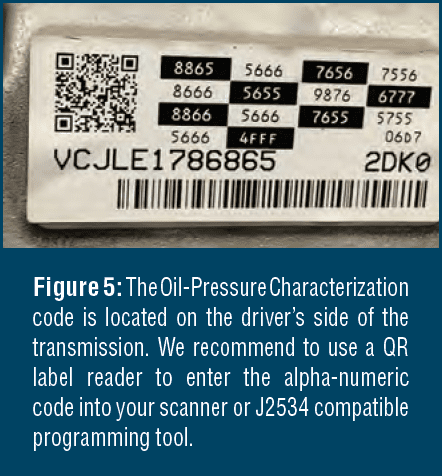
 When replacing the transmission with a new assembly, the Oil-Pressure Characteristics are programmed from a QR label on the driver’s side of the unit (Figure 5). Using a QR scanner to enter this information is recommended, rather than entering it manually.
TAKE CARE OF THE TCM!
The stand-alone TCM has non-volatile memory, which means disconnecting the battery does not clear the adaptive memory. It is essential to keep this in mind, especially after repairs are made. Use the factory scan tool or equivalent to clear the transmission adaptive values after transmission repairs have been performed.
A TCM relearn procedure is necessary after performing any of the following repairs:
- TCM reprogramming and/or replacement
- Transmission overhaul
- New transmission installation
- Valve body service, including solenoid replacement
 To initialize the relearn procedure, warm the transmission to 30-95°C (86- 203°F). Then, use the Transmission Fluid Temperature (TFT) data PID on your compatible scan tool to observe the proper temperature range. Also, ensure no diagnostic trouble codes are present in the TCM. Once the transmission temperature is within the range, the adaptive procedures are initialized by performing the specified sequences.
There are two learn procedures that you must perform.
Garage Shift Learn:
- Apply the service brake with 0% throttle.
- Shift to N and hold for 3 seconds, then D for 3 seconds, then R for 3 seconds.
- Repeat the sequence at least four times or until engagements are acceptable.
Adaptive Drive Learn:
- Drive the vehicle through all gears in the D range.
- Drive from stop to 1st through 8th, keeping a fixed throttle opening.
- Downshift from 8th through 1st, coming to a stop.
 Repeat the above driving pattern four times or until desired shift quality is reached, keeping the throttle between 15 and 30% opening (use scan data to observe). Both the Garage Shift Learn and Adaptive Drive Learn procedures may be repeated to correct shift quality and engagement concerns.
The evolution of transmissions has taken us down a path that boggles the imagination. Staying on top of all the variations as they come out seems impossible. That’s why here at ATRA, we are dedicated to delivering the information you need on the latest technology so you can confidently deliver the goods to your customers!