

The Dodge RFE transmission series began in 1999. It was first introduced as a 4-speed and called the 45RFE. A few years later Dodge modified the computer programing and turned it into a 5-speed and called it the 545RFE. In 2007 Dodge introduced a heavy-duty 6-speed version called the 68RFE and was used behind the 6.7L diesel engine. Throughout these and other varieties came several changes and parts upgrades. Not to mention, the aftermarket is loaded with heavy-duty parts to meet your needs.
In this edition of Tales From The Bench, we’ll go through some of the changes made over the years and some modifications you can make for interchangeability.
THE VALVE BODY
The valve body went through some changes over the years, so let’s begin.
The 45RFE valve body originally had seven check balls and had a black connector, then a white connector. In 2009 Dodge eliminated the overdrive solenoid along with other changes, including the color of the connector. Other changes include:
- The transmission range sensor plate no longer has the manual 1st and 2nd positions
- Valve body separator plate
- Valve body only uses five check balls
- Computer programing has changed
The early RFE transmissions used the MS (Multi-Select) solenoid for 1st, 2nd, 3rd gears and was off for 4th, 5th, and 6th gears. The MS solenoid is used to send oil to the overdrive clutch (It delivers oil when it’s off). In 6th gear it also uses the Overdrive solenoid, with the #6 check ball separating the two circuits.
Figures 1 and 2 show the oil circuitry for the early model transmissions (prior to 2009).
Figure 1 shows the MS solenoid delivering oil to the overdrive clutch and the transmission in 4th gear.


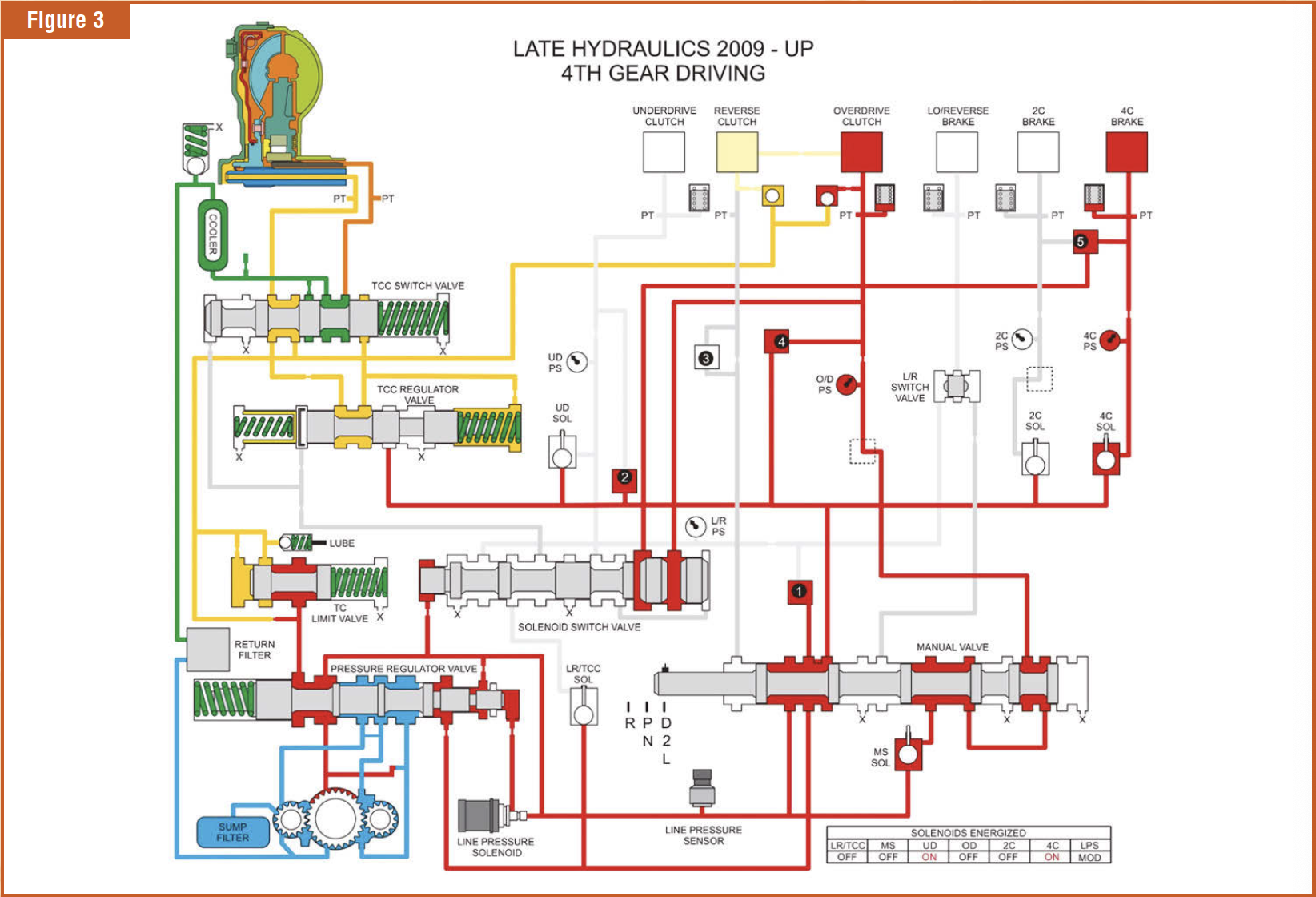

Figure 2 shows the transmission in 6th gear. Notice the OD solenoid now delivers oil to the overdrive clutch. It became an unnecessary feature so both it and the #6 check ball were eliminated in 2009. You’ll see this change in figures 3 and 4.
In addition, the shifter doesn’t have a manual 2-L range and the #7 check ball was eliminated. Manual shifting is now controlled with tap up and down buttons. This also changed the limp mode so that you can’t manually shift it to 2nd gear. Limp mode is just 4th gear now.
SEPARATOR PLATE DIFFERENCES
Figures 5 and 6 show the two separator plates (early and late, respectively). There’s a hole labeled “A” on the late plate (figure 6) that is missing on the earlier plate. This hole is just a vent and can be added, using a 3/16 drill. The hole labeled “B” is not drilled on the seven-ball design. The slot labeled “C” is for the Underdrive clutch release. Dodge reduced this slot to a 0.89″ orifice hole and a new manual valve with an extra land to eliminate a clunking sound when shifting to Park and Neutral. This corrected the noise issues and can be done on any valve body.
The five-ball valve body plate shown in figure 6 shows a new vent location labeled “A”. It has an additional hole (labeled “B”) and has the orificed hole labeled “C”.
VALVE BODY INTERCHANGE
You can use a seven-ball valve body in place of a five-ball valve body, with a few modifications. It is best to find a plate that has hole “C” reduced down to 0.89”.
If you cannot find a seven ball plate with the “C” hole, orifice to 0.89″ and it will most likely be fine. Be aware you might have a mild cluck at times. I have built many of these valve body’s and have never heard the noise complaint, but it was enough of a concern to release a TSB on it.
Then drill the vent hole in the separator plate at location “A” and you’re done.
HOW TO MAKE A FIVE-BALL PLATE INTO A SEVEN-BALL PLATE
If you need to make a five-hole valve body work in place of the seven-ball you must make these changes.
Take some aluminum welding rod and plug the hole labeled “B”. Take a small piece the same size of the hole and flatten it down to make sure it is not going to move.
Holes labeled “A” and “C” are already corrected. The last thing you have to do is drill out the two missing check ball holes to 0.159”, they are labeled with the red arrows in Figure 6. It is best to use a seven-ball plate to mark the holes.
The benefit of this information is you can buy a new Dodge valve body that has the five-ball design (2009-up) for a lot less money than a seven-ball design.
OVERDRIVE CLUTCH
One of the biggest improvements to this transmission has been the added clutch capacity to the Overdrive clutch. There are a lot of aftermarket solutions for increasing clutch capacity and some of these will be personal preference. Go to the online version at Gearsmagazine.com where you’ll find links to many of them.
You’ll also find links for valve body upgrades and repair. It’s a tremendous source so make sure you check it out.
Keep in mind, too, that these valve bodies come in warped a lot of times so make sure you flat sand them while you’re making these upgrades.
If you are not sure what valve body you need for any RFE transmission just install a seven-ball separator plate with a white solenoid and you can’t be wrong. Increase the overdrive clutch capacity, fix the solenoid switch valve bore wear and increase the line pressure and you just built a transmission that will withstand the abuse.