One of the most important tools for building a successful shop is being able to identify your market. Specializing in Fords in an upscale market where most of your potential customers are driving Mercedes and BMWs would be a recipe for failure.
Phil Sims, the owner of Chip’s Transmissions in Sevierville, Tennessee, understands this. And he’s built his business model around attracting and catering to his specific market. It’s a business model that’s helped him grow into three shops near the eastern Tennessee border.
So how does their market differ from others around the country? For one thing, it has a very strong tourist presence. “We’re at the foot of the Great Smokey Mountains National Park,” explains Phil. So they have a lot of people burning up their transmissions going up and down the mountains, or hauling campers without adding a cooler to the transmission lines.
With such a strong dependence on out-of-town customers, their membership in ATRA has been critical to their success. “A huge part of our business comes from tourists, so the Golden Rule Warranty is a valuable resource,” explains Phil. “It’s been instrumental to our success.
“Not that we wouldn’t sell transmission repairs. But it’d be hard to compete with the remans, because they carry nationwide warranties.”
And, while Chip’s has been known to use the occasional reman when the situation warranted, at heart they’re still a custom rebuild shop. “I’m kind of old school in that I believe that our industry is stronger if we rebuild our own transmissions versus buying them,” says Phil.
But tourists are only one part of their market; another big part is commercial, including trucks and farm equipment. While they’ve always tried to serve those commercial customers, Phil really kicked that into high gear in 2011 when he opened Chip’s Diesel Repair.
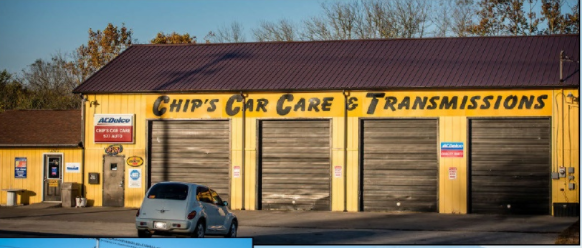
His third shop — Chip’s Transmission and Car Care — is a full-service shop, catering to the local customers as well as tourists visiting the area. Having a general repair shop has been a valuable addition to their business model, because the three shops now refer customers to one ano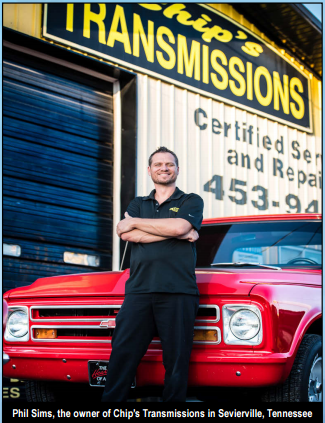 ther, keeping each other busy.
If knowing your market is key to success, Phil should be positioned perfectly for his region.
A Little History
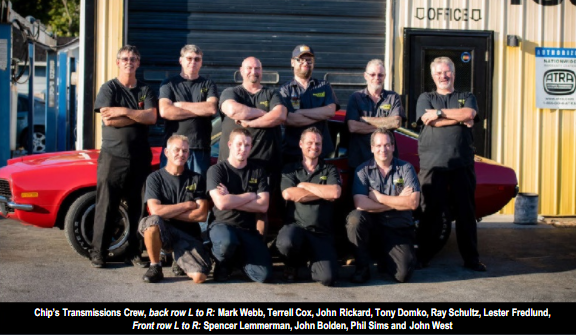
John “Chip” Stewart opened the transmission shop in 1985. Phil came on as a service writer and technician in 2000, became a partner in the shop in 2007, and took over the business in 2011.
They opened a full-service shop — Chip’s Transmission and Car Care — later in 2007. While Phil bought the entire transmission shop in 2011, Chip still retains part ownership in the full-service shop. Phil opened a third shop in 2012: Chip’s Diesel Repair.
How did Phil and Chip begin their relationship? “I came to work for Chip in 2000,” explains Phil. “At the time I was working as an R&R technician and rebuilder for another shop in town. I had some management experience, too; I worked as a night manager for a local hotel because I wasn’t making enough money fixing cars. That’s when Chip approached me about coming to work for him.
“In 2007, I started receiving some really tempting job offers, so Chip talked me into becoming a partner in the business. We opened our second shop — Chip’s Transmission and Car Care in Seymour, Tennessee — later that year.
“In 2011, Chip decided it was time for him to retire. He sold me the rest of the transmission shop; he remained a minority owner in the general repair shop. I opened Chip’s Diesel Repair in 2012, right near the transmission shop.”
In 2001, Phil started moving into performance transmissions, built for use with hotrods and diesels that demand a stronger unit. “That made a big difference in our bottom line,” he says.
“We started as the east coast distributor for Diesel Transmissions Technology (DTT) in Canada. They approached us about becoming a rebuilder/installer shop for them. That’s what introduced us to that market.
“We had a lot of experience with drag racing transmissions, but the diesel trucks were an entirely different animal, with the torque they had to produce. It was a huge learning curve, especially warrantying a transmission that was handling 700-800 horsepower and developing 1500-1800 lb-ft of torque. But it really helped our business.
 “We started the Bulletproof Transmission line and selling heavy duty transmissions under that name. That’s when that part of the business really took off.”
Since then, the Bulletproof market has tapered off, but it’s still part of the business model at Chip’s Transmissions.
Fair and Reasonable
Transmission warranties are always a point of contention. How long do you cover the transmission? What if it fails a few miles or a few months outside the warranty? Should you take responsibility for those units?
Phil thinks so… and much more. That’s why he developed what he likes to call his Fair and Reasonable warranty. “We prorate a 100,000-mile warranty on top of any other warranty we offer. It’s like this: If we did our jobs right, it should go 100,000 miles. If it doesn’t, we want to know why.
“We’re not going to cover it 100% free, but we’ll prorate our coverage based on 100,000 miles. So if one of our customers has a failure after 50,000 miles — maybe the grandson borrowed the car, got it stuck in the mud, and burned the transmission up — we’ll split the cost of the repair 50/50 with the customer. Our customers love that.
“Let’s face it: If you build a transmission and cover it with a 12-month/12,000-mile warranty, and it goes bad in 18,000 miles, you’re probably going to cover it anyway. So you might as well get some accolades for it.”
Well maybe. Of course, we’ve all heard that argument go the other way, too, where the shop won’t cover the transmission once it goes a mile over the warranty. But in general, the most successful shops are the ones who do stand behind their work… even when the transmission is technically outside of warranty. Phil has just expanded on that, and is using it to build his reputation.
Unique Marketing Approach
For most shops today, marketing focuses on a web site. And Chips is no different there:
Chip’s Transmissions: www.chipstranz.com
Chip’s Transmission and Car Care: www.chipscarcare.com
What about TV and radio ads? Some shops do really well with them, but that type of marketing isn’t as effective in an area that depends heavily on the tourist trade. Same thing with billboards: A lot of shops do well with them, but in a tourist area, billboards are extremely pricy. “You’re competing with Dollywood and Dixie Stampede,” explains Phil.
But he has found that he does well with some other marketing programs:
For one thing, he’s tied into Moving Targets; a marketing company that includes coupons for his shop for people moving into the area. It’s a terrific and relatively low-cost way to reach potential new customers while they’re still getting their bearings in a new town.
Another thing that Phil has been very successful with is pens. You read that right: ballpoint pens with his company name and phone number on them.
“We live in an area with a ton of restaurants,” says Phil. “The wait staff don’t make a lot of money and many of them have to buy their own pens. And then customers take them after signing their credit card receipt. I go around and hand out my yellow and black pens regularly. They’re there, they write well, they’re free, and they make their jobs a lot easier.
“And, when they get stolen, it’s really great advertising. I get people coming in all the time saying ‘the waitress gave me your pen and I have a problem with my car.”
 Phil is also partnered with a sculptor who owns a business called Man Cave Metals. “He takes auto parts — transmission parts — and turns them into artwork. We have stools he made out of transmission cases; they’re awesome!
“I give him parts, he creates the artwork, and we sell it. And he sends me a lot of work because they run into car people who ask ‘where can I get my transmission repaired?”
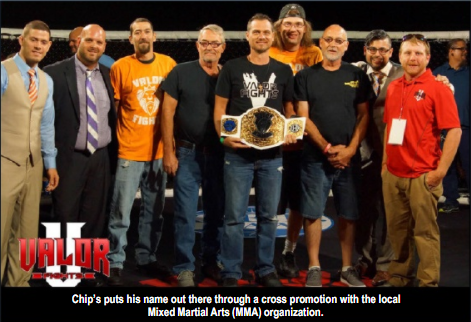
One other way that Chip’s puts his name out there is through a cross promotion with the local Mixed Martial Arts (MMA) organization. “I was surprised in the beginning; I didn’t think we’d get much out of it. But we see a good amount of work from it.”
 Chip’s sponsors shows in his area, and the promoter books shows in several nearby towns. “I go to all of the shows in the area and I’ll meet people outside, and if they have a breakdown while they’re in the area for a show, who are they going to call?”
In addition to sponsoring the local shows, Phil also sponsors Adam “Prime Time” Townsend, a local fighter who’s getting ready to move up to the UFC.
And there are other ways that Phil builds his shops’ reputation, including sponsoring a Toys-for-Tots program each year. “We’ll give people $10 off an oil change if they donate a new toy for the program.”
Chip’s and ATRA
Chip’s has been an ATRA Member since about a year after they opened; they had one of the lowest Member numbers on the east coast.
The reason for joining ATRA? “Mostly the training and information,” says Phil. “That’s been instrumental for providing technical data, updates, and support. Let’s face it: If you have a transmission on the bench that you’ve never worked on before, you’ll need to call someone!”
 And, when Chip’s joined ATRA, it was an important time in our industry. By that time the first transaxles and lockup converters were making their way into the aftermarket shops, and the first fully computer-controlled transmission was just a year or so away. The industry was beginning a major shift that we’re still feeling, so it was no wonder that Chip’s would be interested in what ATRA had to offer.
And, of course, the Golden Rule Warranty was another key advantage to becoming a Member. “The Golden Rule Warranty was instrumental in the shop’s success. Being able to offer the customer a warranty that would protect them when they went home… that’s the only way you can sell a job to most customers, particularly those who live out of the area.”
“It made it possible for us to compete with the big chains. Without ATRA, we’d never have been as successful as we’ve been, or developed the reputation we have today.”
And, while it isn’t a particularly common situation, Chip’s has had to take advantage of the Golden Rule Warranty, from both sides of the program. While it’s never what you’d hope for, Phil can say that he’s been very satisfied with the help he’s received from other ATRA Members, and he’s been proud to honor the warranty when a another Member’s work comes into his shop.
No doubt about it: One of the most important qualities for a successful shop is knowing and serving your market. So it’s no surprise that Chip’s Transmissions and their accompanying stores are doing well, and will likely remain successful for years to come.