The focus of the management track at this year’s Expo was how to help today’s shops attract new technicians. It’s become an increasingly urgent situation, with fewer young people taking an interest in fixing cars for a career.
Jeff McCollough, owner of Builder’s Transmission in Broken Arrow, Oklahoma, may have discovered a new approach to helping introduce young people to the industry… or maybe it’s just a new take on an old technique: He and several other automotive professionals in his area work with a nearby church group to sponsor Hotrod Camp: Heart of the Craftsman; a camp for young people.
“Every year they take 20 boys from the boys’ home and they build a ’32 Ford coupe from the ground up,” explains Jeff. “I’d encourage everyone who’s not doing something like this to look around for a similar program.
“These kids never had fathers to encourage them. To see them drive the car at the end of the week, when it started out as just a frame… it shows them what they can accomplish with a little hard work, and it shows them there are people who care.”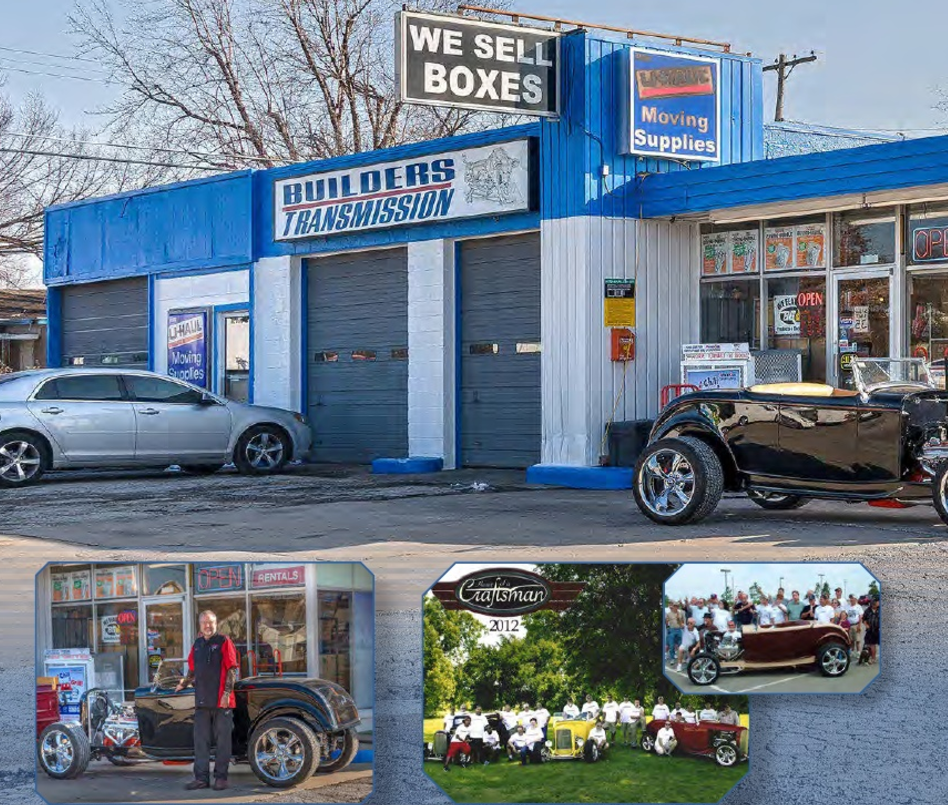
Most of us got our start in the auto repair business by climbing under the hood of a car back when we were still in high school… or earlier.
Maybe it was to change the oil or tune the engine. Or maybe it was something more. But it’s how the bulk of us first dipped our toes into the pool.
Today that isn’t really possible: There’s not much you can do under the hood of a car anymore unless you have some serious training and experience. And almost nothing is adjustable, so there’s no tweaking the carburetor or boosting the timing. Vehicle performance is basically a sealed unit.
So giving these kids an opportunity to build a hotrod from a bare frame may well be one of the best ways to foster interest in a career in auto repair. And it certainly can’t hurt to show these young men that someone cares enough about them to give them a taste of the business that shaped our lives: a worthwhile investment for the community and our industry.
A Look Back
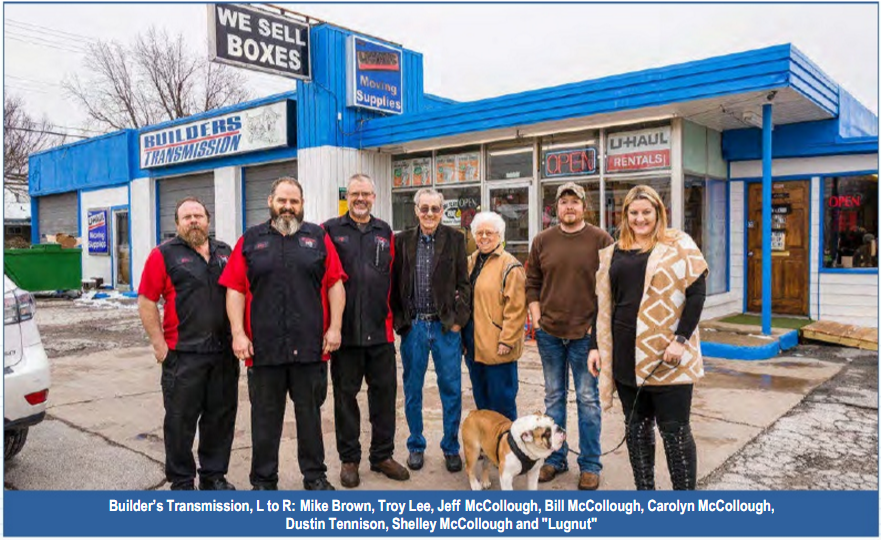
Bill and Caroline McCollough opened Builder’s Transmission in June, 1964. Back then it was a DX full service gas station. Bill was a mechanic and worked the shop while Caroline ran the office.
Jeff was born a year after they opened the shop and he first started working there with his parents “when I could walk,” he says with a chuckle. “I like to tell people that my parents have pictures of me in a walker, pumping gas.”
One of the most valuable things Jeff learned from working at a gas station was the importance of great service. “When that bell rang, you’d better be on your way out to take care of the customer,” he says.
That service ethic has served him well over the years. “You checked the tires, you checked the oil, and you washed the windows, all for $2 worth of gas.”
 The move from a full service gas station into transmissions came during the early gas shortages; Jeff was maybe 12 or 13 years old. Bill closed the gas station, took on a partner who had transmission experience, and the two of them opened Broken Arrow Transmissions in a new location.
“We didn’t have a transmission parts washer back then,” explains Jeff. “I’d put the transmission over a barrel and use a pocket knife to scrape the case, and then spray it with carb cleaner to get it clean.
“We also had a converter flusher, and that was my job: I had to drill and tap the converters.
“By the time I turned 14 I was handling transmission R&R. I wanted to be a builder, but Dad wouldn’t let me do that until I learned how to pull them out, put them back, and make them work.”
Jeff took over the business from his father around 1985; a tough time to be fixing transmissions, with front wheel drives just showing up and electronic controls beginning to overshadow everything else.
Jeff and his crew stepped up to the challenge: They adapted to the changing technology and, by the time the ’90s came along, business was going really well. It was him, two rebuilders, three R&R techs, and an office manager.
But he was working long hours and not making any money. That’s when he attended a shop management seminar where he learned how to operate his business profitably. “I learned that, if you don’t understand how to run your business like a business, you’ll find yourself owning a job,” he says.
Today Builder’s Transmission is a busy shop. They handle complete drivetrain repair, including engine repair and replacement. They have a nice web site at www.BuildersTransmission.com to help reach out to customers. All in all, things are going pretty well for them.
Mother Knows Best
One person who Jeff credits with keeping their business strong is his mother, Caroline. “Back in the ’80s, things got tough; there wasn’t enough work for both me and my dad,” says Jeff. “So Dad decided to leave the shop and got a job selling cars for a nearby dealership.
“At the time he gave me a choice: He said, ‘If you want to keep running the business, that’s fine; if not, I’ll sell the shop.’ I told him I wanted to make a go of it, and Mom said, ‘If you’re going to do it, I’ll stay here with you.’
“Mom handled the back end of the business: She’d answer the phone, pay the bills, order parts… if it wasn’t for my mom I couldn’t have kept it going.
“She’s the one who made sure all the bills got paid first. If it were left to me, I’d probably have blown all the money that came in and gone broke in the first month!
“She just knew everything that was going on in the shop. She was the one who dealt with the parts sales people, and she built a rapport with them. Half the time she could just look at the old parts on the bench, tell me what I needed, and have everything ordered before I said a thing.”
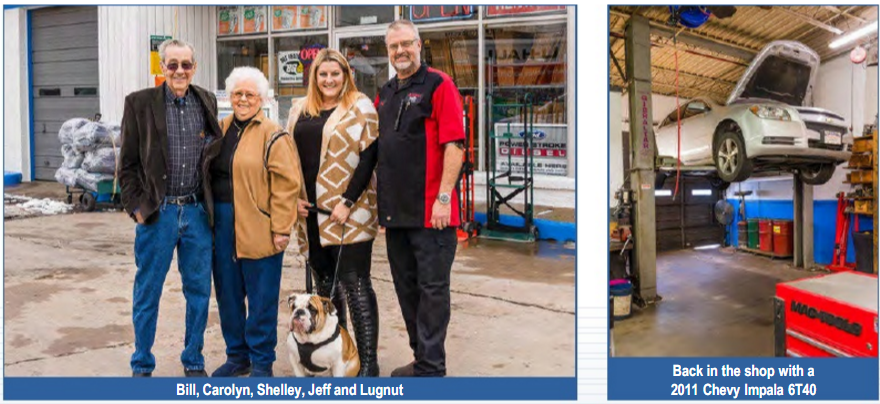
Today both of Jeff’s parents are pretty much retired. Jeff’s wife, Shelley, now handles the office and answers the phone. But Bill and Caroline still keep their hands in whenever they can, keeping Builder’s Transmission a family affair.

Renting Trucks
Toward the end of 2007, the economy took a serious tumble. It wasn’t a good time for auto repair, and Builder’s Transmission was no exception. It reached a point where Jeff would do just about anything necessary to make payroll. “If a person asked me, I’d wash his car; whatever it took,” he said.
Then one day, about six years ago, something changed: “A guy came by in a U-Haul truck and asked me if I’d be interested in renting U-Hauls. And I said, ‘Why not? I have a big lot here; let’s see if it’ll help.’ Today I probably rent $250,000 a year in U-Hauls. And I sell about $5000 a month in boxes.”
Not bad for something that he started on a whim to help make payroll.
“It saved us; it really did. It doesn’t cost anything: They bring the trucks to you; you have to have an internet connection, but who doesn’t these days? You rent their trucks for them; they take care of them. You make 20% of the rental fee and you put the money in the bank.
“It helped pay the bills when things were tight. Now I’m used to the extra money. When we’re busy sometimes it’s a hassle, but I don’t know if I’d want to do without the additional profit.”
There’s no doubt that the U-Haul program has been a lifesaver for Jeff and crew, but there’s an additional benefit that he gets from the program; one that may well be even more valuable than the actual rental fees:“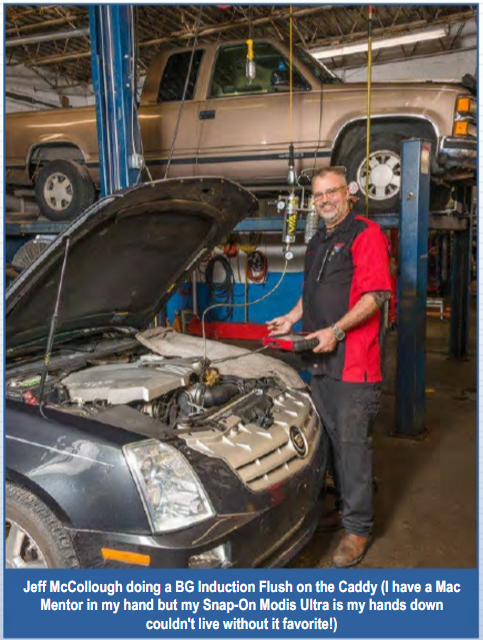
When someone turns in a truck, there’s a good chance they’re new to the area. And very often I’m the first business person in town that they meet. So I always introduce myself: ‘Welcome to town! I’m Jeff; I work on cars here. If you have any problems — if your Check Engine light comes on — just give me a call. Here’s my card.’
“In this business it’s a challenge to get a customer to walk through your door the first time. Once you get past that first meeting, all the uneasiness is over… assuming you treated them right when they came in.
“So everyone that just moved to town and comes in to drop off a truck, I’m one of the first people they meet. It’s like being the Welcome Wagon for them.
“It’s been terrific in more ways than I can count, because I make a lot of money doing it and I meet a lot of people I might never have met otherwise. And I get a lot of new customers out if it.”
Working Together
Just like many other transmission shops, Jeff built some strong relationships with some of the other repair shops in his area. Very often those shops come to him when they have a transmission-related problem. When that happens, Jeff’s philosophy is pretty simple.
“When one of those shops come by with a problem, my primary goal is to get the customer back on the road. We’ll worry about making money on the next; the important thing is to take care of the customer.
“Here’s the thing: if that customer’s happy, he’s going to tell 50 people, what with social media and such. And in the end it’ll pay you back with referrals and good reviews.
 “Actually, if you treat the customer well, most of the, are way too busy to go online and write about it. But if you have someone who thinks he wasn’t treated right, he’s going to go onto Google and Facebook and whatever else he can find, because that’s the only way they can vent.
“So we try to avoid it completely by putting the customer first.”
Sounds reasonable. And it seems to be working well for Jeff and his crew at Builder’s Transmission. It’s a business model we can all take a lesson from.