

When transmissions age, the likelihood of them having been overhauled at least once increases. With every additional overhaul comes other concerns beyond the basic banner kit rebuild. The 42-48RE units fall squarely into this category with 15-20 years of history.
These units have proven themselves to be reliable. The hard parts seem to stand up to heavy abuse, even with tuner kits adding extra horsepower and torque. However, they tend to have a common area of concern; the valve body. In this article, we will look into assessing the condition of the valve body and solutions!

OVERVIEW
The valve body is the nerve center of the RE units. There are no hydraulic control circuits outside of the valve body. So, pressure, converter charge, converter clutch control, lubrication, and cooling all rely on the health of the valve body. Since these units were engineered not to use valve body gaskets, they have a natural leak.
A THOROUGH INSPECTION
While you have the unit on the teardown bench, take time to inspect the valve body. Be extremely observant! Check for obvious modifications, over-torqued bolts, damaged castings, and broken springs. In your process, there are several other factors to take into consideration, but most importantly, these:
- How many total miles are on the unit
- Valve bore and valve wear
- Aftermarket modifications
- Valve body warpage
Assessing at the teardown stage will prepare you for a worst-case scenario where you may be better off getting a different valve body than repairing the existing unit.

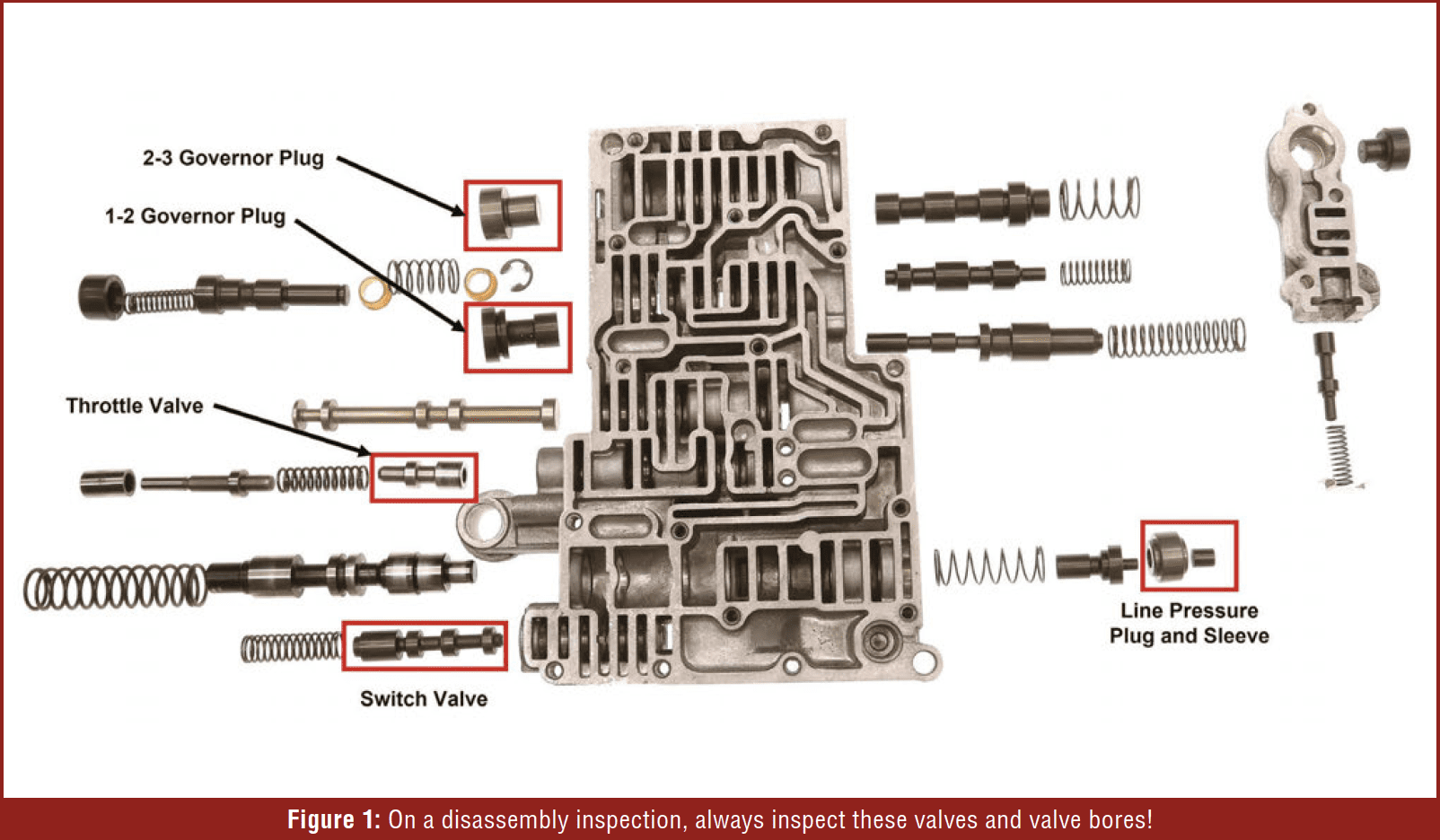
WHERE’S THE WEAR?
First and foremost, inspect the valve body for wear! While there are numerous aftermarket repairs that fix most wear issues, you don’t want to use all of them to resurrect your valve body. There is a point where the cost of repair versus the cost of replacement comes into play. Making this assessment on teardown is extremely important. The RE valve bodies tend to wear the most in these four areas (figure 1):
- Throttle Valve Bore
- Switch Valve Bore
- The 1-2 and 2-3 Governor Plugs
- The Line Pressure Plug and Sleeve
Note that other valve bores are prone to wear as well. Also, each valve will present specific issues when they are compromised, and it is crucial to be familiar with them, especially when making a diagnostic test drive.
THE THROTTLE VALVE AND GOVERNOR PLUGS
Have you ever had a 46RE with a throttle cable that you just couldn’t dial in? You loosen up the adjustment, and you are in third gear at 25 mph with no kick down; then you tighten it just a little, and the 1-2 shift holds out until 25 mph! Chances are the throttle control oil is leaking. Note that the throttle valve bore acts in conjunction with the governor plugs. So, when assessing a shift timing-related concern, you must inspect all three valve bores and address wear accordingly.
Throttle valve bore wear is especially problematic on the 48RE applications that use the Transmission Throttle Valve Actuator (TTVA) motor for throttle control. The computer has an algorithm to move the transmission throttle lever a specific distance relative to the engine throttle input and load. However, this is a mechanical calculation with no direct feedback on the resulting pressure. As a result, when the throttle bore becomes worn, the expected pressure given the commanded throttle position will be incorrect, causing early or late shifts. Several aftermarket kits can restore the proper pressure control in this circuit.
THE SWITCH VALVE
Issues related to lock-up apply and release are often directly connected to the Switch Valve. While the factory valve is suspected of performing the task satisfactorily on a good day, once this valve has seen more than 100k miles, all bets are off. Concerns of an overheated torque converter, TCC applying at idle, lugging or stalling the engine, and TCC slipping or no application are common.
Bore wear is common, and the spring end of the valve may be worn or mushroomed. Therefore, restoring the hydraulic health of this circuit is critical to keep this unit from short-term failure! There are several aftermarket fixes for this.
THE LINE PRESSURE PLUG AND SLEEVE
The Line Pressure Plug and Sleeve are easily overlooked but can cause a world of harm to your RE transmission if they are worn. Delayed engagement, slip in reverse, poor converter and cooler charge, soft or slipping TCC apply, and overall line pressure instability point directly to a compromised Line Pressure Plug and Sleeve. Make it a part of your teardown routine to pull this assembly out of the valve body and inspect it. You will be surprised how many times you will find these worn. The aftermarket has several options to restore this hydraulic circuit. Repair and replace as necessary.
AFTERMARKET MODIFICATIONS
Several companies offer a shift enhancement, shift modification, or heavy-duty application kit to install into the RE valve bodies. Most of these companies have a support line that can assist you in cases where premature unit failure may result from an incorrectly installed kit. Identifying springs and drilled holes needed for the correct operation may lead to a simple fix for proper kit installation and correct transmission function.
Here’s where being a detective can save you from a comeback or a no-go. Be aware that some kits may require drilling holes through the casting, grinding valve lands, adjusting the throttle valve stop, etcetera. Try to identify the shift kit manufacturer and reach out to their tech support if necessary. Remember, most aftermarket kits are only as good as the person installing them!
MAKE SURE IT’S FLAT!
On a good day, the RE valve bodies are leaky! I like to call them built-in calibrated leaks. It is always a great idea to flat sand every flat surface on this valve body. And I do mean every flat surface! It will make a world of difference in overall pressure management. Mike Brown wrote an article in the May 2015 edition of GEARS detailing a case involving flat sanding solving pressure control issues. Whether you use truing stones or a piece of glass with 600-grit wet-and-dry sandpaper, your work will bring long-term rewarding results.
Putting an old reliable vehicle back in service by repairing the transmission is rewarding. However, knowing that you handled the critical areas that will keep it on the road is reassuring. Taking a little extra time to address the details will help you confidently deliver the goods to your customers the first time!